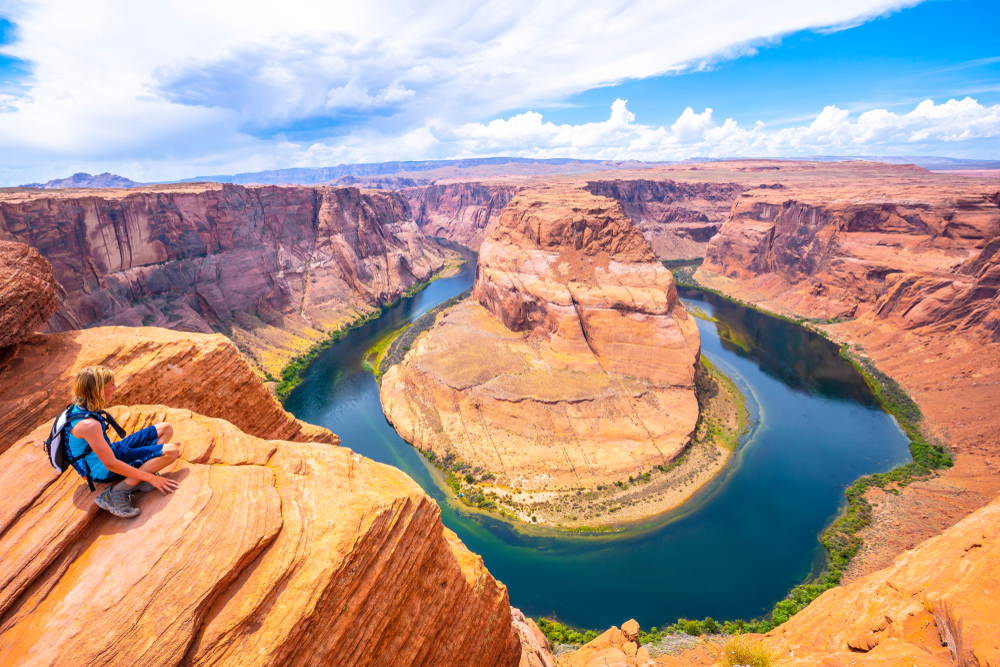
A narrow trail outside Page leads to an abrupt opening where the land gives way to a sweeping curve of the Colorado River at Horseshoe Bend. In this setting, solo travel is defined less by the journey and more by the moment of arrival, where the landscape reveals itself all at once. The transition from enclosed path to open canyon creates a shift in scale that feels immediate, placing the viewer in direct relation to the depth and structure of the terrain.
@muycalliente_ ❤️🩹 #solotravel #arizona #horseshoebendarizona #hiking #travel #pageaz
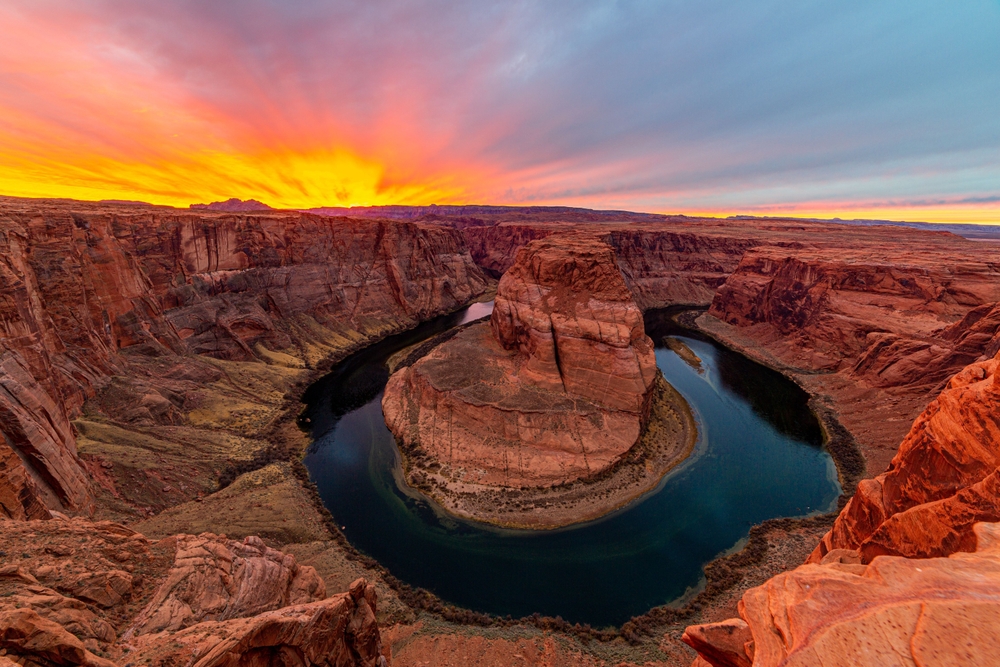
The geological composition of the site shapes the experience as much as the view itself. Stratified rock formations, marked by erosion over millions of years, create visible patterns that guide the eye across the canyon walls. Warm tones of red, orange, and brown shift subtly under direct sunlight, reinforcing a sense of depth that feels almost architectural in its precision. This is a landscape that demands attention without requiring explanation.
Solo Travel at Horseshoe Bend Arizona
Solo travel at Horseshoe Bend Arizona is structured around proximity to the edge, both physically and psychologically. A short walk from the trailhead leads to a viewpoint where the boundary between land and void becomes immediate. Sitting or standing near the rim introduces a heightened awareness of space, where distance is measured not in steps but in vertical scale.
This environment naturally encourages stillness. Without guided pathways or structured activities dominating the experience, visitors are left to engage with the landscape on their own terms. The simplicity of the setting, rock, sky, and river, creates a focused interaction that feels direct and uninterrupted.
For solo travelers, this clarity is central. The absence of external input allows the experience to become internal, shaped by observation rather than conversation. It reflects a growing preference for destinations that support independence without distraction, where the environment itself provides enough depth to sustain attention.
The Power of Minimal, High-Impact Landscapes
Horseshoe Bend represents a category of destinations where minimal elements create maximum impact. There are no built structures competing for attention, no layered attractions to navigate. Instead, the experience is concentrated into a single, defining view that evolves with light and perspective.
This simplicity aligns with a broader shift in travel preferences. As itineraries become more flexible, travelers are increasingly drawn to locations that offer clarity rather than complexity. The ability to arrive, observe, and remain present without constant movement has become a defining feature of contemporary solo travel.
The visual language of Horseshoe Bend also contributes to its resonance. The curvature of the river, combined with the vertical drop and surrounding rock formations, creates a composition that feels complete from multiple vantage points. It is a landscape that translates easily across formats while retaining its impact in person.
Why Solo Travel Is Becoming More Intentional
The message often associated with places like Horseshoe Bend, “go alone,” reflects a broader cultural shift toward intentional travel. Solo journeys are no longer framed as secondary to group experiences, but as a distinct way of engaging with the world.
This shift is particularly visible among younger travelers, who are prioritizing autonomy and flexibility in how they explore. The ability to move at one’s own pace, choose moments of stillness, and engage with destinations without compromise has become a key factor in travel decisions.
Locations that support this approach tend to share certain characteristics. They offer clear visual identity, minimal external structure, and an environment that encourages reflection. Horseshoe Bend fits within this framework, providing a setting where the experience is shaped by presence rather than planning.
Planning Your Horseshoe Bend Experience
For those considering solo travel to Horseshoe Bend Arizona, preparation remains essential despite the simplicity of the site. The short hike to the viewpoint requires awareness of weather conditions, appropriate footwear, and timing to avoid peak midday heat. Early morning or late afternoon visits offer more comfortable conditions and a different quality of light across the canyon.
Additional visitor information, including access details and safety guidelines, can be found through the official National Park Service partner site: https://www.nps.gov/glca/planyourvisit/horseshoe-bend.htm
What ultimately defines Horseshoe Bend is not the journey to reach it, but the moment of arrival. The alignment of scale, light, and perspective creates an experience that feels immediate and self-contained. For solo travelers, it offers a rare clarity, a space where the world narrows to a single view, and that view is enough.
More from Cultivated Comfort:
- 7 Vintage Home Items From the ’60s That Are Collectors’ Dream Finds
- 7 Vintage Home Goods That Became Collectors’ Gold
- 7 Fast-Food Chains That Changed for the Worse
- 7 Frozen Dinners That Were Better Back in the Day

As a mom of three busy boys, I know how chaotic life can get — but I’ve learned that it’s possible to create a beautiful, cozy home even with kids running around. That’s why I started Cultivated Comfort — to share practical tips, simple systems, and a little encouragement for parents like me who want to make their home feel warm, inviting, and effortlessly stylish. Whether it’s managing toy chaos, streamlining everyday routines, or finding little moments of calm, I’m here to help you simplify your space and create a sense of comfort.
But home is just part of the story. I’m also passionate about seeing the world and creating beautiful meals to share with the people I love. Through Cultivated Comfort, I share my journey of balancing motherhood with building a home that feels rich and peaceful — and finding joy in exploring new places and flavors along the way.