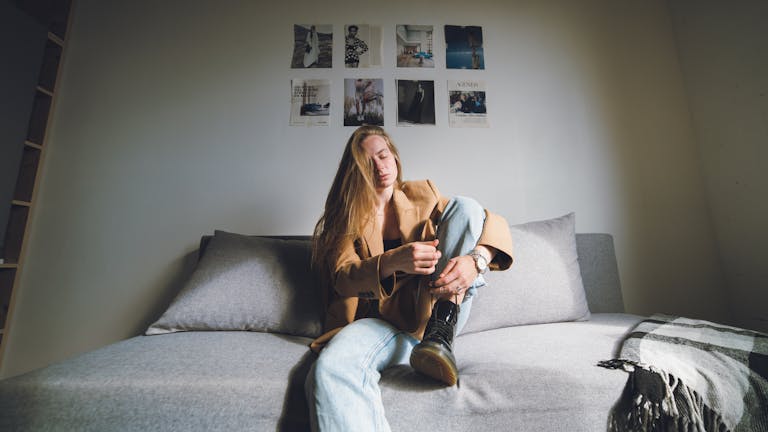
In a quiet suburban neighborhood, there lived a young woman named Mia, who was navigating the tricky waters of adulthood while still living with her parents. At twenty-three, she was balancing a part-time job and college classes, all while trying to establish her own identity beneath the weight of her family’s expectations. One of the more jarring issues in her life was the glaring absence of locks on both her bedroom and bathroom doors. For Mia, this wasn’t just a minor inconvenience; it was a constant source of anxiety.

Every day, Mia felt a knot in her stomach whenever she needed to change clothes or take a shower. She found herself double-checking the hallway outside her bathroom, listening for the dreaded sound of footsteps that would announce an unwelcome intrusion. The thought of her parents walking in on her while she was vulnerable was mortifying, yet it happened far too often. Their understanding of privacy was skewed, and it left Mia feeling like an object rather than a person deserving of boundaries.
“You know I’m here to protect you,” her mother would often say with a dismissive wave, as if Mia’s discomfort was merely a misunderstanding on her part. “I gave birth to you, so I should be able to see you anytime.” This mantra echoed throughout their home, becoming an unsettling justification for her parents’ constant intrusiveness. For Mia, her mother’s reasoning felt like a violation—a message that her body was communal property rather than her own.
Her mother’s perspective seemed to extend beyond physical boundaries. It seeped into every conversation, every opinion Mia attempted to express. Anytime Mia disagreed or voiced an alternative thought, it was met with disappointment, as if she were committing a crime. “How can you think that? We raised you better.” It was as if the very act of forming her own thoughts was an act of betrayal against the family. Each disagreement chipped away at her sense of belonging, leaving her feeling isolated even within her own home.
Mia often daydreamed about freedom and the ability to express herself without fear of reprimand. She envisioned a room with a sturdy lock, a sanctuary where she could change clothes without fear of being barged in on, a place where she could be her authentic self without needing to adhere to her parents’ stringent beliefs. But as much as she longed for that, the reality was that she was still living under their roof, and the consequences of that decision loomed large.
It wasn’t as though Mia hadn’t tried to communicate her needs. After one particularly embarrassing incident where her father walked in on her while she was getting dressed, Mia gathered the courage to confront her parents. “I need you to respect my privacy,” she had said, her voice shaking. “It’s important for me to have my own space.” Yet, instead of understanding, she was met with a flurry of accusations; they claimed she was being ungrateful and selfish. “The world isn’t safe, Mia. We’re just watching out for you.” It was suffocating, the way they twisted her request for basic respect into a perceived selfishness on her part.
The fear of being seen, of having her parents intrude on her most intimate moments, loomed over Mia day in and day out. She learned to strategize her life around their unpredictability, showering at odd hours or changing in her car to avoid the potential embarrassment. But that was hardly a solution; instead, it underscored just how much control they exerted over her life—a control grounded in an outdated belief that she owed her existence to them, and thus her autonomy was a privilege they could revoke at will.
Mia had become adept at hiding her thoughts, burying her feelings beneath layers of compliance in hopes of keeping the peace. After all, in her family, any deviation from their views felt like an act of war, and she didn’t want to engage in a battle she felt she could never win.
As she looked ahead, Mia found herself contemplating the possibility of a future away from her parents. The thought of moving out was both exhilarating and terrifying. Could she really take the step to cut these ties, to break free from the invasive dynamics that stifled her? She didn’t have the answers just yet, but she knew that the journey to claiming her individuality was one she needed to embark on, lock or no lock.
More from Cultivated Comfort:
- 7 Vintage Home Items From the ’60s That Are Collectors’ Dream Finds
- 7 Vintage Home Goods That Became Collectors’ Gold
- 7 Fast-Food Chains That Changed for the Worse
- 7 Frozen Dinners That Were Better Back in the Day