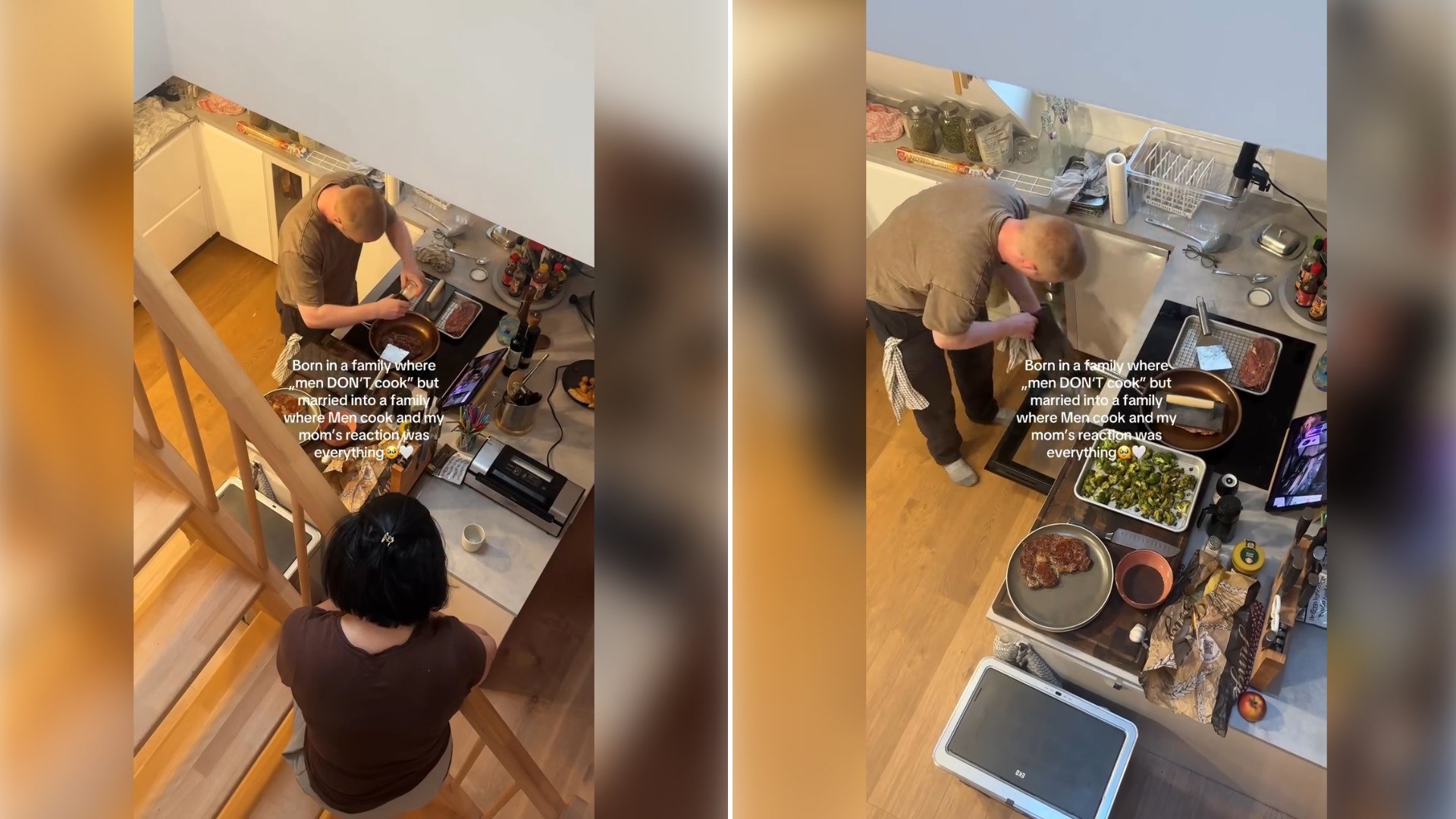
Some of the most telling moments in a marriage happen from a distance, watching quietly rather than participating, and one woman’s view of her husband cooking dinner, filmed from the railing above their kitchen, captures exactly that kind of quiet realization.
The creator, @likakiesow, watches her husband take over the kitchen from above, captioning the moment with a direct comparison: she was born into a family where men simply didn’t cook, but married into one where they do. The video also captures her mother’s reaction to witnessing that culture shift firsthand, a quiet, observational moment set to “Can’t Help Falling in Love.”
View this post on Instagram
Household gender roles around cooking tend to be absorbed early and unconsciously, shaped less by explicit rules than by simply watching who did what in a childhood kitchen. A daughter who grew up never seeing a man cook carries that expectation forward without necessarily realizing it, until a partner comes along and quietly rewrites the assumption altogether.
It’s worth naming just how deeply those early, unspoken household patterns tend to settle into a person’s sense of what’s normal. Nobody typically sits a child down and explains the division of kitchen labor explicitly; it’s absorbed passively, meal after meal, year after year, until it becomes less a belief and more a baseline assumption about how households simply work. That’s precisely what makes a marriage that quietly overturns the pattern so disorienting, in the best possible sense, to notice. It isn’t that she consciously expected her husband not to cook; it’s that some old, half-forgotten internal expectation is being gently corrected in real time, every time she watches him move comfortably around a kitchen that, in the household she grew up in, would have belonged entirely to the women.
The choice of vantage point in this video, watching from a railing above rather than standing in the kitchen itself, does more storytelling work than it might first appear to. A shot taken from inside the kitchen would put her in the scene, an active participant in the cooking. Filming from above instead turns her into an observer of her own household, watching a dynamic play out as though from slightly outside it, which mirrors exactly the psychological experience she seems to be describing, watching a pattern unfold that still, on some level, registers as a small surprise even after presumably years of being married into it.
What makes this video resonate is the multigenerational angle built into it. It isn’t just the creator noticing the difference; it’s her own mother witnessing it too, watching a household dynamic that simply didn’t exist in the family she raised her daughter in. That kind of reaction, an older generation observing a shift firsthand, tends to land with more weight than the shift would on its own. A mother watching her son-in-law cook isn’t just witnessing one household’s dynamic; she’s implicitly comparing it against the entire framework of domestic roles she operated within during her own marriage and her own years raising a family, a framework that, for whatever mix of culture, generation, and personal circumstance, apparently never included a man regularly taking over the kitchen.
That generational contrast also raises a quieter, more complicated question that the video doesn’t resolve but implicitly gestures toward: what did the mother make of watching that shift play out in her daughter’s home? There’s room in a reaction like that for genuine delight, a kind of vicarious pleasure in seeing her daughter’s household operate differently than her own did. There’s also room for something more bittersweet, a reflection on the domestic arrangement she herself lived within for decades, one that simply wasn’t available or expected to look this way. The video doesn’t spell out which of those reactions is actually happening, but the fact that it invites the question at all is part of what gives the moment its emotional texture.
Household cooking arrangements have shifted meaningfully across generations in a lot of families, shaped by broader cultural changes around dual-income households, evolving expectations about domestic labor, and a slow but real renegotiation of who is assumed to be responsible for what at home. A video like this one functions as a small, personal case study of that larger shift, made vivid not through statistics or commentary but through the simple, visual fact of a man cooking dinner while the women in his wife’s family watch, one of them clearly comparing it against a household template that looked nothing like this one.
The choice of song underneath the footage adds its own layer of meaning worth noting. A classic love song rather than anything trendy or ironic signals that the video is meant to be received with genuine tenderness, not as a wry commentary on gender roles or a pointed statement about domestic labor. The framing stays warm throughout, more grateful than critical, more amazed than resentful, which shapes how the whole comparison between her childhood household and her marriage ultimately reads: not as an indictment of the family she came from, but as a quiet, loving acknowledgment of how different, and how lucky, her own household turned out to be.
Watching from the railing rather than standing beside him in the kitchen gives the video its particular tone, observational rather than participatory, as if she’s still, in some small way, taking in how different this household is from the one she grew up in, grateful for the difference, and perhaps still a little amazed, even now, that it’s simply hers.