The reel from @emilylyoness, the account of Emily Lyons, was posted October 5, 2026 and begins with a title line on screen: “The Widower Who Felt Like He Was Cheating On His Wife Called Me Again.” The caption starts the same way, with the caller’s name in quotation marks: “‘Peter’ called me again.” The post does not say whether the call is a recording or a re-creation, so this article describes it as the video presents it.
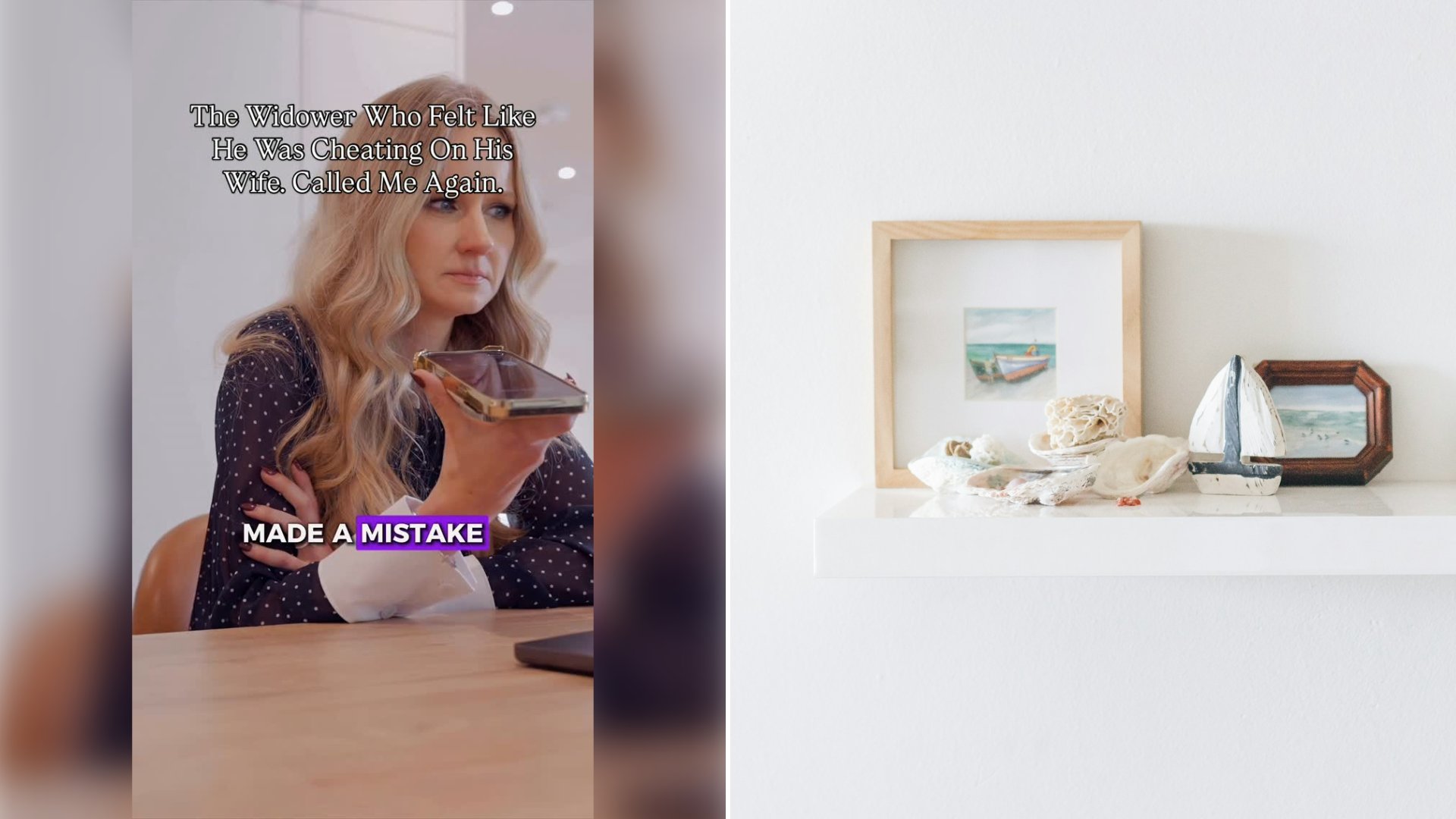
The video is a speakerphone call. Lyons sits at a kitchen island in a dark polka dot blouse with a phone held in front of her, and for nearly two minutes she mostly listens, occasionally cutting to a close shot of her face. The caller’s words appear as large captions with the current word highlighted in purple, and they tell one specific story. A photo of his late wife was out, still beside the bed, when a woman he is seeing came over. “I forgot to put it away,” he says, and the captions describe “another woman standing in” the room “looking at a photograph.”
What the visitor did is the center of the call. According to the captions, she “picked it up,” then “looked at it and said it’s beautiful.” He tells Lyons he told her he would “move it somewhere else.” The reply shows up in captions as “please don’t move it,” and he says she put it “back exactly where” she found it. Along the way the captions mention where the photo was taken, “Italy,” and “our 25th.”
He explains why it threw him. One caption reads “I really like this woman,” and another “I just don’t understand how she’s alright with this.” The captions show him saying he told her there “wasn’t enough room,” with later fragments about “somebody else” and “somebody new,” and the new woman’s answer, “she’s not in competition.” Near the end of that stretch the caption “nobody has to move” appears on screen. The post’s own caption says the same thing in her words: “I don’t think the goal is to ever find someone who makes the person you lost disappear. And I don’t think a new person should have to live in their shadow either.”
The call ends on a small domestic detail. The captions mention “cups beside the picture” and “cups beside that bed,” and a “41 years” caption appears alongside them. A caption reads “I was overwhelmed,” Lyons answers “because you missed her,” and he says “yes.” Near the end the captions turn to the visitor, and the last line shown is “she moved her coffee.”
The post’s caption closes with the idea Lyons is offering viewers: “Maybe the beautiful middle is finding someone who understands that a heart can make room without asking anyone who came before them to leave.” Her profile describes her as an entrepreneur with “12 years inside thousands of love lives,” and she is not presented in the video as a licensed counselor.
On the grief side, the federal Substance Abuse and Mental Health Services Administration says that “bereavement and grief are individual, yet universal experiences” and that “everyone experiences loss in their own personal way.” The widower’s worry about whether a new relationship leaves enough room is his own. The agency also lists the 988 Suicide and Crisis Lifeline, which can be reached by call or text at 988, for anyone in crisis.
For a reader who is dating after a loss, or who is dating someone who has lost a spouse, the call suggests a few concrete moves.
Do not rush to put the photo away. In the story, the offer to move it was met with a request not to, and the woman in the call left it exactly where it was. A simple question, such as “would you like it somewhere else, or is it fine there,” lets the person who is grieving decide.
Say the framing out loud. The line “she’s not in competition” is a sentence a partner can say plainly, and it answers the fear of not enough room before it becomes a silence.
Expect small moments, like cups left beside a photo, to bring grief up. In the call, the response to “I was overwhelmed” is to name the missing person, “because you missed her,” not to talk him out of the feeling.
More from Cultivated Comfort
- Widowhood Is Often Treated the Same as Divorce When It Comes to Dating Again, but Researchers Found a Surprisingly Clear Answer About What Widows Actually Want
- Widow Says the Mundane Moments Are What She Misses Most After Her Husband Died Suddenly, and Commenters Share the Small Things They Miss Too
- Woman Holds Back Tears All Through Her Mom’s Move Into Memory Care Until Her Mother Turns to Her and Says She Does Not Think She Is Going to Make It There