Apple is worth $5 trillion, and yet its brand-new folding phone, the iPhone Duo, is suddenly in the spotlight for all the wrong reasons. Even some brand-new, undamaged units have started springing green lines across the inner screen, always in the exact same places. Now a well-known repair expert has taken one apart to find out why, and what he found inside the hinge has plenty of owners wincing.
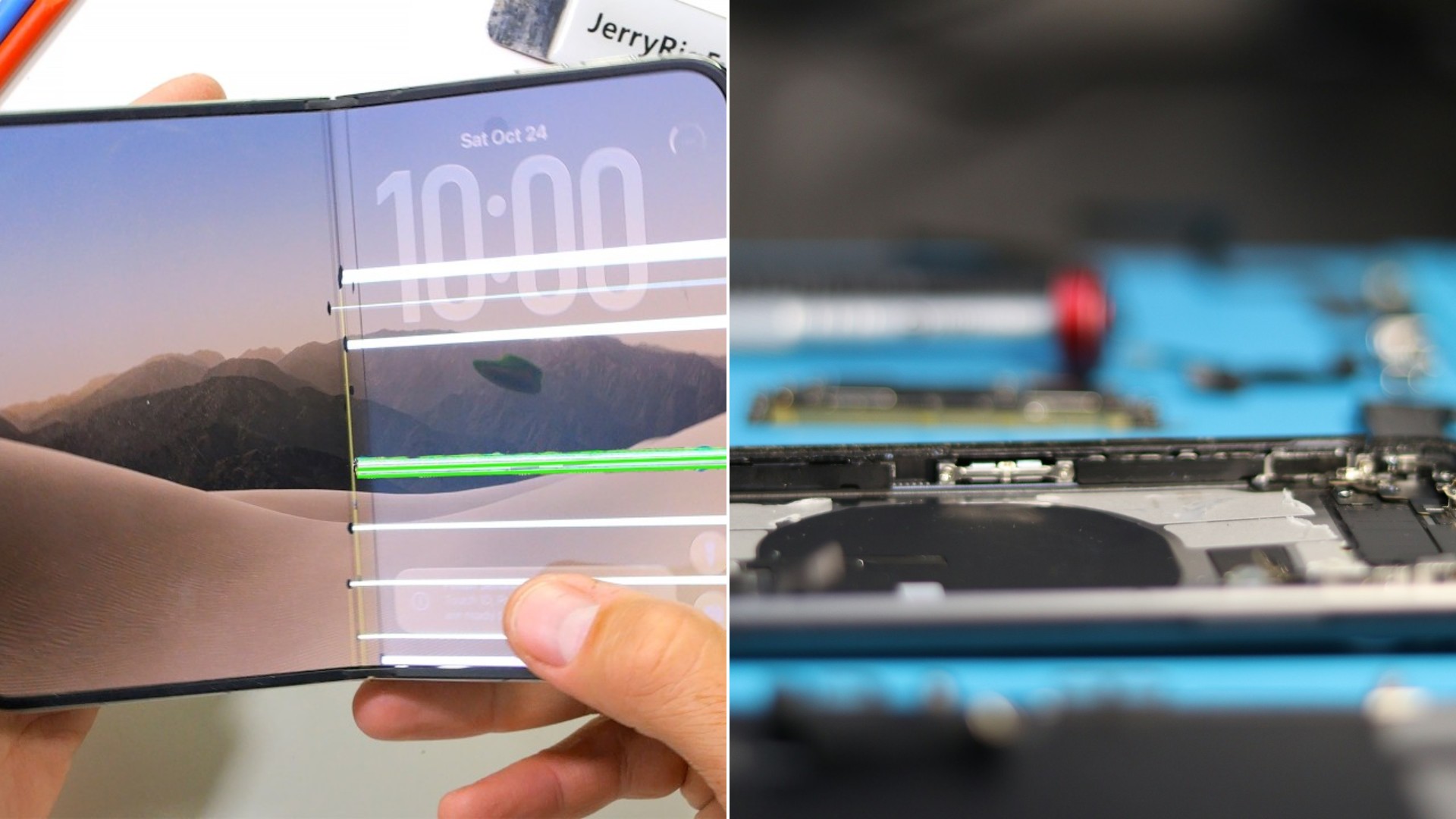
The teardown comes from the JerryRigEverything channel, where the host says he has been taking apart Samsung-made folding screens for eight years. His own iPhone Duo had already been through a durability test, but he wanted to see what lay underneath that folding screen at the spot where other people’s phones keep failing.
He joked about names for the problem, from Green Line Gate to Crackgate, before getting serious. His hope, he said, is that if he finds something, Apple will take care of the customers affected. After all, he noted, a company worth $5 trillion should be able to afford it, though he added that you do not get to $5 trillion by being generous.
Sand Everywhere Inside The Hinge
As he lifted the flexible screen off its frame, the host says he found an incredible amount of dust and dirt. He joked that taking that much sand from a beach would be a misdemeanor in some states. For a phone that is rated IP68 for water and dust resistance, he called that pretty unacceptable.
His dust test was admittedly excessive, he says, and the phone was in the dirt for only a few seconds. Still, he says, all it takes is a single grain of sand to puncture through and destroy the $1,000 flexible inner screen, and inside his phone the grains were literally uncountable. Each black dot on the screen, he explains, was likely a pressure point from a grain of sand that slipped in through the hinge.
He also reports that the metal shields around the circuit board did a good job of keeping his dust test out of that compartment. The trouble, he says, was the hinge itself, where lifting the plastic shields revealed a whole litter box worth of debris.
A Second Problem With The Hinge
The creator is careful to say he thinks the sand and the green lines are two separate but complementary problems. Sand, he explains, will crack your screen anywhere. The green line failures, however, show up in one specific location on every phone that broke on its own.
He pointed to one small hinge component sitting right at that spot, which he nicknamed the Pixel Pincher 9000. His theory is that a screw is coming loose or one of the guiding slats is breaking enough to poke the screen from behind. He stressed that he would need to open one of the broken phones to be sure, so this part is his best guess.
That matters because, according to him, replacing the center screen costs $1,000. He also noted that Apple says it designed the hinge itself, a mechanism with over 100 tiny precision components. The screen, he said, is made by Samsung, and he does not believe the screen failures are Samsung’s fault.
What Else He Found Inside
It was not all bad news. He confirmed the phone really does have two layers of ultra-thin glass inside the folding screen, which he called very cool, and he said the phone might be the best-looking iPhone Apple has ever made once opened up. There are around 95 different screws inside, he says, and Apple has posted a repair guide of roughly 300 pages online.
He also praised the battery design. Apple uses an adhesive that lets go when a 9-volt battery is clipped on for about 90 seconds, and the battery is made with 95% recycled lithium and 100% recycled cobalt. The two batteries together total 4,883 mAh, and he says the new adhesive can last 5 to 10 years, which should make repairs easier down the road.
Is The Dust Rating Misleading?
An IP rating, he explains, is tested in a lab with the phone stationary, with fine particles blown around inside an enclosure. If nothing gets in, the test is a success. Real life, he argues, is different, because people will take the phone to the beach, the garden or a dusty workshop.
In his words, the IP rating Apple advertised is a bit misleading, because people will assume their phone is dust resistant in everyday life, and he says it most definitely is not. He thinks Apple should warranty the inner displays for the long haul, and he says he hopes the company will do the right thing for first-generation owners. His verdict: you are not folding it wrong, Apple built it wrong.
What Owners Can Do In The Meantime
If you own one or are thinking about buying one, there are sensible steps to take. Keep the phone away from sand, sandy pockets and gritty surfaces, and do not open and close it on the beach. The creator points out that Apple’s own cases are not full-body, with a $130 folio case that leaves the sides exposed and an $80 regular case that leaves the hinge popped out.
- Keep the hinge clean. Avoid dusty places, and never fold the phone with grit on the screen.
- Choose a case that covers the hinge area, not just the back.
- Know your warranty. Check what Apple’s coverage says about the inner display before you need it.
- Skip DIY repairs. With around 95 screws, he says anyone attempting a first repair should really pause and think about it.
The host says he is now using an iPhone Duo himself for the next 30 days, as promised, and will report back on how it holds up. For anyone eyeing a folding phone, the lesson from his teardown is simple: ask how it handles dust, and what a repair would cost, before you pay for the privilege.
More Stories You May Like
- Costco Shopper in Irvine Finds the Rice She Bought Was Infested with Bugs and Shows What She Found Inside the Bag
- She Met Her Husband 39 Years Ago, Fell In Love With His Mom, And Her Dream Of An In Law House On Their Property Finally Came True
- Woman Says Never Have a Destination Wedding and Lays Out Why the Dream Trip Turns into a Headache for Guests and Family