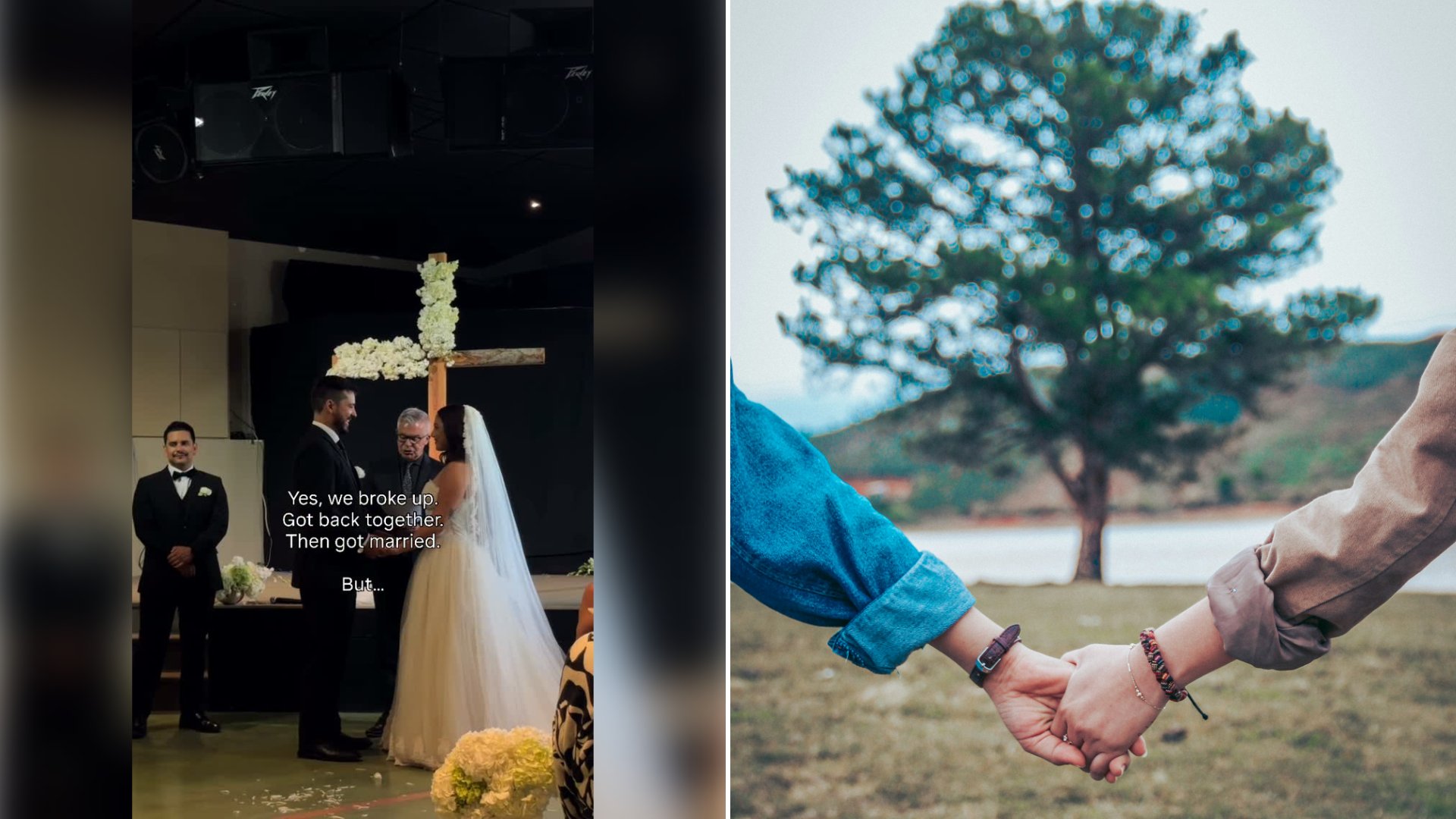
The reel from @kalibdias is only about six seconds long, and it is a single steady shot of a wedding ceremony. A bride in a long veil and a groom stand facing each other in front of a tall cross covered in white flowers, with an officiant between them and a groomsman in a black suit standing off to the left. Text on screen reads “Yes, we broke up. Got back together. Then got married.” and below it, “But…” Near the end the couple kiss and the groomsman applauds.
The rest of the story is in the caption, which opens by repeating the on screen line: “Yes, we broke up. We got back together. And then we got married.” The next sentence is the point of the whole post: “But getting back together didn’t magically give us a relationship with less conflict. It gave us a second chance to learn how to handle conflict differently.”
The caption then lists what reconciling did not mean. It did not mean they “suddenly agreed on everything, stopped triggering each other, communicated perfectly, or never hurt each other again.” And it lists what it did mean, in a run of short lines: learning that “being right wasn’t always more important than understanding each other,” having “uncomfortable conversations instead of avoiding them,” and learning “how the other person needs to be loved, even when it doesn’t come naturally to you.”
Two of the items are concrete enough to try tonight. One is “apologizing without adding a ‘but.'” The other is “forgiving things we couldn’t go back and change.” The caption is also candid about the daily reality of a marriage, including “choosing each other on days when loving each other felt a lot easier than liking each other,” followed by a laughing emoji. And it reframes commitment as “not the absence of hard seasons,” but “deciding how you’re going to walk through them together.”
The caption does not pretend the second try fixed everything outside the relationship either. “Life still happened. Stress happened. Parenthood happened. Work happened. Old wounds came up.” What changed, it says, is that “now I have someone standing beside me through all of it,” and that the relationship “stopped being about finding someone who would make life easy and became about building a life with someone who was willing to keep growing beside me.”
The reason for the original breakup is stated in one line: “We broke up once because loving each other wasn’t enough to make us healthy together.” The second chance came with a condition, which was that “we couldn’t just recreate the same relationship and expect a different ending.” The caption describes the wedding itself as “us standing before God and saying we choose this,” not as a claim that they had “finally figured everything out.” It ends: “Take two didn’t come with less life. It came with a better understanding of how we wanted to walk through it together.”
Researchers have looked at how common this path is among young adults. A 2013 study from the National Center for Family and Marriage Research at Bowling Green State University drew on the Toledo Adolescent Relationships Study, a random sample of nearly 800 people aged 17 to 24 in Lucas County, Ohio. It found that about 44 percent of those who had a romantic relationship in the previous two years had experienced at least one reconciliation, meaning a breakup followed by getting back together. The university’s summary says researchers still do not know what this pattern means for well being, and suggests future studies examine whether it predicts later instability in cohabitation or marriage.
For a reader thinking about giving an old relationship another try, the caption offers specifics. This couple says love alone was not enough the first time, so name what actually caused the breakup. Try the caption’s own examples: apologize without adding a “but,” and have the uncomfortable conversation instead of avoiding it. And expect the stressful seasons to arrive regardless, since the caption says life, stress, parenthood and work all still happened after they reunited.