Maurice flies about 30 times a year, spends five and a half months abroad, and moves to a new place every two weeks or so. So when he says choosing a travel backpack comes down to eight decisions, he has earned the right to be heard.
The creator behind Maurice Moves is a carry-on-only traveler on more than 90% of his flights. He walks through the eight choices that narrowed every backpack in existence down to the one he carries now, a 45 L bag.
His warning up front is a good one. The decisions are about you, not about him, and none of them is really about the backpack itself.
Decision One, Your Airline Is The First Boss
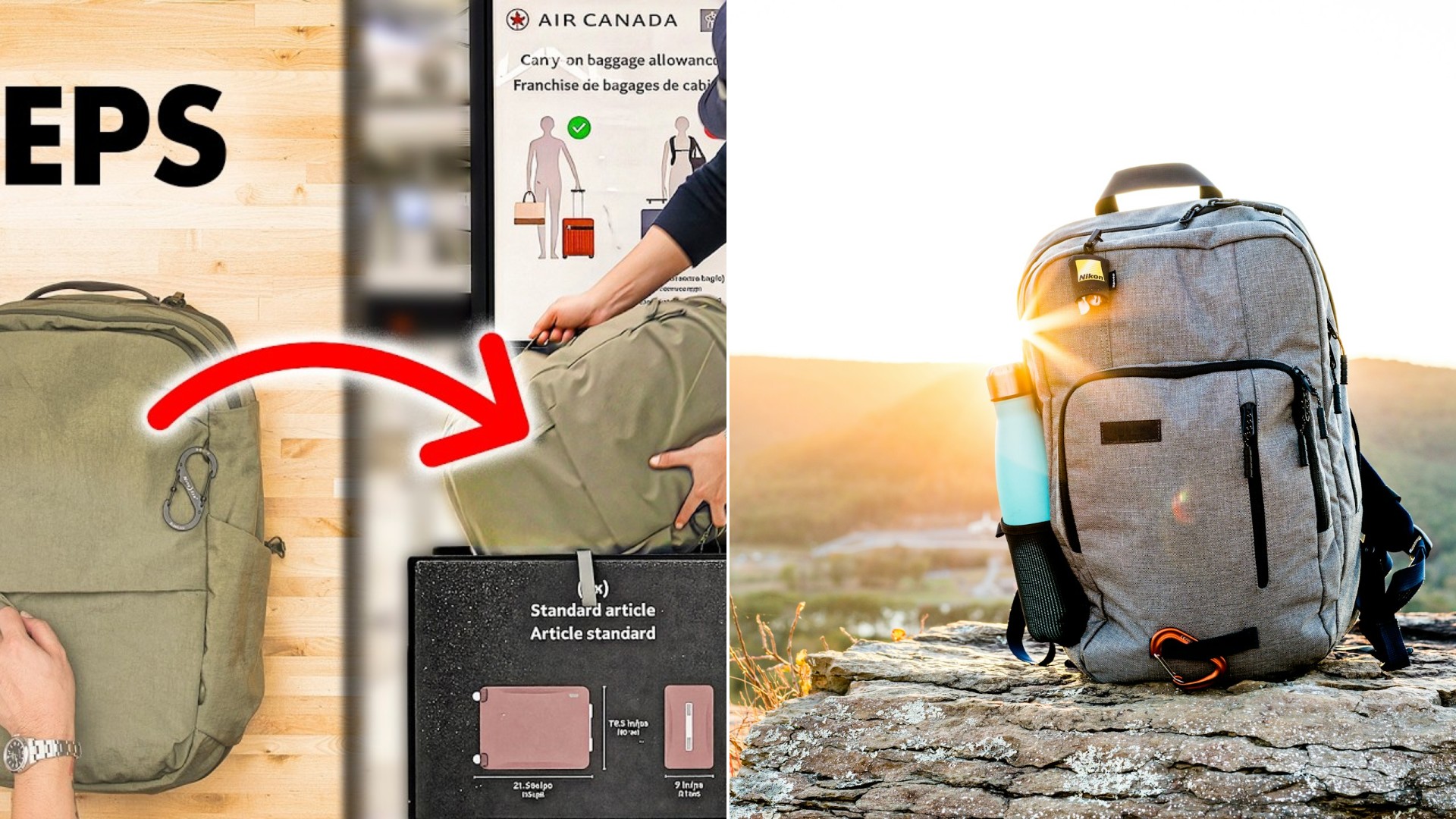
About 90% of his flights are with EVA Air, a legacy carrier. His rule is to research the size and weight limits of your most likely airlines before you shop, because every other choice flows downstream from that.
His fully packed 45 L bag slides straight into the airport sizer with no pushing and no forcing. If you do not have a go-to airline, he says the rest of the decision tree still applies.
Decision Two, Pick The Way Your Brain Packs
Maurice packs with cubes and lots of small pouches. That means built-in organizer pockets are just noise to him, and he wants as many roomy, open compartments as he can get.
You may be the opposite and love built-in organization. He says there is no right answer, only whether the bag’s packing philosophy matches yours.
Decision Three, A Bag That Opens Like Hard-Shell Luggage
His bag opens like a hard-shell rolling suitcase, in two clear halves. With no telescoping handle eating into the space, he says it holds even more than a roller.
That lets him give each half a job. One side is clothes, and the other is hygiene, tech and everything else.
If you prefer a top loader or one big clamshell with a laptop sleeve, that is a personal call. He likes things separate and visible at a glance.
Decision Four, Why He Tossed The Hip Belt The Day He Got It
This is the one about imagining the bag’s whole journey, which for him includes subways, trains, buses, scooters and taxis. After he lands and unpacks, the main bag stays put, and he heads out with only a personal item bag.
So the hip belt that shipped with the pack came off immediately. He says he cannot even find it anymore, and he realized on camera that he forgot to remove the sternum strap he never uses either.
If you walk a lot with a full pack, he says a hip belt and sternum strap are worth shopping for, because they share and steady the weight on long carries. If you use rolling luggage often, a luggage pass-through is a must.
Decision Five, Squishy Straps Feel Great Until Hour Two
Here the question changes from “does the feature exist” to “does it hold up at hour two, three, four or five under load.” The counterintuitive part, he says, is that lush memory foam straps feel amazing at first but sink and stop working after an hour of heavy carrying.
Stiffer pads keep their structure and do not bottom out. Pair them with load lifters, which pull weight up and forward onto your shoulders and off your back, and he says the difference is noticeable immediately.
He still tightens the lifters for scooter taxis. On a bumpy road, he explains, your spine is squeezed by the bag’s weight pushing down and the potholes pushing up, and he sometimes rides for up to an hour.
Decision Six, Pay Less Of The “Friction Tax”
Maurice thinks of micro friction as a tax that compounds. If you take one vacation a year, that tax is close to zero, but he changes lodging every two to three weeks for five or six months.
So every compartment on his bag opens from the outside without unzipping the whole clamshell. His laptop slides out for airport screening, and each half has its own top zipper.
He packs his travel adapter with the cable already attached at the top, so on a train or in a cafe he opens one zipper and starts charging. A flat back pocket holds a folded rain shell and an ultralight daypack that he uses on budget airlines with tighter limits.
Two front pockets hold his notebook and pens and small items like lip balm and hand sanitizer. Outside anchor points let him clip a sweaty hat or a small water bottle, so nothing leaks or smells inside the bag.
Decision Seven, Water Resistance Without The Toxic Coatings
Durability starts with materials. Maurice says he has been wary of microplastics and toxic coatings for years, so he wanted a bag with a non-coated, water-resistant build.
The exterior is 420 denier ballistic nylon for puncture and tear resistance. He points to bar tacks at the stress points, which are extra passes of reinforced stitching so a strap does not fail under a heavy load over the years.
Decision Eight, Look Respectable Then Be Instantly Forgotten
Appearance is the least important in real use, he says, and often the most important to our subconscious. He likes a clean, flat, solid-color bag with no loud branding.
His goal when he travels is to be seen as respectable and just as quickly forgotten. A logoless bag and a logoless wardrobe, he says, make him so boring that he evaporates from people’s minds.
The Bag Is Just Where His Answers Landed
His pick is the Packed One Travel Bag V3, and he says it is probably right for some people and definitely wrong for others. Looking back, decision one was about his airlines, two about how his brain packs, and three about how he wants packing days to feel.
Four was about where his body has to go, five about protecting his back after a bumpy 30-minute scooter ride, and six about how much friction he will tolerate. Seven was about what a bag failure would cost him, and eight was about who he wants to be in a new city.
His closing advice is to resist a knee-jerk purchase. Run through the eight decisions first, decide what you are optimizing for, and he says the bag mostly picks itself.
More Stories You May Like
- 6 Costs to Settle Before Sharing a Cruise Cabin or Hotel Room With Friends So Money Does Not Quietly End a Friendship on Vacation
- 6 Boundaries to Settle Early So In Law Holiday Showdowns Over Whose House, How Long and Who Decides Do Not Blow Up Again This Year
- Harvard Study That Followed Lives for Nearly 80 Years Found Happy Relationships at 50 Predicted Health at 80 Better Than Cholesterol Did