You walk into the grocery store for a gallon of milk. One item, five minutes, and you are out the door. But right inside the entrance there is a table of fresh flowers, a fruit basket and some seasonal goodies, with a $3 price on the flowers, and you grab them without thinking. According to YouTube creator Barry Explains, that table is no accident, and it is only the first move in a layout built to turn a quick errand into a full shopping trip.
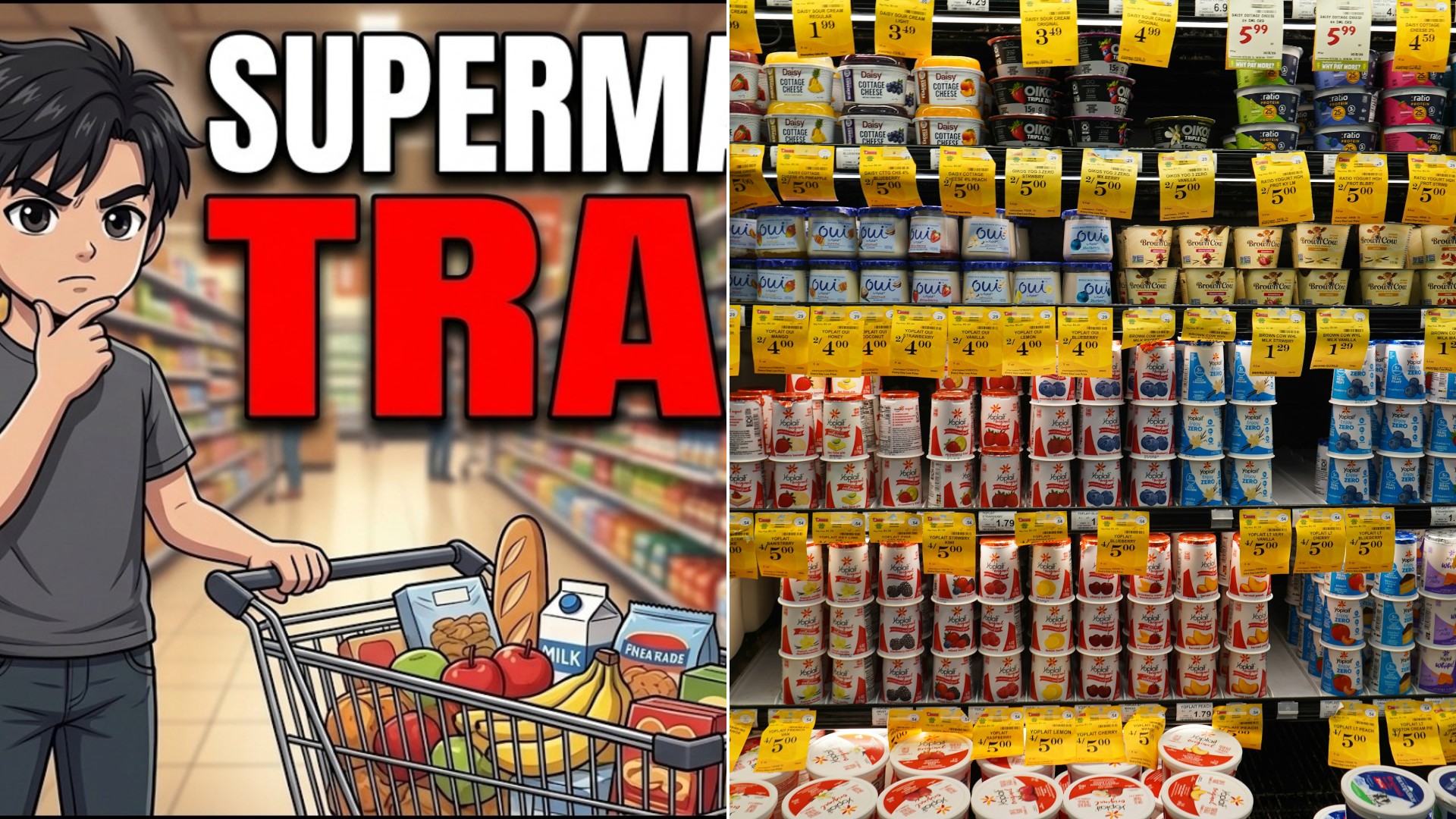
He walks through the whole system in seven levels, from the front door to the checkout to your yearly grocery budget. Here is what he says is happening around you every time you push a cart.
The Entrance Trap
Supermarkets call the first 10 to 15 feet inside the door the decompression zone. It slows you down while your senses adjust from the parking lot to the bright, fluorescent interior, and the flowers, the bakery smell and the bright colors nudge your brain from get in, get out to let me just look around. The stacked displays near the door are known in the industry as speed bumps, and their job is to start filling your cart before you reach the first real aisle.
He cites a 2025 survey by Optimum Retailing that found 72% of American consumers had made at least one unplanned in store purchase in the prior month, and the top trigger was attention grabbing displays. Once anything lands in the cart, behavioral researchers say you have crossed a commitment threshold. A quick errand has become a shopping run, and one item becomes permission for two more.
The Layout Maze
Now think about where the milk is. It sits at the very back of the store, and so do the eggs, the bread and the butter. Every staple you came for is as far from the front door as possible, and he says the long walk is not purely about refrigeration. It takes you through dozens of aisles full of things you did not plan to buy, and research on in store travel distance links longer paths with more unplanned purchases.
Shelf placement has its own logic. Brands pay what the industry calls slotting fees to sit at adult eye level, roughly four to five feet off the floor, while cheaper store brands sit on the bottom shelf. Character cereals and snack packs are placed at a child’s eye level because a kid asking for a box converts better than a billboard. Endcaps, the displays at the end of aisles, look like promotions, but he says the price is often identical to the one inside the aisle. The average supermarket carries over 30,000 products, and you came in for maybe five.
The Pricing Illusion
Prices do more than tell you what something costs. A price of $4.99 instead of $5 makes your brain read the four first, so it feels closer to $4. Stores also place a $12 jar of pasta sauce beside a $7 jar, and most shoppers were never going to buy the $12 one. Its job is to make the $7 jar feel reasonable.
Multi buy pricing works the same way. Two for $6 sounds like a deal even if you needed one and it costs $3.50 alone, and you end up spending a dollar more than you planned. He also points to a study by Brian Wansink and colleagues across 89 grocery stores. When a soup display said limit 12 per person at 79 cents each, shoppers bought roughly seven cans, compared with three or four without the limit. The number on the sign worked as an anchor.
The Shrinkflation Game
This one has no display and no sign. The package looks the same and the price is the same, but there is less inside. He gives examples such as a bag of tortilla chips going from 7.5 ounces to 5.5 ounces, a box of cotton swabs dropping from 500 to 400, and a dish soap that loses 3 ounces.
Because most people shop on autopilot, the cost goes up without anyone explaining a price increase. The defense is simple, if tedious: check the per unit price on the shelf tag, the small number under the sticker price showing cost per ounce, count or serving. It is the only number that lets you compare products honestly.
The Loyalty Trap
Loyalty programs feel like the one part of the store that works for you, and some savings are real. But every scan builds a purchasing profile of what you buy, how often and when, and that data produces personalized offers meant to bring you back at specific intervals. A targeted coupon might cost the store a dollar, while the unplanned purchases during the extra trip can exceed its value several times over. In his words, the coupon is not the product, the trip is.
He adds that member prices can sometimes just restore the expected retail price, citing documentation by consumer advocates including Choice in Australia. That does not make the programs worthless, he says, but the primary purpose is to generate data and increase visits.
The Checkout Squeeze
By the register you have made decisions for 20 or 30 minutes, and psychologists call the resulting drop in self control decision fatigue. Candy, gum, chips, cold drinks and lip balm sit within arm’s reach, and a $2 candy bar hardly feels like a decision. Many self checkout lanes now have impulse items on both sides and screens suggesting add ons.
He also notes research from Priya Raghubir at NYU suggesting people tend to spend more with credit cards or gift certificates than with cash, because paying with a card makes the loss less visible. Store brands, which he says averaged roughly 35% margins in one analysis compared with about 26% for national brands, often get favorable placement as well. By the time you leave, he says, that milk run has become a $40 or $50 trip.
The Annual Cost
Zoom out to a year. He cites USDA data showing the average American household spends approximately $677 a month on groceries, about $8,100 a year, with food at home prices forecast to rise around 2.4% in 2026. A Wharton study led by David Bell that tracked 2,945 grocery shoppers found roughly 20% of purchases were decided in the store. At 20% of $8,100, that is about $1,600 a year in purchases that were not on anyone’s list.
He is careful to add that unplanned does not always mean unnecessary, since some of those purchases are things you simply forgot to write down.
How to Push Back
He closes with three changes that make the biggest difference.
- Shop with a list and stick to it. Research consistently links list based shopping with lower spending.
- Eat before you go, because hunger amplifies impulse buying in every aisle.
- Read the per unit price rather than the sticker price, the one honest comparison tool the store gives you.
Next time you grab that $3 bouquet by the door, you will know it was never just $3. It was the first step in a path designed to run past 30,000 products on the way to your milk.
More Stories You May Like
- 5 Rules to Settle Before Adult Kids Move Back Home So Rent, Chores and Timelines Do Not Quietly Turn Into Resentment Under Your Roof
- 6 Ways to Protect Your Home and Retirement When Dating Later in Life Before You Move In Together or Merge Money Too Soon With a New Partner
- Wedding Budget Creep Traps From Guest List Growth to While We Are at It Upgrades That Quietly Blow the Plan Before the Big Day