Holiday decorating has a way of exposing what looks truly luxurious and what reads as bargain-bin, no matter the price tag. Designers say the difference often comes down to scale, material, and restraint, not how much someone spent, and a few repeat offenders reliably cheapen a room even when they are brand new and costly.
From plastic greenery that shines under the lights to matchy ornaments and towering inflatables, certain pieces signal “mass-produced” instead of “considered.” Knowing which items professionals quietly avoid makes it easier to invest in decor that feels intentional, polished, and personal for years to come.
Oversized inflatables and lawn clutter
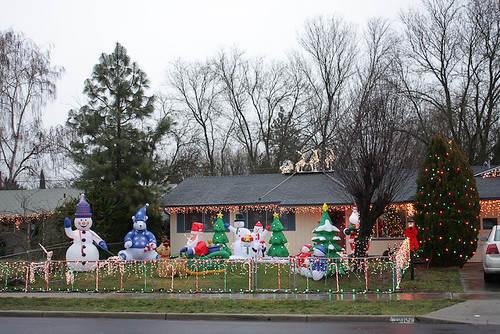
Big-box holiday inflatables promise instant curb appeal, yet designers consistently rank them among the fastest ways to make a home look juvenile rather than festive. Even when the figures are expensive, large characters slumped on the lawn or crowding a small yard can overwhelm the architecture and distract from any thoughtful details. Alex Thies, owner and creative director at Adelyn Charles Interiors, specifically calls out Oversized Inflatables as a tacky move that instantly drags down an otherwise charming exterior.
The problem is not just size, but clutter. Designers warn that piling on multiple inflatable figures, light-up characters, and plastic yard stakes can make even a high-end property resemble a discount display. Reporting on Expensive holiday decor notes that too many statement pieces at once quickly look chaotic instead of celebratory, and that Minimalism built around one or two elements has far more impact. A single, well-placed wreath, a simple string of warm lights, or a pair of planters with real greenery will always look more refined than a yard full of inflated nylon, no matter how much the inflatables cost.
Plastic greenery and faux garlands that shine
Artificial greenery can be practical, but certain versions instantly reveal themselves as cheap, especially under bright lights. Designers point to glossy, unnaturally stiff branches and bright, synthetic hues as the main giveaways. Guidance on Getting the scale and materials right for Christmas decor stresses that overly shiny finishes rarely mimic the depth and texture of real foliage, so they tend to look more like craft supplies than seasonal greenery. When those pieces are draped across mantels or stair rails, they can cheapen an entire room, even if they came from a high-end retailer.
Specific trends have fallen out of favor for this reason. Designers now flag Plastic Garlands With Red Bows as a classic example of decor that looks dated and inexpensive, because the high-gloss finish and uniform color read as fake from across the room. Shannon Murray Petruzello, principal designer and owner of Shannon Murray Interiors, also cautions against Decorating With Faux Garla that is thin, sparse, or overly uniform, noting that these pieces often look flat and lifeless instead of lush. She recommends choosing fuller, more realistic branches or mixing in real stems to soften the effect, which aligns with broader advice that Christmas decor should complement, not fight, the existing room.
Matchy ornaments, generic signs, and slogan decor
On the Christmas tree, designers say one of the quickest ways to make an expensive setup look basic is to rely on identical, store-bought ornaments from top to bottom. Reporting on Matchy Matchy Ornaments notes that a tree covered in generic baubles can leave everyone cold, no matter how much the set cost. The effect is especially flat when every piece is the same size and finish, because there is no visual rhythm or sense of story. Experts instead recommend layering different shapes, textures, and personal keepsakes so the tree feels collected over time rather than purchased in one afternoon.
The same principle applies to wall art and tabletop pieces covered in mass-produced phrases. Designers caution that Even the most heartfelt sayings can feel generic when they appear on every shelf and throw pillow. Guidance on seasonal red flags suggests that Instead of leaning on slogans, homeowners should let shapes, textures, and natural elements do the talking, whether that is a bowl of real pinecones or ceramic pumpkins in more realistic tones. The same logic carries into December, where a simple arrangement of greenery, candles, and metallic accents will usually look more elevated than a cluster of signs all repeating the same holiday greeting.
Harsh lighting, bad scale, and overcrowded trees
Lighting can quietly undermine even the most beautiful decor, particularly when it is too bright, too cold, or simply too much. Designers who walk clients through Consider common Christmas mistakes emphasize that getting the Getting the scale and tone right is crucial. Oversized, flashing bulbs or stark white LEDs can make a room feel more like a storefront than a home, while tangled strings draped haphazardly across furniture read as clutter. Experts recommend choosing one consistent color temperature and weaving lights thoughtfully through greenery and architectural features instead of covering every surface.
Tree styling has its own set of pitfalls. Advice on Things to Never Do When Decorating Your Christmas Tree highlights that skipping foundational steps like Skipping the Prep Work for Fresh Cut Trees can leave even a pricey tree looking sparse or lopsided. Other missteps include hanging all ornaments at the tips of branches, ignoring depth, and overloading the tree with decor so that no single element can shine. Separate guidance on Aug holiday mistakes notes that proportion matters throughout the room as well, from tree height to stocking size, and that pieces that are too big or too small for the space will always feel off, regardless of cost.
Cheap-looking plastics, mismatched plastics, and missed opportunities to thrift
Plastic is not automatically a problem, but certain finishes and colors are hard to disguise. Designers single out thin, hollow pieces and overly bright tones as the main culprits, especially when they are grouped together. In the same list where Alex Thies critiques inflatables, she also flags Mismatched Plast as a visual distraction that can make a room feel cluttered and low quality. Mixing several different plastic finishes, from glossy berries to neon ornaments and rigid garlands, tends to amplify the artificial look instead of balancing it.
Professionals suggest that homeowners look beyond big-box aisles to avoid this trap. Curated boards like Tavle collections that feature this specific Pinnen of Christmas Pins highlight how Cheap Thrift Store Finds Designers Love for Hol can look surprisingly elevated when they are glass, metal, or wood instead of plastic. Vintage brass candlesticks, real silverplate trays, and secondhand glass ornaments often cost less than new plastic decor but bring weight and patina that read as far more expensive. Designers argue that editing out flimsy plastics and replacing them with a few substantial, thrifted pieces is one of the simplest ways to make holiday decorating feel intentional rather than disposable.