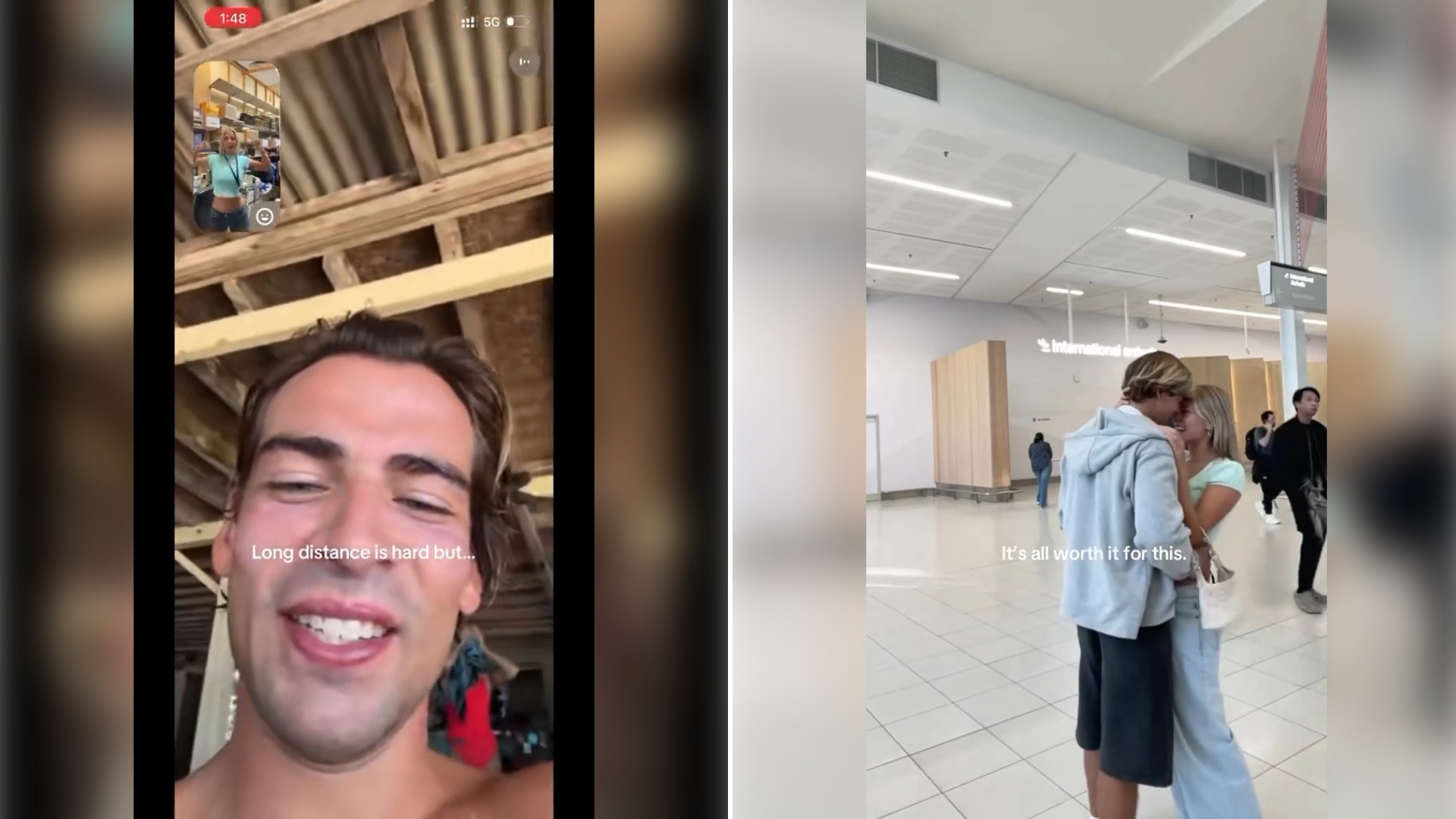
Long-distance relationships tend to run on a specific kind of visual shorthand: a grid of split-screen video calls, stacked up over weeks and months, each one a small placeholder for the in-person time the couple isn’t getting.
The creator, @leilani.philip, built a montage out of exactly that, split-screen video calls with her partner stretched across a long stretch of distance, before the video finally cuts to the payoff: a reunion at the airport. The caption is short and direct, “it’s so worth it,” framing the entire emotional arc of the video around the payoff after so much time spent apart.
View this post on Instagram
The split-screen call format has become something like the visual language of long distance online, instantly recognizable and instantly relatable to anyone who has maintained a relationship primarily through a screen. Stacking months of those calls together before cutting to an in-person reunion does more narrative work than either clip could do alone; the calls establish just how long the wait was, and the airport reunion delivers the release that wait was building toward.
What makes the split-screen montage such an effective storytelling device is how much repetition it can compress into a few seconds. Each individual call in the grid likely looked more or less the same in real time, two faces lit by phone screens, a conversation happening across however many time zones separated them. Strung together, that sameness stops reading as monotonous and starts reading as evidence, proof of consistency, of two people choosing to show up for each other night after night despite the distance, even when there was nothing new or exciting about doing so. A single video call says very little on its own. Dozens of them, compiled side by side, say quite a lot about persistence.
Relationship researchers who study long-distance couples consistently find that the waiting itself, not the eventual reunion, is usually the hardest part to sustain emotionally. Video calls help close some of the gap, but they also serve as a constant reminder of exactly what’s missing: physical presence, a hand to hold, a hug that isn’t mediated by a screen. That tension is part of what makes reunion videos like this one land so hard. The relief on screen isn’t just about seeing a partner again, it’s about finally getting the thing that months of calls could only approximate.
There is also a particular emotional texture to airport reunions specifically that sets them apart from other kinds of homecoming footage. Airports are transient, impersonal spaces by design, full of strangers moving in every direction, announcements echoing overhead, nobody paying attention to anyone else’s story. Dropping a deeply personal, long-awaited reunion into that anonymous backdrop creates a striking contrast: two people entirely absorbed in each other while a crowd of indifferent travelers streams past on either side. That contrast is part of why airport reunions have become such a durable staple of this genre of video, the setting itself amplifies the intimacy of the moment simply by being so impersonal everywhere else in the frame.
Long-distance relationships have also become considerably more visible online over the past decade, in part because video call technology has made it possible to document the waiting period itself, not just the eventual reunion. A generation ago, a couple separated by distance might have relied on letters or phone calls that left no visual record behind. Today, every call can be screen-recorded, every reunion filmed from the moment a plane lands, which means the entire arc of a long-distance relationship, the waiting, the loneliness, the small rituals built around scheduled calls, and eventually the reunion, can be documented and shared as a single continuous story rather than remembered only in fragments.
That visibility has, in turn, built a specific kind of community around long-distance relationship content, one where viewers who are themselves separated from a partner find validation in watching someone else’s version of the same experience. Comment sections under videos like this one are often filled less with generic compliments and more with specific, personal responses: people naming their own countdown to a reunion, describing their own current stretch of separation, or simply expressing that watching this kind of footage makes the distance feel a little more bearable. The video isn’t just documenting one couple’s story; for a meaningful slice of its audience, it’s functioning as a kind of shared proof that the wait, however long, tends to end somewhere good.
It’s worth adding that the montage format itself, calls building to a reunion, has become a kind of template within this genre precisely because it mirrors the emotional structure of the experience it’s documenting. A long-distance relationship isn’t one continuous feeling; it’s long stretches of manageable routine punctuated by occasional, overwhelming moments of either separation or reunion. A video that simply showed the airport hug without the preceding grid of calls would still be sweet, but it would miss the structural honesty of actually showing the waiting, the sameness, the quiet accumulation of ordinary nights spent talking through a screen before the one night that finally isn’t.
Whatever the exact distance and timeline behind this particular couple’s story, the caption’s simple declaration, that it was all worth it, captures something a lot of long-distance couples eventually arrive at: the wait is real, the difficulty is real, and so, apparently, is the reunion that makes it worth enduring, a small, three-word verdict standing in for months of split-screen calls, quiet loneliness, and counted-down days.