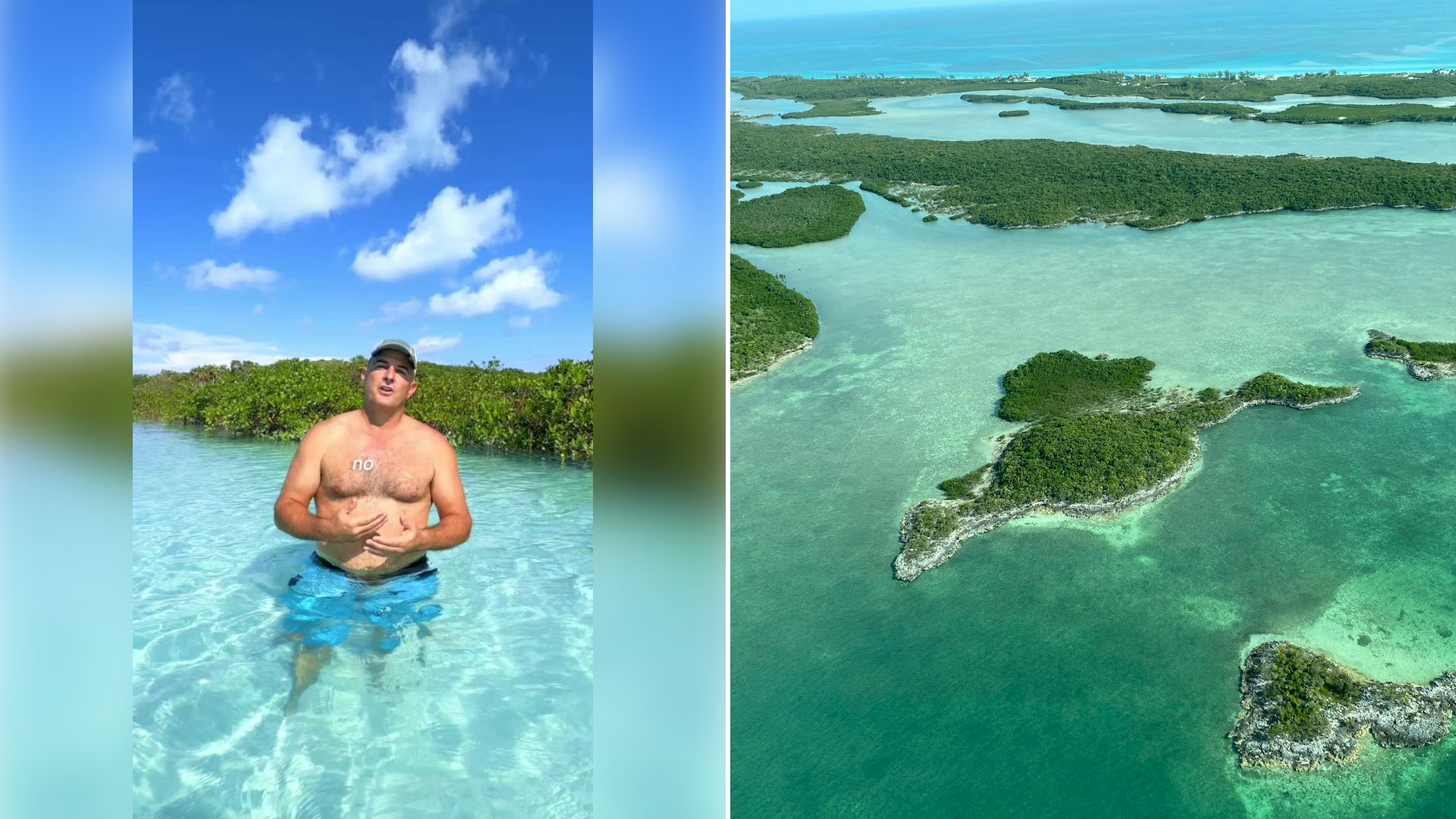
“No human has ever built a lazy river this beautiful.” A man in a gray cap stands chest deep in glassy turquoise water with a green wall of mangroves behind him and delivers that line straight to the camera. The clip is from @thegoodlifebahamas, an account called The Good Life, and its caption places the scene at Moriah Harbour Cay in the Bahamas.
The video runs only 24 seconds, and most of it is footage rather than talk. A drone view pulls back to show narrow, bright blue channels cutting through dark green mangrove forest, and the man says that from above “you can see the rivers are almost like veins going into this ecosystem.” Closer shots show a group of swimmers in the channel, and a later frame shows a green sea turtle resting against the mangrove roots on a pale sandy bottom.
The idea of the lazy river is simple. “Sometimes we’ll come through as a group,” he says. “You get in the river in one place and just float your way to somewhere else.” He calls the area “both totally wild and totally calm,” and says that “very rarely in life do you get to be in nature at such a level, in such a pristine environment where the water is just glass calm.” The last shots go underwater, where a snorkeler swims beside the mangrove roots, which stand in clear water over sand like a forest of thin stilts.
The caption explains the name. These channels are not technically rivers, it says. They are shallow tidal creeks and lagoons winding through mangrove wetlands, with water level and flow driven mainly by the tides. As the tide moves in and out, the current makes a gentle flow through the channels that can carry a floating swimmer along, much like the ride at a resort pool. The caption says visitors can arrive by kayak, slip into the water with snorkeling gear and drift past sea turtles, juvenile fish, starfish and rays, and it calls the experience one of the safest, calmest ways to see untouched Bahamian nature.
The claim about young fish matches what the U.S. National Oceanic and Atmospheric Administration says about mangroves in general. On its Florida Keys National Marine Sanctuary page, NOAA says many reef fish and invertebrates that matter to fishing use mangroves as a nursery habitat, sheltering in the tangled roots. The same page says the prop roots give sponges, algae and barnacles a place to grow and give small fish and invertebrates places to hide, and that mangroves reduce wave energy and trap sediment from land that could otherwise smother nearby coral reefs. NOAA also notes that there are about 80 mangrove species worldwide. The page is about Florida, so it describes the habitat type, not this particular Bahamian creek.
There is also an official rulebook for the area the caption names. The Bahamas National Trust manages Moriah Harbour Cay National Park on Great Exuma, designated in 2002, and its park rules identify the mangrove creeks at Moriah Harbour Cay and Man O War Cay as no wake zones, where vessels must stay at or below 3 knots. The rules also ban extractive fishing of any kind, ask snorkelers to use the yellow buoys at snorkeling sites or anchor in sand to protect reefs and seagrass, and ask visitors to leave animals and plants in their habitat. The video does not say whether the filming location is inside the park boundary, so those rules are offered as the Trust’s published guidance for the park of the same name.
For a traveler thinking about a float like this, the practical points follow from the video and the caption. The caption says the flow is driven mainly by the tides, so the clip’s calm current is the creator’s description of one moment and not a promise for every hour. Snorkeling gear matters, since the best view in the clip is the underwater one. The animals in the frames are best watched, not touched, in line with the Trust’s guidance to leave wildlife where it lives.
More from Cultivated Comfort
- Caribbean Tourism Headlines Almost Always Go to the Same Handful of Big Name Islands, but a Tiny Island Most Americans Could Not Find on a Map Just Posted Its Best Six Months Ever
- Beachfront Resort Pools Are Usually the Most Photographed Spot on Any Tropical Vacation for Every Single Guest, but One Tourist’s Footage Shows a Storm Left Nothing Left to Photograph
- Boat Passengers Get the Shock of Their Trip When a Whale Breaches the Water Right Beside Them Not Once but Twice