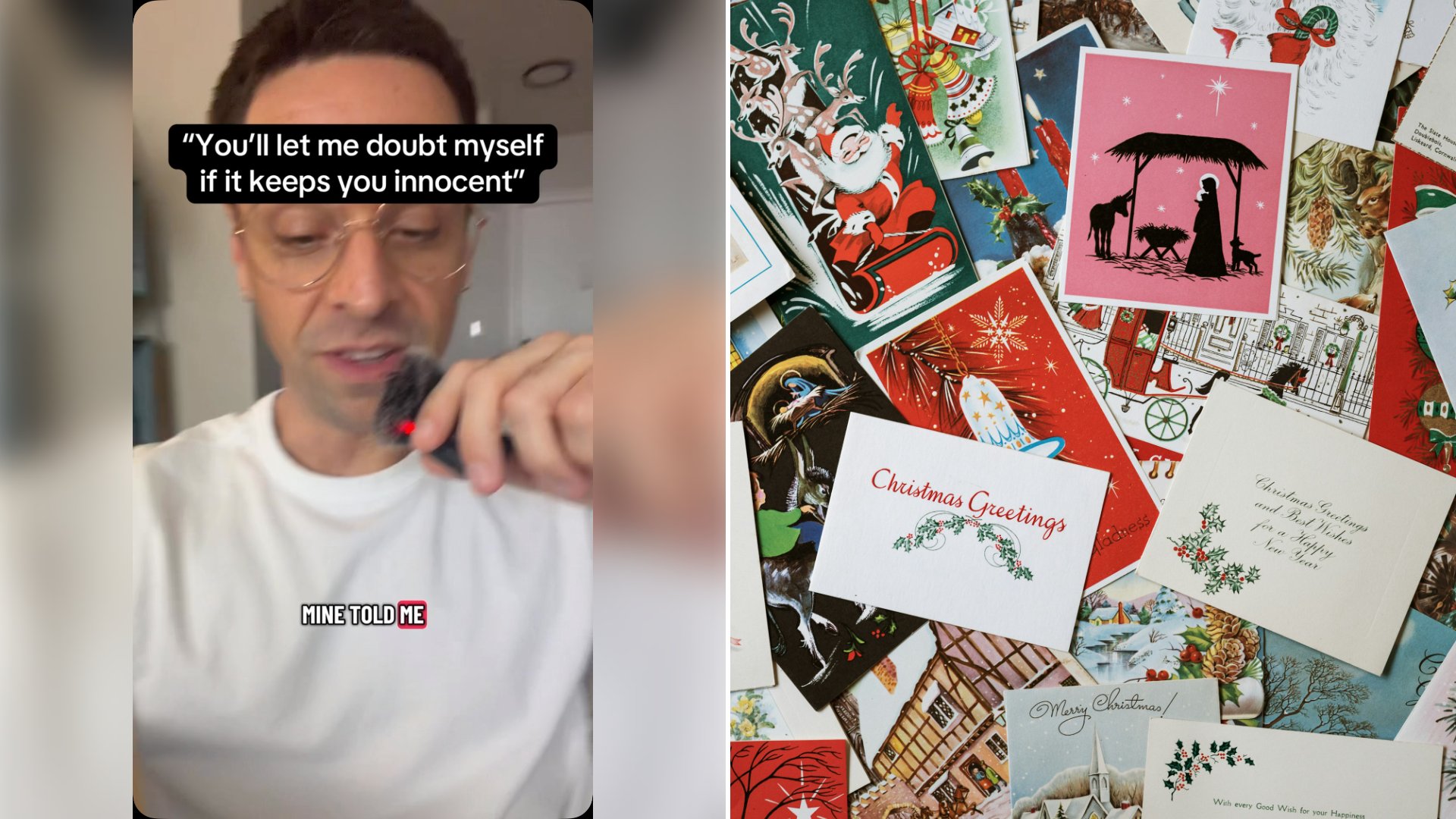
A man in gold rimmed glasses and a white shirt talks straight to the camera while running an electric shaver along his jaw, and over about two and a half minutes he tells a story about a husband, a wife and a set of Christmas cards. The post comes from @ajsaxsma, and its caption states the point in one sentence: “You can forgive someone and still never give their word the same weight again.”
The hashtags on the post are #storytelling, #subtext, #writingsubtext and #fiction, so the piece is told as fiction rather than as something that happened to him. A line of text stays pinned at the top of the frame from start to finish: “You’ll let me doubt myself if it keeps you innocent.” The story itself arrives as captions burned into the video, one short phrase at a time, and the phrases that can be read give a clear outline.
The captions open on a couple who have been together eight years. A late night exchange follows, one short line at a time: “This out now?” “Already checked it.” “You checking it again?” “Sure of what?” The answer is a single word, “Trash.” The wife, in other words, has a habit of searching the garbage, and her husband has noticed.
The captions then go back in time to explain why. “The Christmas cards” were her “last Christmas cards,” and “Grandma had passed.” She had “been keeping the” cards, and “one afternoon” she “couldn’t find them.” The captions list where she looked, “Kitchen up and down” and then the bedroom, and say it went on “for weeks, the same thing.” Then comes “Eventually,” and the line she was given as an explanation: “Must have misplaced them.”
The truth surfaces sideways. According to the captions, the two “were arguing” about something “completely unrelated” when it came out that the cards had gone “away by accident.” Her reaction is one word, “What?”, and the captions mark a pause with “Stopped.” before “She said,” and then “You did not.” The fragments that follow include “I didn’t want,” “for them” and “That I lost them.” The captions arrive in short pieces, so the exact order of who says what is not fully readable.
The last stretch jumps ahead. Captions mention “a very long time,” then “Eventually,” then “Except she started,” and the question from the opening returns: “Checking the trash again?” The closing lines turn to the narrator’s own commentary, with “Brutal. Maybe it’s both.” and “behaviour in a relationship,” and the last readable caption is “learned the other.” The post does not show a reconciliation or a breakup. It ends on the habit and on the caption’s point that a person can forgive and still weigh a partner’s word differently afterward.
Ohio State University published a study on what makes an apology work. Researchers led by Roy Lewicki of the Fisher College of Business tested six elements across two experiments with 755 people in total: expression of regret, explanation of what went wrong, acknowledgment of responsibility, declaration of repentance, offer of repair and request for forgiveness. According to the university, acknowledgment of responsibility mattered most, the offer of repair came second, and the request for forgiveness mattered least. Lewicki’s advice in the release was to say it is your fault and that you made a mistake.
Set against the story, that research points to the step the captions never show. The cards were thrown away by accident, and an accident on its own is forgivable. What kept the wife searching for weeks was the explanation she was handed, “Must have misplaced them,” which put the problem on her. If something that matters to your partner is broken, thrown out or forgotten, tell them the same day, say plainly that you did it, and offer to help find a replacement or a substitute. A late explanation costs more than the accident did, which is the point the caption makes.