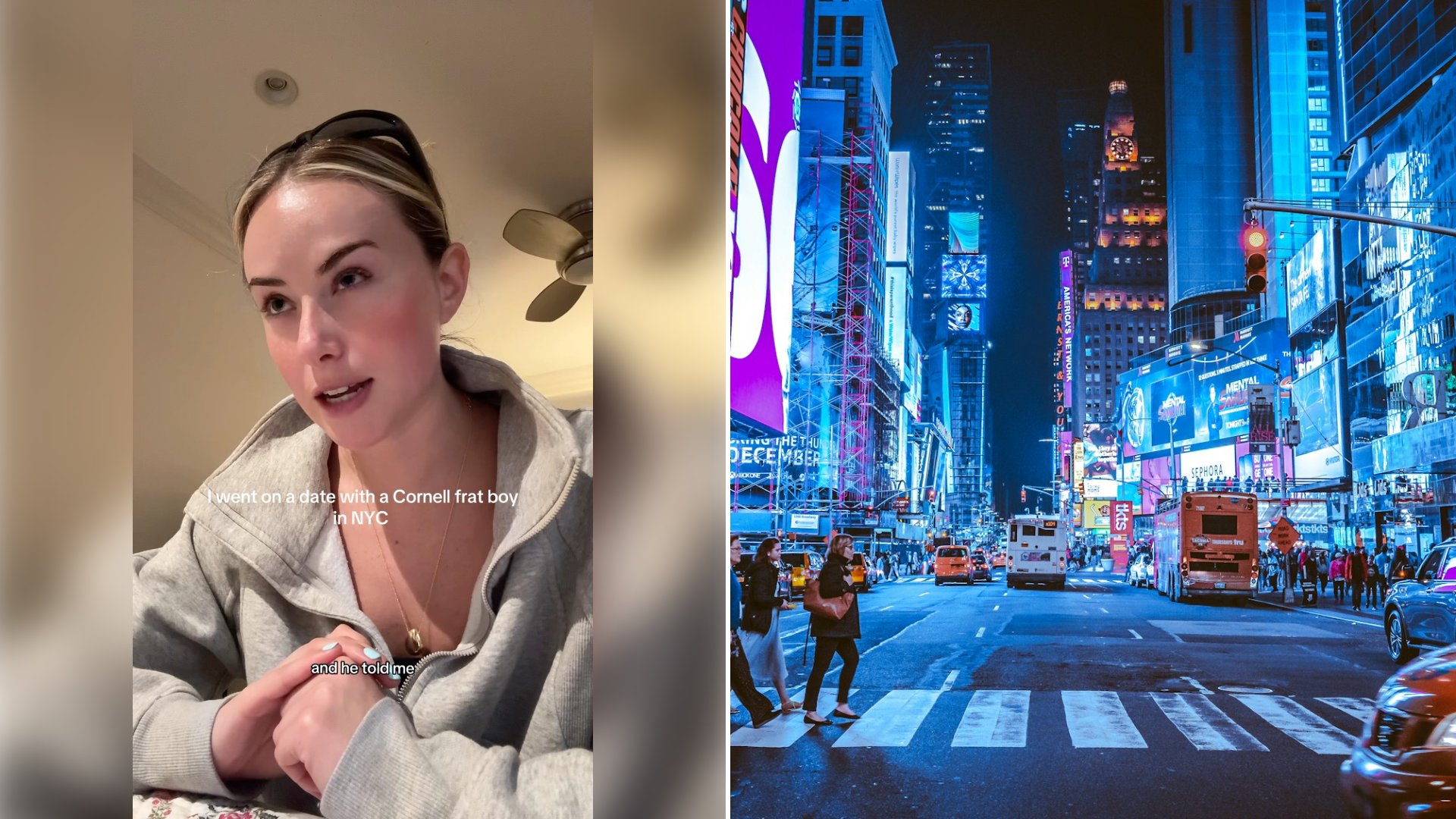
@soudersam posts a 56 second video in a gray zip hoodie with sunglasses pushed up in her hair, and everything she says arrives as burned in captions. A line stays on screen from start to finish: “I went on a date with a Cornell frat boy in NYC.” The post is tagged New York, New York, and its caption is four words: “Put them all behind bars.”
The first caption is “And speaking of the Cornell Seven,” and she then says the date was “a few months ago.” What she describes is her own evening, told entirely from her side.
According to her captions, the man told her something “in their frat” that was “not related to a woman” and was “so vile that I was like, as soon as he said it, I will never see this person again.” She keeps the details to herself. The only specific she gives is “it was involving baked goods,” followed by a line that she can say no more than that. Her verdict on it is plain: “but it was disgusting and alarming.”
Then comes the part she says made it worse. “I cannot believe” it “was a good idea,” she says, “let alone on a first date, if you’re telling me this.” She adds that she does not know what else “they were doing.” Her last captions turn to the date itself: “he also was really creepy,” and “I had to ask him to stop touching me like three or four times on a first date.” The video ends there, with no outcome and no reply from the man, who is never named or shown. Everything above is her account.
For anyone planning a first date, or helping a friend plan one, the options for what to do afterward are laid out publicly. Cornell’s Title IX office says anyone can report online, including anonymously (faculty and staff who are designated reporters are the exception), and that you can report to police and to the university at the same time. It also says you have the right to make a police report or to choose not to, and it lists confidential resources, including Cornell Health and the Victim Advocacy Program, whose conversations are kept private except in rare cases. Those pages are written for the Cornell community, but they show the general shape of the choices: report to the institution, report to police, talk to a confidential advocate, or do none of those for now.
A few practical habits follow from what she describes. Meet in a public place and arrange your own way home. Tell a friend where you are and when you will check in. Treat a comment that alarms you as information, which is what her captions say she did when she decided on the spot never to see him again. And if a date keeps touching you after you have asked him to stop, you are not required to give him a fourth request, a fifth or a polite exit.
More from Cultivated Comfort
- Content Creator Describes an Accidental Date With a Sushi Chef During a Solo Dinner in Tokyo, Then Her Own Comment Reply Draws More Attention Than the Video
- Woman Says Her Boyfriend Gave Her an Ultimatum Over Her Social Media Account, Then Wrote Guess He Got His Answer After She Refused to Give It Up
- Man Who Moved Across the World to Start a New Life in New York Says He Was Broken Up With Two Hours After He Arrived, Then Talks It Through From His Fire Escape