Allison Wilcox walked into an emergency room thrilled to be newly pregnant and walked out believing she had lost her baby. Over the next eight months, she rode a medical roller coaster that included a staggering 36 ultrasounds and repeated warnings that her pregnancy was not viable. Instead of a tragic ending, she eventually delivered a healthy child her family now calls a miracle.
Her story is not a feel‑good fairy tale so much as a messy, human account of fear, persistence, and the limits of medical certainty. It also sits alongside other parents’ experiences of “impossible” babies, from fragile preemies to children born after devastating diagnoses, that quietly challenge how we talk about risk and hope in pregnancy.
The terrifying start: bleeding, ER visits and a bleak verdict
The trouble began almost as soon as Allison Wilcox saw a positive test. The day after she learned she was pregnant, she started experiencing heavy bleeding that felt less like a minor scare and more like a full‑blown emergency. At the hospital, staff treated the situation as a likely loss, and she later recalled an ER doctor telling her that “at this point, miscarriage is the best outcome,” a line that landed like a door slamming shut on the future she had just started to imagine with her husband. That early verdict shaped everything that followed, because it framed her pregnancy as something dangerous rather than fragile but possible, and it left the couple trying to process grief and fear at the same time.
Even as the bleeding continued, Allison Wilcox did not immediately accept that her story was over. Follow‑up care focused on the assumption that she was “having” a miscarriage, and she was told more than once that the pregnancy was not progressing the way it should. In detailed accounts of those early days, she and her husband are described sitting through scan after scan while clinicians explained that the odds were stacked against them, and that any heartbeat, if it appeared at all, might be fleeting. The emotional whiplash of being newly pregnant one day and then hearing that “miscarriage is the best outcome” the next is captured in reporting that centers Allison Wilcox and her husband trying to absorb that blow while still clinging to the possibility that the doctors might be wrong.
Refusing to accept the loss and chasing answers across Colorado
Plenty of people in Allison’s position would have gone home, mourned quietly and tried to move on. She did something else. Refusing to accept the diagnosis, she started seeking out second and third opinions, driving to different clinics across Colorado in search of someone who could tell her, with certainty, whether there was still a baby to fight for. That determination was not blind denial so much as a gut‑level sense that the story did not quite add up, especially as her symptoms shifted and small signs of progress appeared. Her persistence is described as a turning point, the moment when she stopped being a passive recipient of bad news and became an active advocate for her own pregnancy.
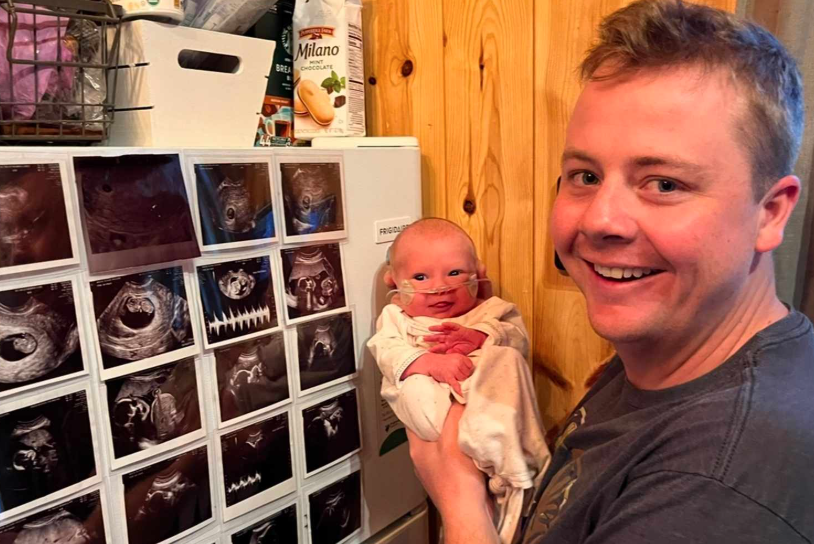
That advocacy came with a serious emotional and financial price tag. Over the course of the pregnancy, Wilcox went through a total of 36 scans as she bounced between providers, each ultrasound a fresh opportunity for hope or heartbreak. One detailed account notes that she and her husband kept every printout, even when the images were ambiguous, and at one point they taped an early ultrasound photo to their fridge as a quiet act of faith that there was still a baby in there worth celebrating. That detail appears in coverage that describes how Allison Wilcox and tried to build a sense of normalcy around a pregnancy that doctors kept telling them was already over.
Thirty‑six ultrasounds, a worrying yolk sac and a heartbeat that changed everything
As the weeks ticked by, the scans piled up. One report bluntly sums it up with the phrase “Woman Gets 36 Ultrasounds After Doctors Insist She’s Having a Miscarriage. 8 Months Later, Gives Birth to ‘Miracle’ Baby,” a line that captures both the sheer volume of imaging and the stubbornness of the original diagnosis. The number is not an exaggeration: she really did undergo 36 separate ultrasounds, each one meant to confirm a loss that never quite materialized. At one point, the yolk sac on the screen appeared unusually large, a classic red flag that can signal a failing pregnancy, and clinicians warned her that this was yet another sign things were going in the wrong direction.
Then came the moment that shifted the narrative. During one of those many appointments, a technician finally picked up a clear fetal heartbeat, a sound that instantly reframed all the previous scans. The same coverage that notes the enlarged yolk sac also points out that the heartbeat marked a major milestone, proof that the embryo was still fighting despite everything. That detail is laid out in reporting that describes how, even with that reassuring rhythm on the monitor, doctors remained cautious because of the earlier findings. The tension between those two facts, the worrying sac and the strong heartbeat, is captured in accounts that highlight how Allison Wi was told to brace for the worst even as she listened to the most hopeful sound in the world.
The long wait to delivery and the baby everyone called a miracle
From that point on, the pregnancy became a high‑alert waiting game. Allison Wilcox kept going back for more imaging, more bloodwork, more conversations about what might go wrong. The phrase “NEED TO KNOW” appears in one summary of her case, followed by a bullet‑point list that starts with the heavy bleeding and moves through the repeated warnings she received. Another key word in that same rundown is “Despite,” a nod to the fact that, despite so many red flags, the baby kept growing. Those details are laid out in coverage that introduces NEED and KNOW as shorthand for the key beats of her story and emphasizes how Despite everything, she kept showing up for the next appointment.
By the time she reached the third trimester, the tone around her care had shifted from “this will probably end” to “we need to be ready for anything.” Earlier reporting notes that she had been told flatly that she had miscarried, yet eight months after that first ER visit she delivered a living, breathing baby that staff and family alike quickly labeled a “miracle.” One detailed feature describes how Refusing to give up had carried Wilcox through months of anxiety, and another notes that her journey involved zigzagging across Colorado in search of reassurance. The same narrative is echoed in coverage that frames the whole saga under the banner “Woman Gets 36 Ultrasounds After Doctors Insist She’s Having a Miscarriage. 8 Months Later, Gives Birth to ‘Miracle’ Baby,” underscoring how Months Later she finally heard the first cry she had been told would never come.
Other “impossible” babies and what parents take from stories like this
Allison’s experience is striking, but it is not the only story of a baby who arrived after experts warned there was little hope. In the United Kingdom, parents of a boy named Oakley have spoken publicly about being told during pregnancy that their child might not survive, only to welcome him and watch him grow. A local feature invites readers to “Meet gorgeous little miracle baby Oakley,” explaining that he arrived after his mum, Meet the little boy whose story has become a touchstone for other families facing grim prenatal predictions. That same coverage highlights Oakley and his mum, Hannah Cole, as another example of a family who heard the worst and still ended up celebrating a first Christmas together.
More from Cultivated Comfort:
- 7 Retro Home Features That Builders Should Bring Back
- 7 Antique Finds That Are Surprisingly Valuable Today
- 7 Forgotten Vacation Spots Your Parents Probably Loved
- 6 Boomer China Patterns That Are Selling Like Crazy Online

As a mom of three busy boys, I know how chaotic life can get — but I’ve learned that it’s possible to create a beautiful, cozy home even with kids running around. That’s why I started Cultivated Comfort — to share practical tips, simple systems, and a little encouragement for parents like me who want to make their home feel warm, inviting, and effortlessly stylish. Whether it’s managing toy chaos, streamlining everyday routines, or finding little moments of calm, I’m here to help you simplify your space and create a sense of comfort.
But home is just part of the story. I’m also passionate about seeing the world and creating beautiful meals to share with the people I love. Through Cultivated Comfort, I share my journey of balancing motherhood with building a home that feels rich and peaceful — and finding joy in exploring new places and flavors along the way.