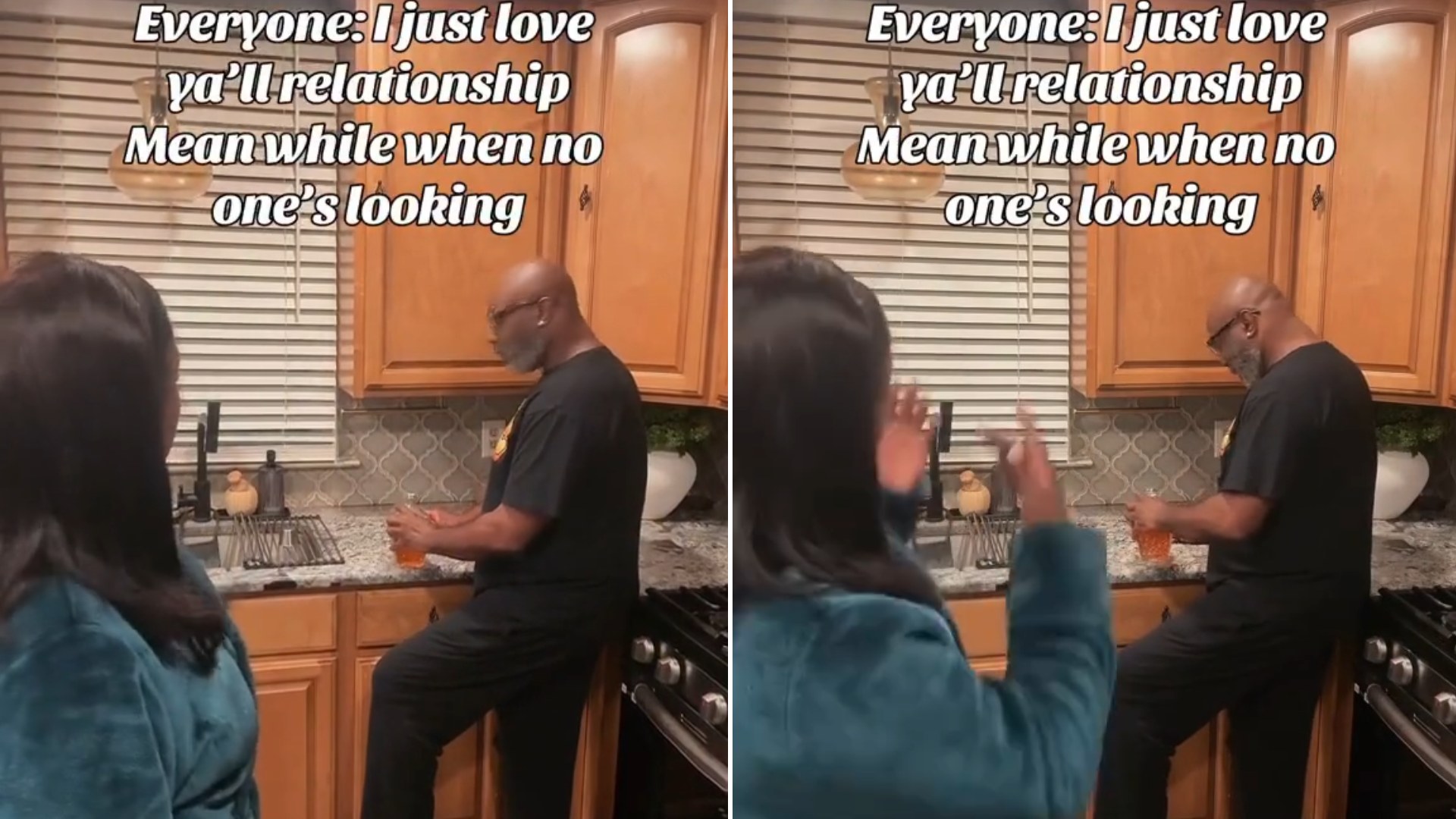
Marriage gets dramatized online constantly, usually toward one of two extremes: either it’s presented as an endless honeymoon of surprise dates and matching outfits, or it’s played for chaos, all shouting and slammed cabinet doors. Creator danaevette_ found the gap between those two versions and built a sketch out of it. The setup is simple — a kitchen, a couple, and the gulf between what married life is supposed to look like and what it actually looks like on a random weeknight. Her own caption sums up the premise plainly: “Married couple comedic sketch, perception vs reality,” she wrote on her Instagram reel, which has reached an audience well beyond her 1,500 followers.
A Small Account With an Outsized Reaction
Fifteen hundred followers is not a large number by the standards of couples content, where accounts with six- and seven-figure followings dominate the conversation. Yet the reaction to this particular sketch suggests the size of an account has very little to do with how far a piece of relatable content can travel. A well-observed bit about a shared kitchen doesn’t need a large built-in audience to find one; it just needs to be accurate enough that people feel compelled to send it to their own spouse.

Why “Expectation Versus Reality” Works So Well for Marriage
The expectation-versus-reality structure isn’t new, but it’s particularly well suited to married life because so much of the genre marketed around marriage — engagement announcements, anniversary reels, curated date nights — sells the expectation half of the equation almost exclusively. A kitchen skit that flips to the reality side, where dinner plans dissolve into leftovers and a “romantic” evening becomes two people silently scrolling their phones a few feet apart, fills in the part of the story most couples content leaves out. Audiences recognize that gap because they live in it too, which is exactly what makes the format land as comedy instead of complaint.
Timing plays a role as well. A sketch built around a specific, mundane moment — the kind of exchange that happens in real kitchens on real weeknights — reads as observed rather than invented. Viewers aren’t laughing at an exaggerated scenario; they’re laughing because the scene is uncomfortably close to something that happened in their own house last week.
How a Small Account Gets Shared Wider Than Its Following
Reach for content like this rarely comes from the follower count on the original account. It comes from the share button. A viewer who sees their own marriage reflected in a sketch is far more likely to forward it directly to a spouse or a group chat than to simply like it and scroll on, and that kind of person-to-person sharing can carry a video well past whatever audience the creator started with. Recommendation feeds on platforms like Instagram are built to notice that pattern, too, surfacing a clip to strangers once enough people engage with it in ways that look like genuine recognition rather than passive viewing. A sketch doesn’t need a following to travel under those conditions; it needs a moment specific enough that people feel implicated by it.
Relatable Beats Polished, More Often Than Not
High-production couples content has its place, but it also carries a built-in distance: viewers can admire the lighting and the editing while still feeling like spectators. A smaller account working with a phone camera and a real kitchen doesn’t have that barrier. There’s less to suggest a performance is happening, so the humor reads as documentation rather than dramatization. That’s a meaningful advantage for accounts without a large production budget, because the thing that makes a marriage sketch land isn’t polish — it’s the small detail that gets the moment exactly right.
There’s a trust factor at play as well. Audiences have grown accustomed to distinguishing between content built by a team and content built by two people who happen to be married in real life. The latter carries an implicit credibility the former has to work much harder to manufacture, since viewers assume a smaller creator has less incentive, and less capacity, to exaggerate a bit purely for engagement.
What a Kitchen Skit Can Say About a Marriage
Comedy about married life tends to succeed less when it’s aspirational and more when it’s specific. Danaevette_’s sketch works because it isn’t trying to sell an idealized version of a relationship; it’s naming the ordinary friction that comes with sharing a life, and doing it with enough affection that the joke never curdles into complaint. That’s a harder balance to strike than it looks, and it’s probably why a sketch from a fifteen-hundred-follower account is resonating with an audience many times that size. Accuracy, it turns out, is its own kind of production value.