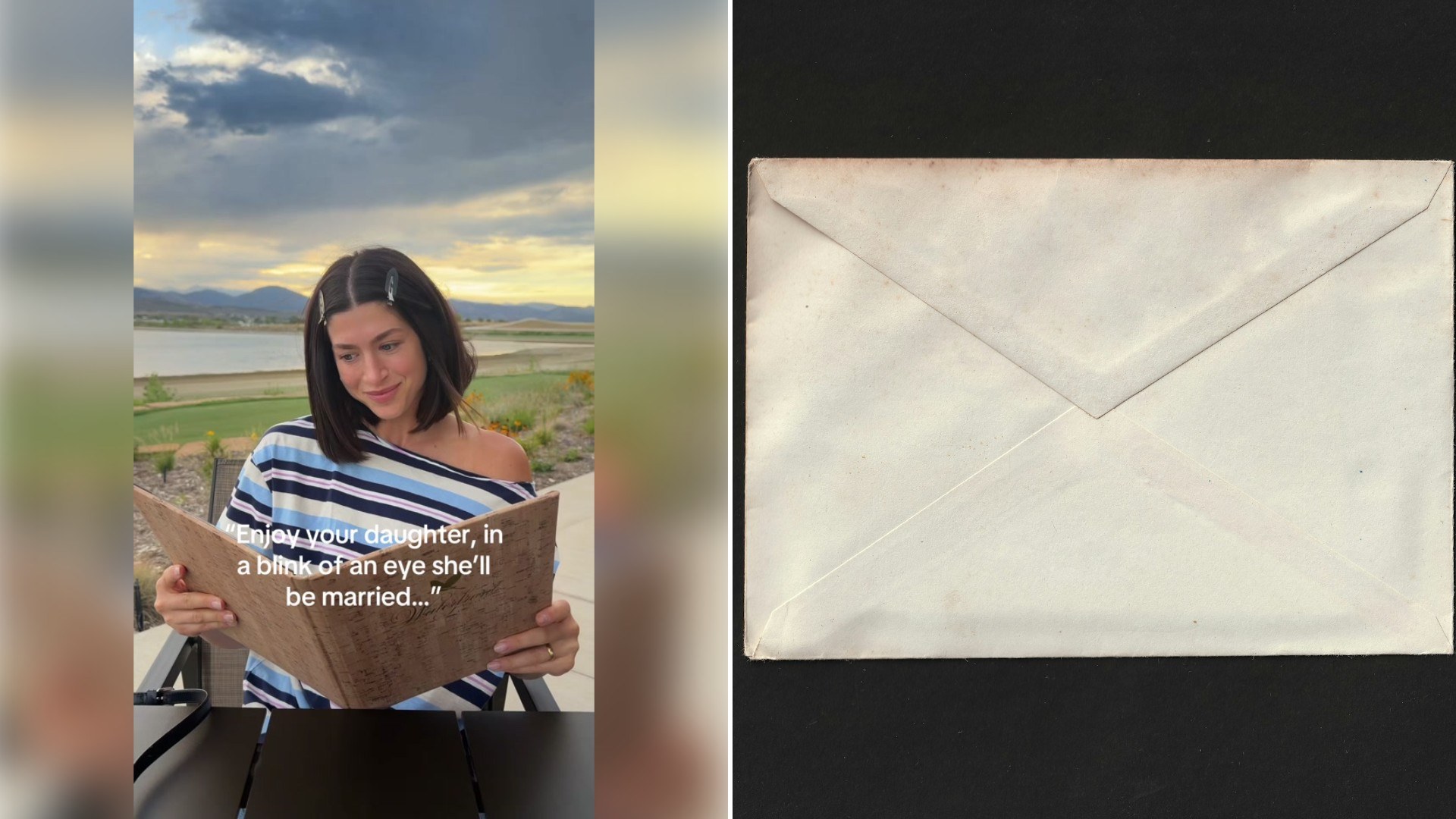
Cards from parents have a way of landing with far more emotional force than their size would suggest, and one young woman’s reaction to a note from hers proves exactly that.
The creator, @itskatesteinberg, opens a card from her parents on camera that reads less like a casual note and more like a warning about how fast time passes before a daughter ends up married and starting a life of her own. The message catches her completely off guard, and she breaks down in tears reading it. She turns the camera to show her parents, who immediately begin singing to her, turning what started as a quiet, private moment into a shared family one.
@itskatesteinbergThose blinks were personal
There’s a specific kind of card that manages to be loving and slightly heartbreaking at the same time, the kind that reminds a parent and child both that the current chapter of closeness has a natural expiration point built in. A note about blinking and suddenly losing a daughter to marriage isn’t really about marriage at all; it’s about time, and about the particular grief parents carry even while celebrating their child’s future.
It’s worth naming exactly what makes a message like this one so disarming. Most cards from parents to adult children lean on familiar, comfortable sentiments, pride, love, encouragement. A line about blinking and suddenly finding a daughter married reroutes that expectation entirely, trading comfort for a kind of bittersweet honesty that most families reserve for private conversations, if they voice it at all. Parents often spend years quietly rehearsing how they feel about a child growing up and eventually leaving to build a life elsewhere, and a card is one of the few socially acceptable places to actually put that feeling into words rather than keeping it tucked away for fear of sounding sentimental at the wrong moment.
The specific metaphor of blinking captures something true about how parents tend to experience their children’s growth, not as a slow, steady process they watch unfold day by day, but as a series of jarring realizations that time has moved faster than expected. One day a child is small enough to carry, and the next, seemingly without any of the intervening years actually registering, that same child is old enough to be planning a wedding of her own. That compression of decades into a single blink is exactly the kind of sentiment that tends to catch a reader off guard, precisely because it’s true in a way most people rarely stop to articulate.
Family therapists who study parent-child relationships during major life transitions often point out that milestones like this tend to surface emotions that had been sitting quietly in the background for years, unspoken until a card, a song, or a single sentence gives them somewhere to go. The tears in this video aren’t really about the specific words on the page; they’re about everything those words managed to compress into one unexpected moment. A card like this one functions almost like a pressure release valve, giving an entire family permission to feel something openly that they might otherwise have kept to themselves out of habit or a reluctance to make a moment feel too heavy.
The decision to turn the camera toward her parents right as they break into song adds another layer worth noting. A video that stopped at the tears alone would already be moving, but incomplete; showing the parents’ own immediate reaction, choosing to sing rather than simply watch her cry, reveals something about how this particular family processes big emotional moments together. Singing is, in its own way, a way of metabolizing a feeling that words alone can’t quite resolve, turning a moment that could have stayed uncomfortably raw into something the whole family can share and even find joy in.
Videos built around reading a card or letter out loud, rather than simply summarizing its contents, have become their own recognizable subgenre within family and milestone content, and it’s worth understanding why the format works as well as it does. Hearing the exact words, in the moment they’re first encountered, lets viewers experience the emotional arc in real time rather than secondhand. There’s no narration standing between the audience and the reaction; the vulnerability is immediate and unfiltered, which is precisely why a card-reading video tends to hit harder than a description of the same card ever could. The specificity of the wording matters too. A vague sentiment about being proud would barely register. A sentence built around blinking and losing a daughter to marriage is specific enough to feel like it was written just for her, which is exactly the quality that makes it devastating and moving in equal measure.
There’s also something worth saying about why this particular milestone, rather than a birthday or a graduation, tends to produce this specific flavor of emotional reckoning in parents. A wedding doesn’t just mark an accomplishment the way a diploma does; it marks a structural shift in the family itself, the formal beginning of a new household that, however close it remains, is no longer quite the same unit it was growing up. Parents who have spent decades as the primary anchor of a child’s life are, in a sense, handing some portion of that role to someone else, and a card like this one is one of the few places that transition gets named directly rather than simply absorbed quietly into the background of wedding planning logistics.
What could have stayed a private reading turned, by the video’s end, into a full family moment, singing included, which is probably exactly what a card like that one is meant to do, take a feeling too big and too specific for ordinary conversation and give the whole family a way to sit inside it together, if only for the length of one song.