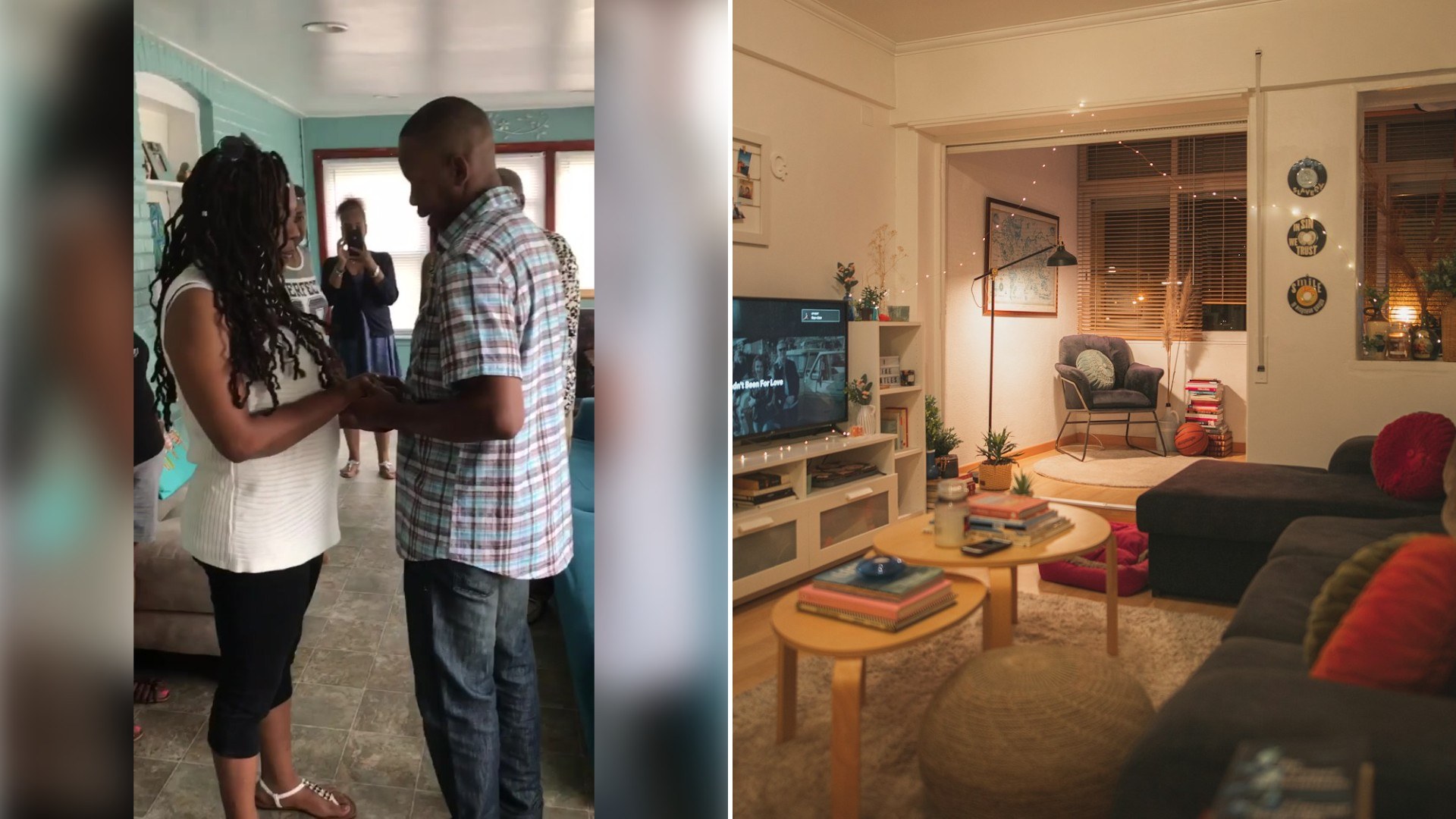
Living room proposals carry a specific kind of intimacy that a public venue can’t replicate, mostly because the only audience is the people who actually matter, crowded onto couches and doorways to watch it happen.
The creator, @trinityyjoy, shares a raw, unedited clip of her cousin proposing to his partner inside a family living room, surrounded by relatives who came specifically to witness it. She notes it’s a throwback to the moment, joking that her uncle, the father who apparently helped orchestrate the surprise, is “a true Cancer” given just how sentimental he made the entire thing. The candid family reaction is the real focus of the clip, more than the proposal itself.
@trinityyjoythrow back to when my cousin proposed to his wife 😭 my uncle is a true cancer lol.
Home proposals staged in front of extended family require a specific kind of coordination that a private, two-person moment doesn’t, getting relatives in the right room at the right time without tipping off the one person who isn’t supposed to know. Pulling that off successfully means everyone else in the house had to hold the secret together, often for weeks, just to make the reveal land.
It’s worth naming exactly how much has to go right logistically to get an entire extended family gathered in one living room without raising suspicion. Someone has to invent a plausible reason for a gathering, coordinate arrival times so nobody shows up too early and spoils the setup, and keep every relative, aunts, uncles, cousins, grandparents, disciplined enough not to slip and say something that gives the surprise away. A secret held between two people is hard enough to maintain. A secret held successfully across an entire extended family, all the way up until the exact right moment, requires a level of collective discipline that’s easy to take for granted watching the finished clip.
The choice to stage a proposal specifically inside the family home, rather than at a restaurant or a scenic outdoor location, says something notable about what this particular family values. A living room isn’t a backdrop chosen for its photogenic qualities; it’s chosen because it’s already saturated with meaning, the room where holidays happen, where the family actually lives its ordinary life together. Proposing there folds the engagement directly into the fabric of the family’s shared history rather than setting it apart as a separate, curated event, which likely explains why the reaction in the room reads as so unguarded and raw rather than performed for an audience.
Family therapists who study major milestone moments often note that group reactions, a room full of people gasping, crying, and cheering together, tend to produce a fundamentally different kind of memory than a private proposal does. The emotion isn’t contained to two people; it ripples outward through everyone watching, which is exactly the dynamic this living room clip captures. Watching a room full of relatives react in real time also does something a scripted, professionally filmed proposal video can’t replicate, since nobody in that room had time to compose themselves for the camera. Every gasp, every hand clapped over a mouth, every instinctive cheer happened before anyone had a chance to think about how it would look on video, which is precisely what gives the footage its unmistakable authenticity.
The detail about her uncle’s role, and the affectionate jab about his sentimentality, adds its own texture to the story. Every family has someone who takes on the emotional stage-managing of a moment like this, the person who insists on the right lighting, the right timing, the small sentimental touches that elevate a proposal from a simple gesture into a fully realized occasion. Being teased for that instinct, lovingly, by his own niece suggests it’s a known and appreciated trait within the family, the kind of running characteristic that gets affectionately referenced for years afterward whenever a big moment rolls around and he inevitably gets involved in engineering it.
There’s also something worth saying about the decision to label the clip a throwback rather than a freshly filmed moment. Revisiting and resharing older footage, well after the initial excitement of an engagement has settled, suggests the moment has only grown more meaningful with time, not less, the kind of memory that gets pulled back out specifically because it still holds up on rewatch. That impulse to return to a favorite family memory, rather than letting it fade into an old camera roll, mirrors exactly what family milestones are supposed to do: keep circulating, keep getting retold, keep mattering long after the actual moment has passed.
Videos like this one also resonate because they push back against the increasingly common, highly produced proposal genre, the drone shots, the professional photographers hidden in the bushes, the choreographed flash mobs. A raw, unedited clip filmed on someone’s phone in a crowded living room offers the opposite experience entirely, less a performance staged for an online audience and more a genuine family moment that happened to get recorded. That distinction matters to a lot of viewers who have grown a little fatigued by overly polished proposal content, and it’s likely part of why this particular clip found an audience well beyond the family’s own circle.
Whatever specific role her uncle played in orchestrating the sentimentality of the moment, the result, by his niece’s own account, was a proposal the whole family will be talking about for years, not just the couple at its center, a single living room moment that managed to fold an entire extended family’s joy into one shared, unscripted memory.