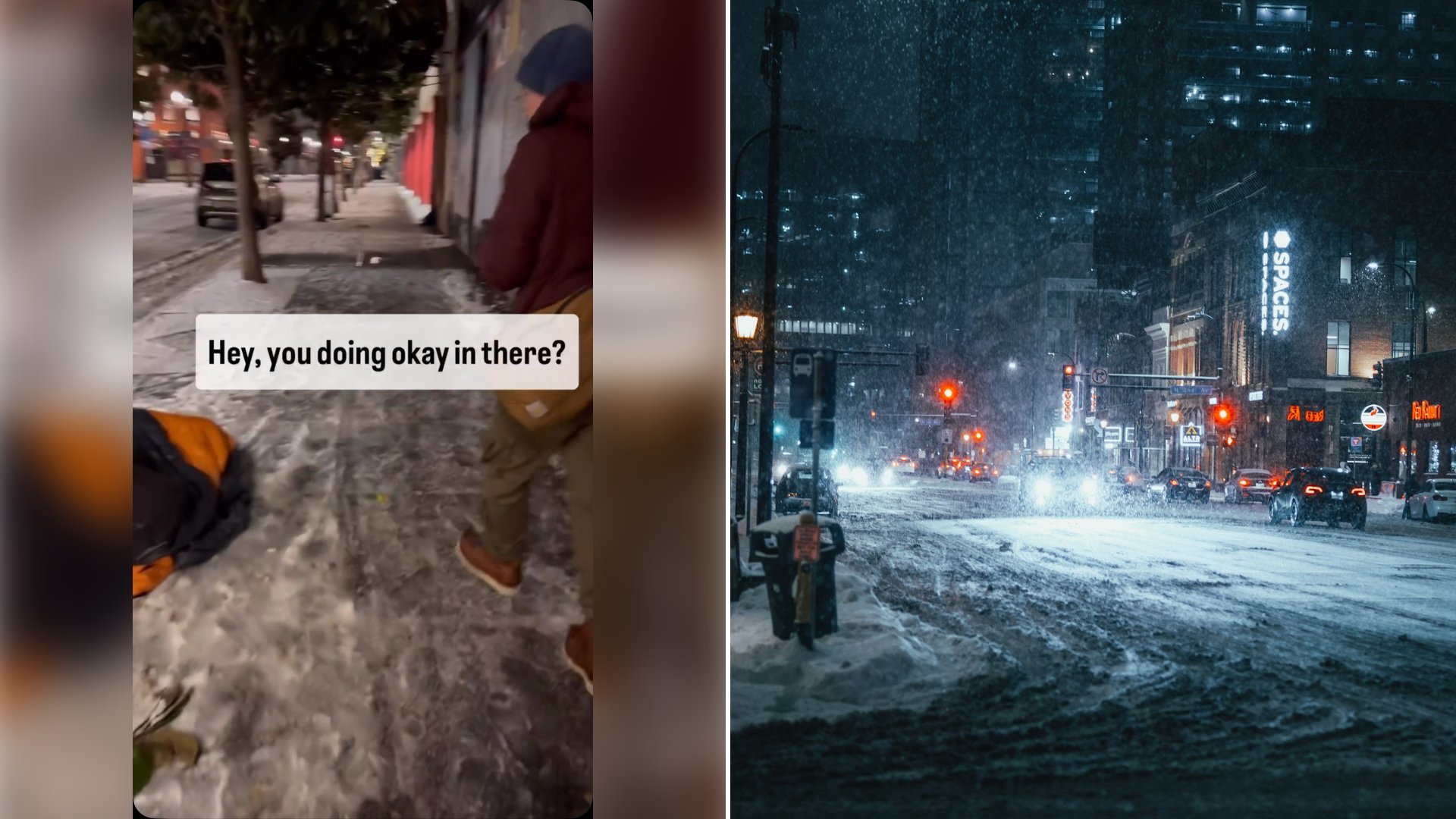
“Your sleeping bag is soaking.” That is one of the first lines on screen in a 2 minute 18 second clip posted on September 19, 2026 by @kevinvdahlgren, filmed at night on a snow covered sidewalk where a man is lying in a sleeping bag. The post is tagged Portland, Oregon, and the caption explains why he was out there: “I stayed the night on the coldest night of the year to check on people and to get them into a shelter.”
He opens the caption with a warning: “Winter is quickly approaching. Every year people freeze to death.” The clip itself is a single rescue from that night, start to finish, with every spoken line written out in captions at the bottom of the frame.
A woman working with him stands over the sleeping bag in boots and a heavy coat while the conversation plays out in captions: “We have some friends who can pick you up and drive you,” then “We’re really worried about…” and “Your sleeping bag is soaking.” Later the captions read “I know you’re going to sleep,” and that it would be “much better” inside, and then the plan: “So, we’re going to text him.”
The ride arrives in under a minute of footage. A minivan pulls up at the curb with its side door open, and the captions read “brother your van’s here” and “We’re going to transport you.” A second woman steps out with “Hey bud” and “We got space for you.” Someone tells him he will be “happier in about 20 minutes,” and the volunteers add, “We got some dry stuff for you too.”
He gets up off the snow, gathers his things and climbs into the van, with the captions reading “You can sit wherever you…” At the next stop, outside a building, the women explain what is waiting for him there: “And they’ll have a change of…” and “if you’re soaking wet.” The last frames follow him and one of the volunteers across the snow, under a lit entrance and toward the door.
Why a Wet Sleeping Bag Changes Everything
The detail the volunteers keep coming back to is the wet bag, and the U.S. Centers for Disease Control and Prevention explains why. According to the CDC, hypothermia can happen even at cool temperatures above 40°F if a person becomes chilled from rain, sweat or cold water. Its listed warning signs in adults are shivering, exhaustion or feeling very tired, confusion, fumbling hands, memory loss, slurred speech and drowsiness.
One commenter on the reel wrote that it is hard to be polite “when your body is using all of its capacity to prevent death from hypothermia.” The CDC’s list backs up the physical part of that: exhaustion, confusion and drowsiness are among the warning signs it names. The CDC’s first aid steps also match what the volunteers did. It says to get the person into a warm room or shelter and to remove any wet clothing, and to get medical attention immediately if the person’s temperature is below 95°F.
The post is tagged Portland, and Multnomah County’s cold weather page, which covers shelter in Portland, spells out when the county’s severe weather shelters open. They open as needed when, for at least four hours between 8 p.m. and 7 a.m., the forecast calls for a temperature of 25°F or below; a temperature at or below 32°F with an inch or more of rain and sustained winds above 10 mph overnight; or an inch or more of snow over 24 hours. The county directs anyone looking for cold weather resources to call 211, and its page says people seeking shelter in Portland can call 311 between 7 a.m. and 8 p.m.
Another commenter raised a different concern: whether the man agreed to be filmed and posted, and whether help can be given while protecting a person’s dignity by not filming them at their hardest moment. That is a fair question for anyone thinking of doing this themselves, and it shapes the steps below.
If You Pass Someone Outside on a Freezing Night
Check first, from a respectful distance. Speak to the person and look for the CDC’s warning signs: shivering, confusion, slurred speech, fumbling hands or heavy drowsiness. If the person is unsheltered and their life appears to be in danger, Multnomah County’s guidance is to call 911.
If it is not an emergency, use the local line. In Multnomah County, the county’s page lists 503 823 3333 as the non emergency number for requesting a welfare check, especially for someone who is not dressed for the weather, and 211 for cold weather resources. In other places, look up your own county’s cold weather page before the first freeze and save the numbers in your phone.
Have transport lined up before you approach anyone. The rescue in this clip worked because the volunteers could text friends with a van and tell the man, within minutes, “We’re going to transport you.” An offer of shelter is much easier to accept when the ride is already on its way.
Carry dry layers. Socks, a dry blanket or a change of clothes answer the exact problem in this video, a soaking sleeping bag, and the CDC lists removing wet clothing as one of the first steps.
Ask before you film, or do not film at all. If you want to share what you saw to encourage others, the story can be told without a stranger’s face in it.
More from Cultivated Comfort
- Woman Flying American Airlines Days After Her Marriage Ended Says a Flight Attendant Asked if She Needed a Hug, Then Came Back With a Tray, a Cup and Whiskey
- Solo Hikers on Remote Trails Usually Turn Up Within a Day or Two If Something Goes Wrong, but One Seventy Year Old Man Was Not Found Alive Until Eleven Days after Vanishing
- Man Lives Through a Flash Flood in Nepal, Then Offers Context and Safety Reassurance to His Worried Followers Back Home About the Disaster