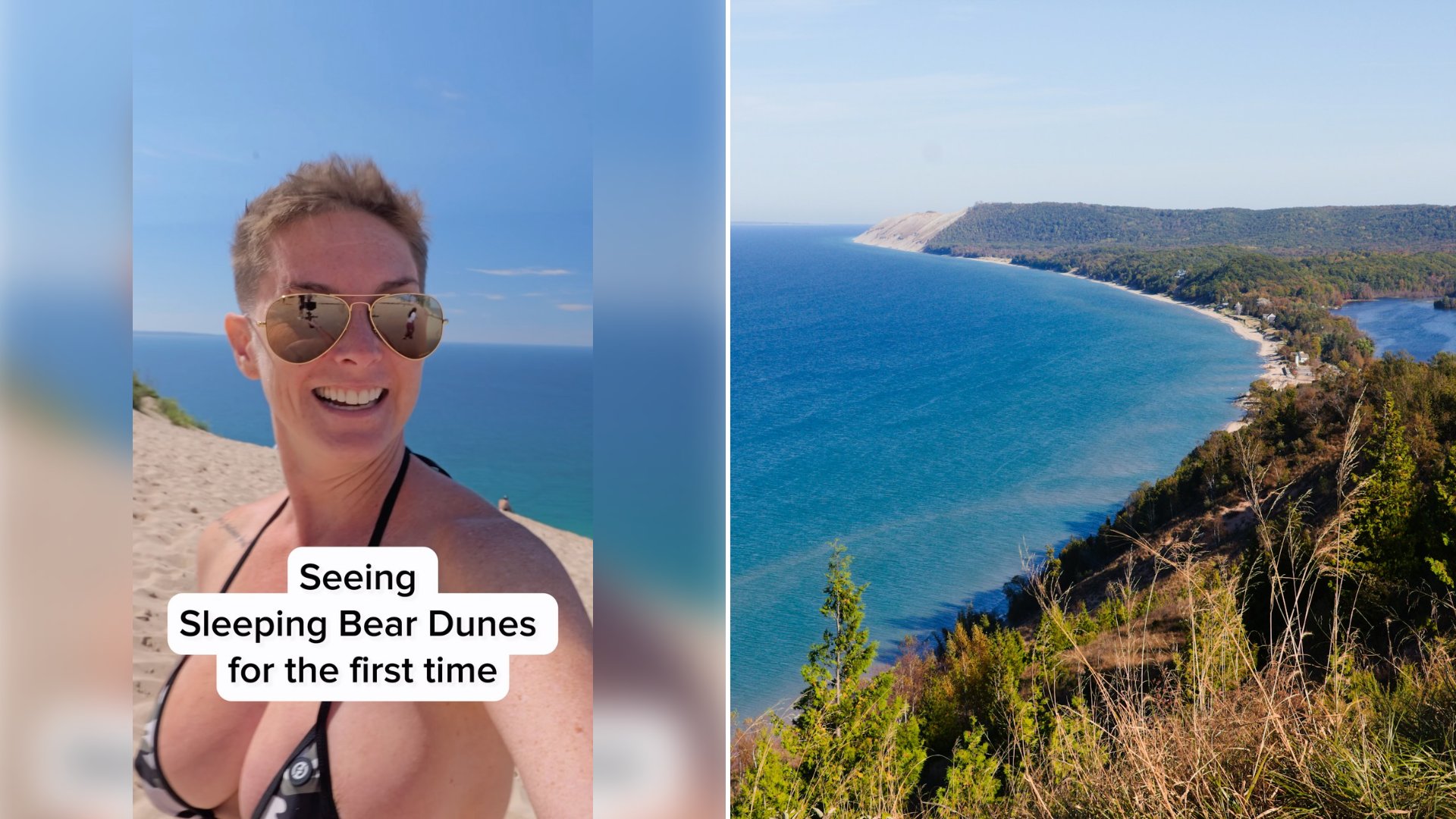
@wanderingrvbabe films the whole reel at arm’s length on the face of a dune, with a deep blue sky behind her and Lake Michigan filling the horizon. A white caption box on screen reads “Seeing Sleeping Bear Dunes for the first time,” and it stays up for the opening six seconds while she smiles into the lens in sunglasses. The post’s caption is short: “It really is THAT epic!” Its hashtags include #sleepingbeardunes, #nationalparks and #traveldiaries.
The video runs about 25 seconds. After the opening selfie she turns her head toward the slope. Visitors in red shirts are scattered down the sand, and a few trees stand on a ridge above them.
Around the 14 second mark she swings the phone away from her face and the picture becomes sand, a small figure standing on the dune, and a band of bright turquoise water under a pale blue sky. She turns the camera back to herself, raises a hand to her face, then pans to the lake once more before the clip ends. There is no map, no trail name and no on screen address, so the video itself does not say which part of the park she is standing in.
The National Park Service describes the place she is naming. Sleeping Bear Dunes National Lakeshore lists its tallest dune at 450 feet and its size at 71,199 acres, and gives October 20, 1970 as its founding date. The agency says the park gets more than 1,600,000 visitors per year, which is a lower bound and not an exact count.
The park’s own guidance also covers the thing the video shows, a steep sand slope. The Park Service says steep slopes can collapse, especially in winter and early spring, and tells visitors to stay on marked trails with blue or green topped posts and to avoid ridge tops and steep sandy slopes. It says hot sand can cause severe burns on feet, so visitors should wear footwear, and recommends at least two liters of water per person. It adds that cell coverage in the dunes is unreliable, so visitors should go with a buddy and tell someone their plans.
The Park Service also warns about the walk to the lake. The Dune Climb is about 2 miles from Lake Michigan, and the Dunes Trail round trip is about 3.5 miles and takes 3 to 4 hours, according to the agency’s Dune Climb page. The same page says hiking in the dunes can be disorienting. Its advice is to agree on a plan before splitting up and to follow the marked posts.
More from Cultivated Comfort
- Man Walks Up to a Stranger on the Great Wall of China and Tries to Ask Her Out on the Spot
- Woman Tries to Be Kind to Nature While Traveling and Instead Gets Ambushed by a Wasp Nest She Had No Idea Was There
- Client Asks Her Hairstylist to Braid an AirTag Into Her Hair Before a Solo Trip and the Reaction Says It All