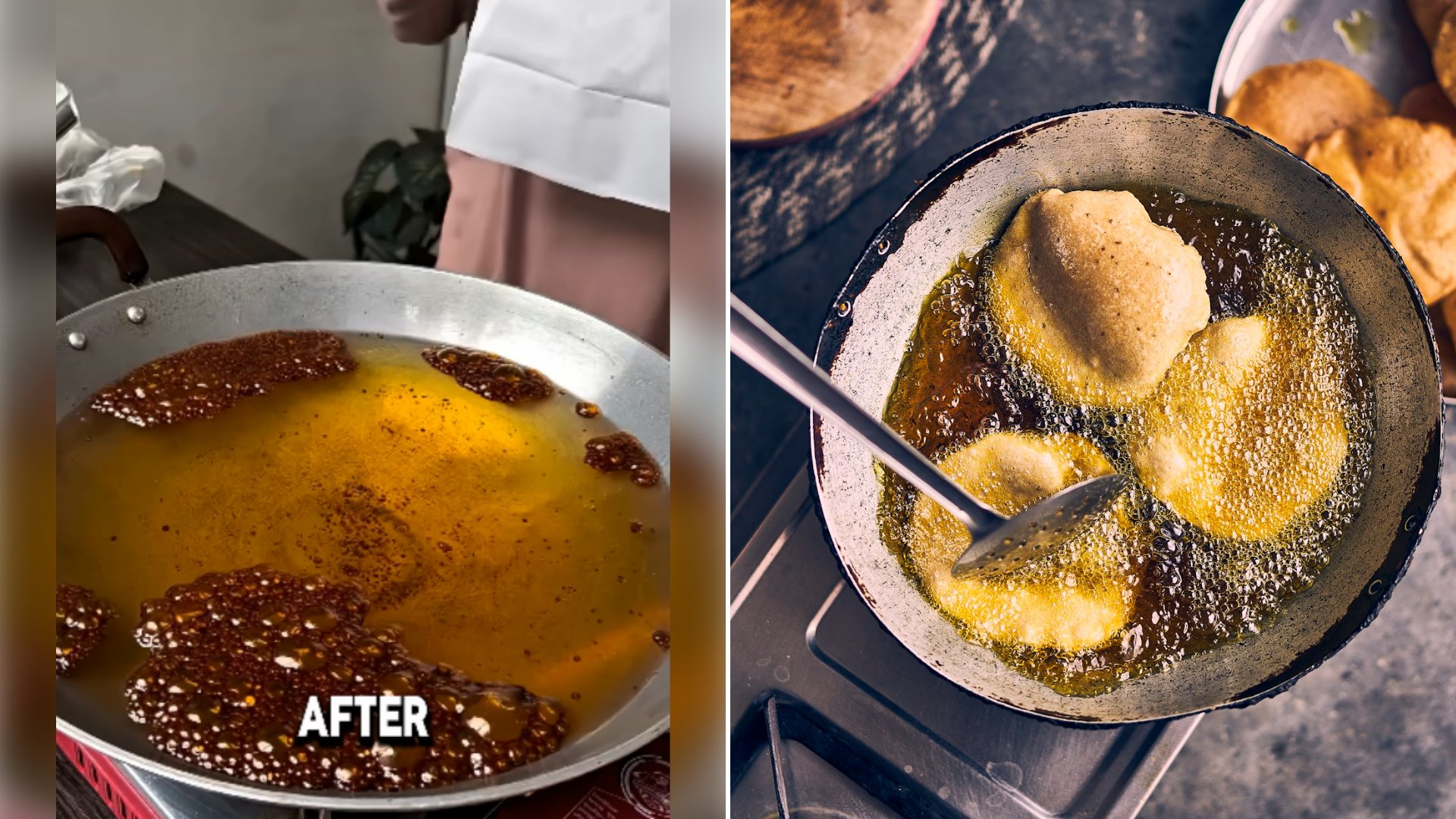
A wide pan of used frying oil, dark with burnt bits, is where a 21 second TikTok from @bonfyp, an account named BON, begins. Its caption reads “The Trick to Reuse Cooking Oil,” and a narrator, whose words appear as captions on screen, lays out the problem: “After cooking, when oil becomes dirty, most people usually remove the floating residue with tissue paper, but this doesn’t completely clean the impurities inside the oil.”
The first few seconds show exactly that. A hand lays a sheet of paper towel on the surface, the burnt crumbs stick to it, and the sheet comes up stained dark brown, leaving the oil underneath still cloudy with specks. Then the narrator introduces the alternative: “In Japan, people first mix cornstarch and vinegar into the dirty oil.” That attribution is the narrator’s. The video does not show who first used the method or where.
The footage changes here to a second pan and a different hand. A clear plastic jar of milky white liquid is tipped over the pan and poured across the dark layer of crumbs. The captions name cornstarch and vinegar together, but the jar is the only thing shown being poured, so the video does not show the vinegar on its own or any measurements.
What follows is the satisfying part. A wooden spoon stirs the pour into the oil, and the crumbs begin to clump together. “All the impurities gather together and harden into one clump,” the narrator says. By the end of the stirring, the spoon lifts a single large, dark mass out of the pan, dripping at the edge, and the oil left behind is a clear amber color. The last frames show a slotted spoon skimming across the surface. “This process helps clean the oil, making it usable again,” the narrator concludes.
The clean amber color is the video’s only proof. It does not show the oil being used to cook again, and clear oil is not the same as safe oil, which is where outside guidance matters.
The U.S. Department of Agriculture’s Food Safety and Inspection Service covers reuse in its deep fat frying guidance. It says oil you plan to reuse should be strained through a cheesecloth or sieve, stored in a sealed, light proof container for up to three months, and refrigerated for the best quality. It also says to throw the oil out if it is clouded, foams, or has a foul odor, taste or smell. Its advice is about straining, storage and checking the oil, and it does not describe a cornstarch method.
So the fair way to use this clip is as a first step, not a finish. After lifting out the clump, strain the oil as the agency advises, let it cool, and store it sealed. Then judge it by the signs the agency lists before every reuse. If it is cloudy, foams in the pan or smells off, the clean amber color in the video will not change that, and the oil should go.
More from Cultivated Comfort
- Content Creator Pairs an Engineer Known for Science Experiments With a Chef to Test a Watermelon Peeling Technique, Then Viewers Argue Over the Knife Work
- Woman Says Her Czech Grandmother Cooked Onions Low for Ten Minutes, Finished Soup With Vinegar and Kept Noodles Out of the Pot, Habits She Lists in One Short Reel Caption
- Son Shows Off the Homecoming Feast His Mom Cooks From Scratch With Steak, Glazed Chicken, Seafood, Mac and Cheese, Biscuits and Cake Every Time He Comes Home