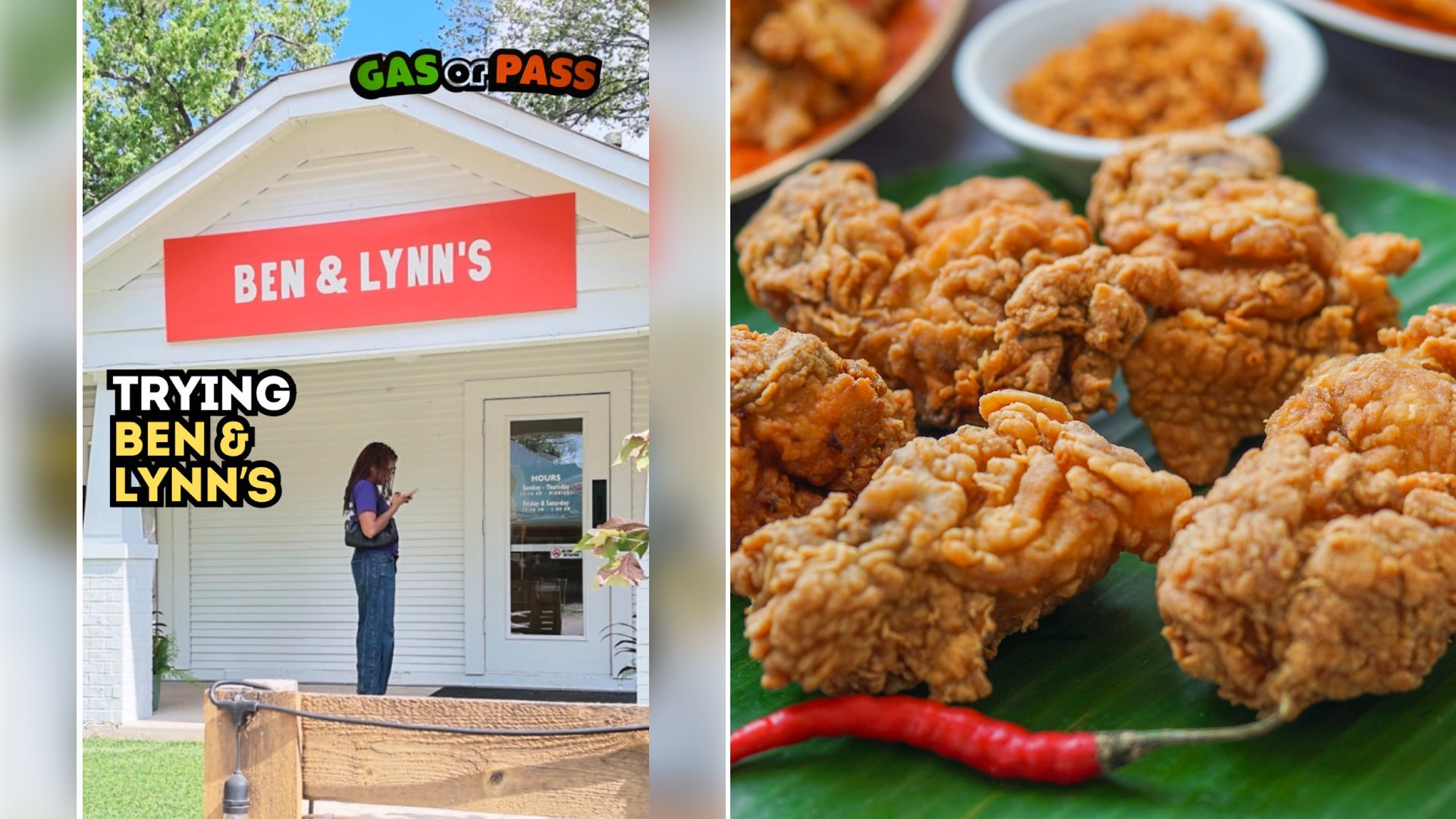
The TikTok from @bwoodcooks opens with a screen recording of a celebrity chef’s online channel, then cuts to the reviewer sitting in a parked car, wearing a bib that reads “You’re going to the grinder.” He explains the premise fast. The chef has opened a fried chicken restaurant in Austin, Texas, named after his parents, and the reviewer says he “drove three hours” to find out whether it is “gas or pass.” His caption gives the scale, with a score of 0 to 3 a pass, 4 to 7 a mid and 8 or higher gas.
The video runs a little over four minutes, and it is built as a tray by tray tasting. He tells the camera what he ordered and what each item cost. The signature chicken sandwich, which he got dipped, was $11.95. The restaurant’s nuggets were $10, sauces were $1.50 each and an order of fries was $3.95. A green on screen total reads $32.00. “Put in the comments how do y’all feel about those prices,” he says.
Then the fries. They arrive in a paper boat, and he likes the staging, saying the restaurant “could have put it in a fry box, but they put it in a boat. It makes it feel like it’s an elevated side.” The fries themselves are less of a hit. “I would probably give the fries a solid six,” he says. He later works out the point of them: they are lightly salted because they are meant to be dipped, so the sauce can be “the starter show.”
The nuggets get better marks for how they look. “They look like real fried battered chicken nuggets,” he says, not something processed, and the frames show craggy, golden pieces with a thick crust. The sauces are where he spends the most time. He calls the homemade ranch fresh and refreshing. The honey mustard “could be better” in his view because it is “more mustard than sweet.” The hot honey is “okay,” and then he tries the house secret sauce and goes quiet before declaring it so good that he does not care how long the review is taking.
The sandwich is a split decision. He notes that the bun is toasted and calls that “a major thing,” but then admits, “I don’t even want the sandwich. Just give me the chicken by itself with a side of ranch and that secret sauce.” His score for it is a 6 or a 7, and after a beat he settles on a 7. He also tried a vanilla ice cream finished with olive oil and sea salt and says it is better than he expected, comparing the taste to something an auntie made at home, and puts it between a 7 and an 8.
The final call comes at the very end. “If I had to rate this place in totality, I would give it a solid eight,” he says, and the last words are the answer to his own question about what an 8 means: “Gas.” That lines up with the scale in his caption, and it is a verdict from a single visit and a single reviewer’s taste.
A hot meal eaten in a car raises a practical question for anyone copying the idea. The U.S. Department of Agriculture’s Food Safety and Inspection Service says on its takeout food page that hot food should stay at 140 degrees Fahrenheit or above and that perishable food left out for more than two hours, or more than one hour when the air is above 90 degrees, should be discarded. For leftovers that contain meat or poultry, the page says to reheat them to at least 165 degrees, checked with a food thermometer.
More from Cultivated Comfort
- Woman Drives Six Hours From Ohio to North Carolina to Test Out a Rapper’s Chicken and Waffles Restaurant, Then Her Comment Section Argues Over Whether It Was Worth It
- Burger Restaurant Owner Surprises a Stranger With a Free Meal and Tells Them on Camera That He Owns the Place, Then Gets Asked to Do It Again
- Diner Trying Balkan Food for the First Time Finds One Man Running the Whole Plano Restaurant as Owner, Cook and Waiter, Then Leaves With Pralines and a $39.28 Receipt