Most toddlers want to know why the sky is blue. One little boy named Levi wants to know whether there is yeast in his bread, and then he wants to explain the answer to everyone else. His kitchen has become a classroom, and every meal is a lesson.
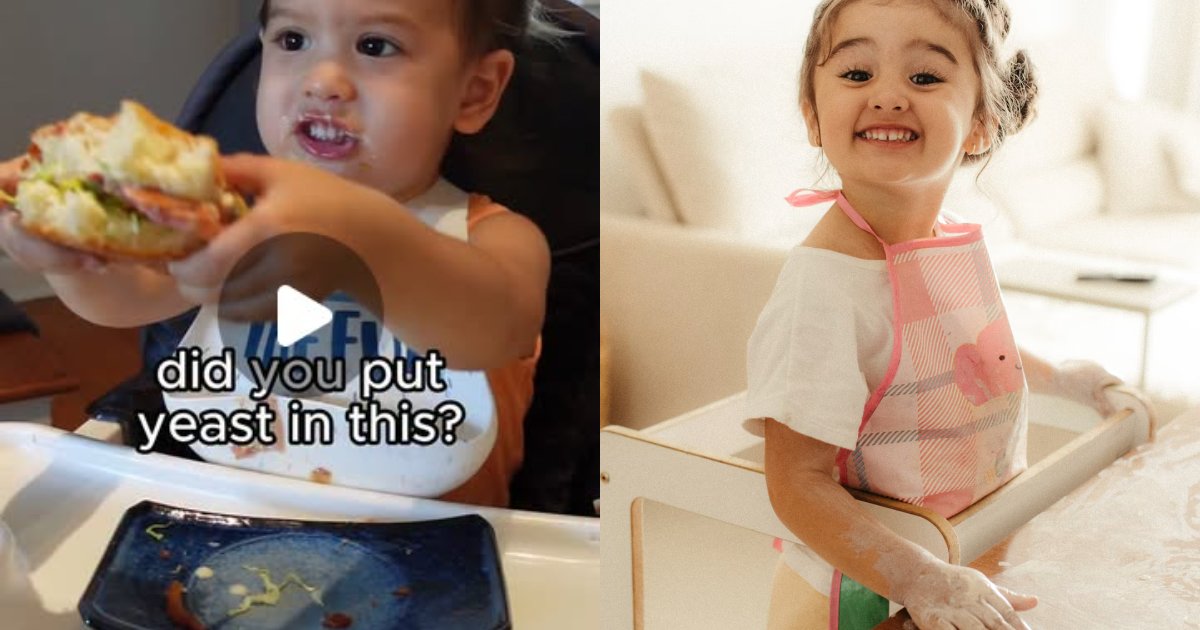
The family shares these moments through @cookingforlevi on Instagram, and this collection of kitchen conversations shows how curiosity can grow at the dinner table.
Bread, Bubbles and Thick Sauce
It begins with Levi in his high chair, eating bread and asking whether his dad put yeast in it. When dad says yes, Levi asks what would happen without it, and learns it would be unleavened bread. He then points out the small holes in the slice and announces that they are air bubbles.
At the stove, wearing a little apron, he watches his dad whisk a pot and hears that the sauce will get thicker and more concentrated as it cooks.
Kidney Beans and Crustaceans
At the table, he holds up a single bean from his plate of chicken and beans and asks if it looks like a kidney. His dad says that is exactly why it is called a kidney bean. Later, holding a cooked lobster claw over a bowl of pasta, Levi is asked what kind of animal a lobster is, and answers proudly, “Crustacean!”
Kelp, Salt and a Smart Guess
Father and son examine sheets of dried kelp, and the dad asks about the white powder on them. It is salt. Levi studies the pieces and reasons that the one with the most salt must have stayed in the sea longer.
Gravity, Math and Seafood Facts
While brushing egg wash onto unbaked buns, he is told to use the tip of the brush. When asked why the egg runs down the brush, he answers, “Gravity.” At another point, his mother asks why an apple turned pink, and he answers that it dyed.
He asks whether fish have teeth and whether they can bite people, and later declares that an octopus is a cephalopod and that a jellyfish is not actually a fish. When his dad checks the oil in a cast iron skillet with an infrared thermometer and says it is at 320 degrees, Levi correctly works out that it needs 30 more to hit 350. A plate of yellow noodles with shrimp ends the lessons, and Levi guesses turmeric.
Bring Curiosity Into Your Own Kitchen
- Ask open questions while you cook, such as why something changed color or what an ingredient does.
- Let little ones do real jobs, like brushing egg wash or slicing soft foods with supervision.
- Use numbers naturally, for example by counting how many degrees to go until the oil is ready.
- Connect foods to the world. A bean that looks like a kidney or kelp from the sea makes meals memorable.
- Celebrate guesses, even wrong ones, because reasoning is the real lesson.
The Science Hiding in Everyday Cooking
A kitchen is full of tiny experiments, and many of the facts that came up at this table have simple explanations worth knowing.
- Yeast is a living organism that feeds on sugars in dough and releases carbon dioxide gas. The gas gets trapped in the dough and creates the bubbles you see as holes in a baked slice.
- Sauces thicken as they simmer because water evaporates, leaving the flavors more concentrated.
- Lobsters, crabs and shrimp are crustaceans, animals with a hard outer shell and jointed legs.
- Octopuses and squid are cephalopods, and jellyfish are not true fish because they have no backbone.
- Turmeric is a golden spice made from a root, and it is used in many dishes for its warm color and earthy flavor.
Safe Kitchen Jobs for Small Helpers
Children are usually eager to help, and giving them a role builds confidence and curiosity. The key is matching the task to what they can handle safely, with an adult close by.
- Start with washing hands, since this is the first step of any cooking session.
- Offer simple, low risk tasks like rinsing vegetables, tearing herbs, stirring cool mixtures or pressing cookie cutters into dough.
- Keep a sturdy stool or a safe high seat so the child can see the counter without leaning.
- Turn pot handles inward, keep hot pans out of reach and explain what is hot before the child gets close.
- Keep sharp knives and hot oil as adult jobs, and let kids watch from a safe distance.
Common Questions From Parents
What if I do not know the answer? Say so, and look it up together. Showing a child how to find information is as valuable as knowing the answer yourself.
Does cooking together slow dinner down? A little, but the trade is a child who is more willing to taste new foods and more interested in what is on the plate.
The Takeaway
Curiosity does not need a classroom. It needs a patient adult, a few ingredients and the willingness to answer one more question. Levi’s kitchen shows that learning can happen between the stove and the table, one bite at a time.
Credit for the original post goes to @cookingforlevi on Instagram.