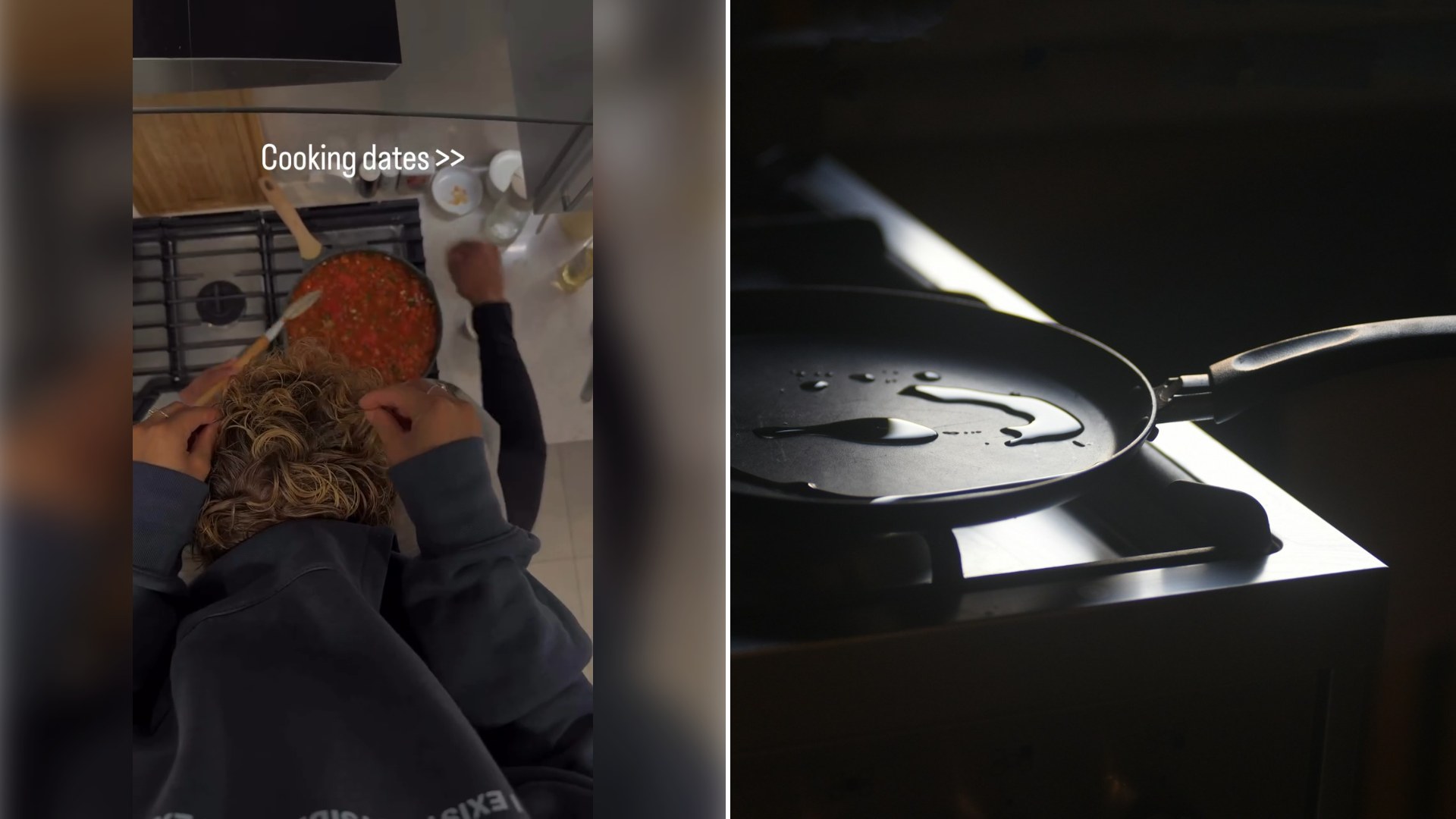
Shot from a high, almost documentary-style angle above the stove, this video follows a couple moving through the familiar choreography of cooking dinner together, and it’s precisely the lack of narration or dramatic framing that makes it so quietly compelling.
There’s no voiceover explaining the relationship, no caption breaking down their dynamic in words. Instead, viewers are left to read the relationship purely through movement: who reaches for the salt without being asked, who steps aside instinctively when the other needs the stove, the small unspoken coordination of two people who’ve clearly done this exact dance hundreds of times before.
This kind of ‘show, don’t tell’ approach has become increasingly popular across home and relationship content, partly as a reaction against the oversaturation of couples narrating every detail of their relationship for the camera. There’s something refreshing about a video that trusts its audience to pick up on intimacy through behavior rather than explanation.
Overhead cooking shots in particular have a specific visual appeal that goes beyond just showing off technique. The bird’s-eye perspective turns a kitchen into something closer to a stage, flattening the scene into a kind of choreography, which makes the small, synchronized movements of two people cooking together read almost like a dance routine, even though neither person is doing anything performative.
There’s also a quiet argument embedded in this format about what domestic partnership actually looks like day to day. It’s rarely the dramatic gestures that define a relationship’s health, but rather the accumulation of small, low-stakes moments of cooperation, handing someone a spoon before they ask for it, instinctively dividing tasks without a conversation, moving around a shared, often cramped space without friction.
Relationship researchers have long pointed to these kinds of ‘bids for connection,’ tiny, often wordless moments of attunement, as one of the strongest predictors of relationship satisfaction over time, often more reliable than grand romantic gestures. A couple who can cook dinner together smoothly, without tension or miscommunication, is demonstrating a form of intimacy that’s easy to overlook but genuinely significant.
It also speaks to why cooking together, specifically, has become such a popular genre of relationship content. Unlike a staged date night or a vacation highlight reel, cooking dinner is something almost every couple does regularly, which makes it an unusually relatable lens through which to showcase relationship dynamics. Audiences aren’t watching an aspirational fantasy; they’re watching something close to their own Tuesday night.
The appeal also ties into a broader cultural craving for slowness and routine, a counterbalance to the constant highlight-reel pressure of social media. A video with no plot, no conflict, and no resolution beyond ‘dinner got made’ offers a kind of visual exhale, proof that ordinary domestic life, filmed honestly, can be just as watchable as anything more dramatic.
In the end, the video works precisely because it doesn’t try too hard. It simply documents two people cooking dinner the way they probably do most nights, and lets that quiet competence speak for itself.
There’s a reason this kind of unscripted, low-drama couple content tends to outperform more produced relationship videos over time. Audiences have become increasingly attuned to the difference between a relationship performed for an audience and one simply existing, caught almost incidentally on camera, and the latter tends to earn a deeper, more durable kind of trust.
This genre also reflects something true about how actual domestic partnerships function day to day. The health of a long-term relationship is rarely measured by its biggest moments, anniversaries, proposals, milestone trips, but by the accumulation of small, cooperative gestures that happen almost too quickly to notice individually, yet add up to something substantial over months and years.
It’s worth pointing out, too, how much the home and kitchen specifically function as a kind of relationship laboratory, a shared space that two people have to navigate together regularly, with its own small logistics and negotiations. Watching that negotiation happen smoothly says something real about the underlying partnership, even when nothing explicitly dramatic is being discussed.
For anyone building their own version of a shared household, this kind of content offers a useful, low-pressure model, proof that care doesn’t need to be loud or elaborate to register as meaningful, and that the quiet, repeatable rituals of daily life are often where a relationship’s real strength lives.
It’s also worth noting how much this kind of low-key, documentary-style content benefits from repetition over time. A single video is charming on its own, but a creator who consistently shares this kind of quiet, unscripted domestic footage ends up building something closer to an ongoing, trusted record of a real relationship, which audiences tend to invest in far more deeply than a single viral moment.
For anyone building their own shared home with a partner, this kind of footage offers a useful, achievable benchmark, not a flawless, aspirational relationship, but a genuinely comfortable one, built through small, repeated moments of cooperation rather than grand, occasional gestures.
It’s worth stepping back, too, to consider why a platform like Instagram has become such fertile ground for this exact kind of storytelling in the first place. The format rewards brevity, but it doesn’t punish depth, which means a creator willing to pack real substance into a short runtime can still build something that resonates far beyond the usual fifteen seconds of attention most content gets. That tension between short-form constraints and genuine emotional or comedic payoff is part of what makes a clip like this worth stopping for in a feed otherwise built for scrolling past.
There’s also a reason this kind of post tends to travel well beyond its original audience, reaching people who may never have come across the creator’s account otherwise. A specific, well-told moment, whether funny, tender, or simply honest, has a way of getting shared directly between friends and family members precisely because it says something that feels worth passing along, rather than just worth watching once.