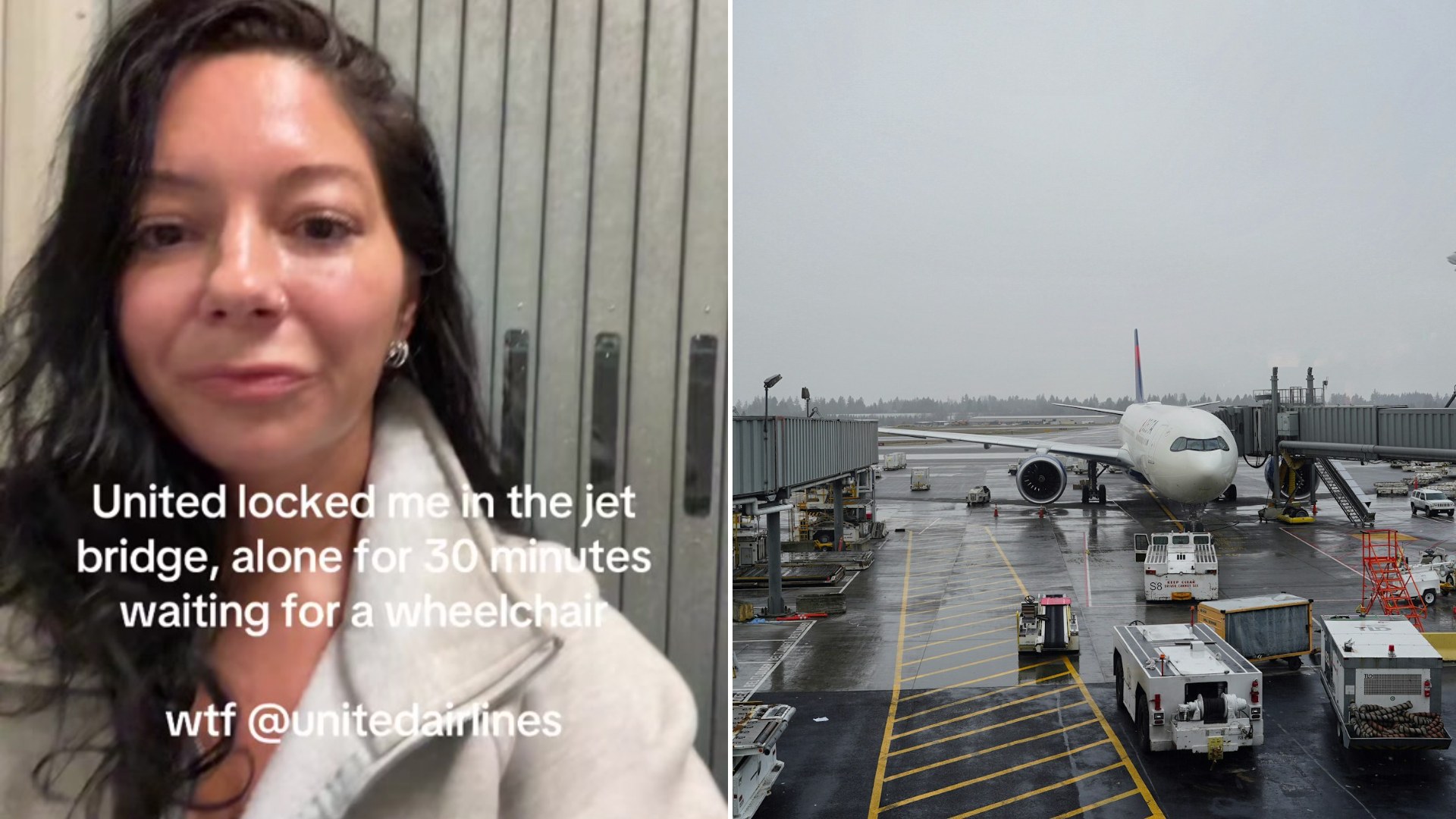
The video from @birdiecda starts mid-panic, her voice shaking as she explains what’s happening in real time. “I don’t think you’re gonna believe this because I’m shaking cause I’m not believing it,” she says. She’s a disabled traveler flying United Airlines, and she’s just been left, alone, on a jet bridge, with the plane already closed and no one around to help her.
Her warning to other disabled travelers is specific and direct: make sure your reservation has your wheelchair service noted “all the way through.” It’s a detail that sounds minor until you’re the one stranded because of it. “I am internationally stuck on the jet bridge with the plane closed all by myself,” she says, “nowhere to sit, just waiting, hoping that they will bring somebody to come rescue me.”
What makes the clip so striking isn’t elaborate storytelling — there isn’t any. It’s the rawness of watching someone document a moment of genuine vulnerability as it’s still unfolding, before she knows how it resolves. There’s no edited retrospective narration here, no calm recap after the fact. It’s a person alone in a liminal space — no longer in the terminal, not yet on the plane, without a wheelchair, without staff, and without a clear plan for what happens next. “Do better, United,” she says. “Come on.”
That short, simple appeal is doing a lot of work. It’s not a rant, and it’s not asking for sympathy so much as accountability — a reminder, aimed squarely at the airline, that a mobility accommodation isn’t a courtesy to be handled loosely. When the system that’s supposed to move a wheelchair user from the gate to their seat breaks down partway through, the result isn’t an inconvenience, it’s someone physically stuck, with no way to move themselves forward or back.
The video resonated widely, in part because disabled travelers have been raising similar concerns for years, and in part because the moment is so viscerally uncomfortable to watch: a jet bridge, by design, isn’t a place anyone is meant to be left waiting. It’s a connector, not a destination. Watching someone stranded there, with no chair to sit in and no one coming, put a face and a voice to a failure that’s often discussed only in the abstract, in complaint statistics and accessibility reports.
What Air Travel Still Gets Wrong for Disabled Passengers
Everything here reflects what @birdiecda showed and said in the moment, as it was happening. There’s no way to know every detail of United’s internal process that led to this gap, and this piece isn’t speaking for the airline. What the clip does capture clearly is a specific, avoidable failure point in how mobility accommodations are supposed to work end to end.
- Wheelchair service has to be confirmed at every leg of a trip, not just booked once. Disability travel advocates consistently recommend confirming accommodation requests directly with the airline close to departure, since notes can fail to transfer between booking systems, gate agents and ground crews.
- Jet bridges are a known accessibility blind spot. Advocacy groups have flagged the handoff between gate and aircraft door as a recurring gap, precisely because it’s a transitional space where responsibility can get unclear between staff.
- Documenting an incident in real time creates accountability. Filing a formal complaint with the airline, and with the Department of Transportation’s Aviation Consumer Protection Division for U.S. flights, is something advocates encourage, since video evidence and timestamps can support a claim.
- Being stranded isn’t just inconvenient — it’s a safety issue. For travelers with mobility needs, a gap in service can mean being unable to move, sit, or seek help unassisted, which is why advocates push back hard on framing these incidents as minor logistical hiccups.
Travel stories like this one travel far because they put a real person and a real moment behind a problem that’s too often discussed only in policy terms. For disabled travelers navigating the same systems, a firsthand account like this can be both validating and useful — a reminder that these gaps aren’t imagined, and that documenting them is one of the few tools travelers have to push airlines toward doing better.
You can watch the full video and follow @birdiecda on TikTok for more.

As a mom of three busy boys, I know how chaotic life can get — but I’ve learned that it’s possible to create a beautiful, cozy home even with kids running around. That’s why I started Cultivated Comfort — to share practical tips, simple systems, and a little encouragement for parents like me who want to make their home feel warm, inviting, and effortlessly stylish. Whether it’s managing toy chaos, streamlining everyday routines, or finding little moments of calm, I’m here to help you simplify your space and create a sense of comfort.
But home is just part of the story. I’m also passionate about seeing the world and creating beautiful meals to share with the people I love. Through Cultivated Comfort, I share my journey of balancing motherhood with building a home that feels rich and peaceful — and finding joy in exploring new places and flavors along the way.