Vermont’s high ridgelines can be well past peak while Colorado’s aspen groves in the San Juan Mountains haven’t started turning, and both moments happen inside the same three-week stretch of autumn. That’s the picture that emerges from the 2026 fall foliage prediction map from SmokyMountains.com, which layers historical climate patterns and National Oceanic and Atmospheric Administration forecast data onto a county-by-county view of the country, according to AFAR’s coverage of the tool. Scroll the map’s week-by-week slider and the idea that autumn arrives on one shared national calendar falls apart fast. Peak color sweeps across the U.S. in a staggered wave, and within a single state it can land three or four weeks apart depending on how high you climb.
The Real Trigger Isn’t the Date on the Calendar
Leaves don’t turn because a month arrives. According to the U.S. Forest Service’s breakdown of the science, color change is “primarily regulated by the calendar as nights become longer,” a photoperiod cue that’s essentially fixed by latitude and elevation. As chlorophyll breaks down under longer nights, it stops masking the carotenoids that were in the leaf all along, and cool nights trap sugars that trigger anthocyanin production, the pigment behind reds and purples. Weather decides how vivid the display gets and how fast it moves. NOAA notes that a wet growing season followed by a dry autumn with sunny days and cool, frostless nights produces the brightest palette, while drought can force an early, dull shutdown and a hard frost can end the show before it peaks. Layer that on top of a photoperiod clock that runs faster at higher latitudes and elevations, and the season unfolds less like one wave than dozens of overlapping ones, each tied to its own patch of ground.
Northeast: A Three-Week Spread Within a Few Hundred Miles
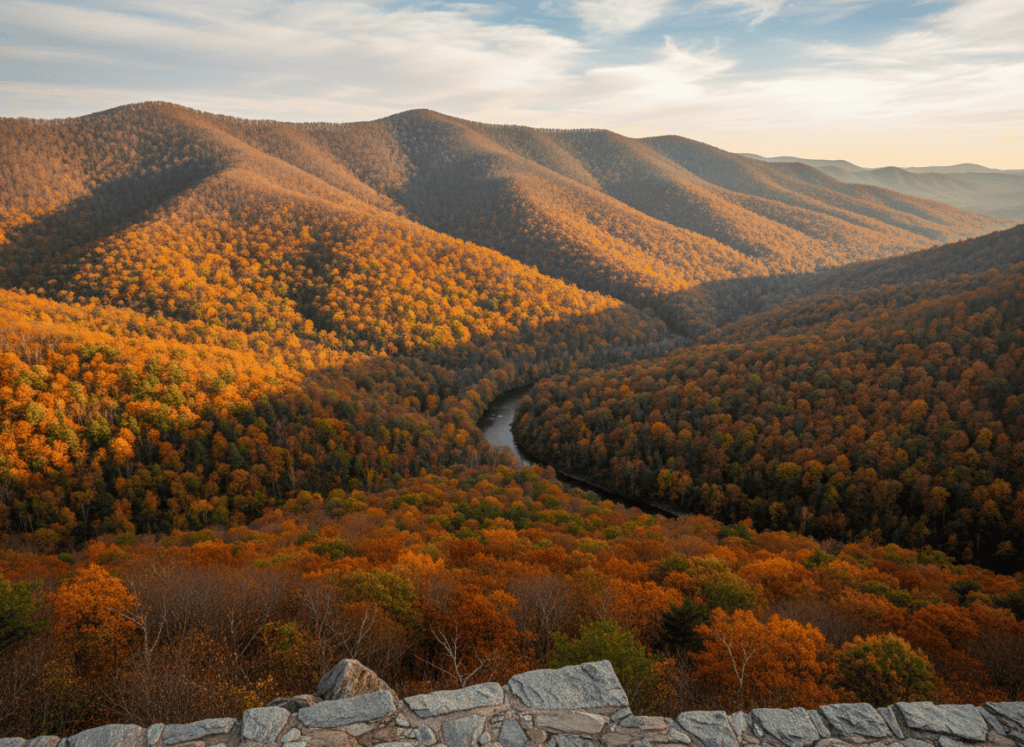
Northern Maine and Vermont’s high country typically lead the region, with the Old Farmer’s Almanac’s 2026 foliage map pegging late September for peak color at elevation in Vermont, while the state’s valleys don’t catch up until early-to-mid October. AFAR’s read of the SmokyMountains.com data has most of Vermont, New Hampshire, Maine, Massachusetts, and Connecticut reaching peak by around October 6, with the Hudson Valley and the Catskills trailing into the week of October 13. Virginia sits at the tail end of the region entirely: Shenandoah National Park isn’t expected to peak until between October 10 and 20, a full month after Vermont’s ridgelines start turning.
Upper Midwest: The Superior Shoreline Moves First
Minnesota’s North Shore along Lake Superior and Michigan’s Upper Peninsula both trend toward a late-September peak, per the Almanac’s regional breakdown, putting them in the same early window as high-elevation stretches of the Rockies rather than with the rest of their home states. Wisconsin splits three ways within its own borders: color peaks late September up north, mid-October through the center of the state, and later still toward the Illinois line. Lower Michigan doesn’t reach its own peak until late October, meaning a single state can carry a full month of separation between its northern tip and its southern counties.
Rocky Mountains: Elevation Beats Latitude
Colorado’s foliage season runs from mid-September through mid-October, and the Almanac’s map is explicit that higher elevations turn first, which is why aspen groves above 9,000 feet in the San Juans and near Aspen itself are usually done well before lower-valley cottonwoods even start. Utah follows the same pattern, with color appearing at altitude by mid-September and moving downslope into October. AFAR’s regional data groups high-elevation Colorado, Utah, Wyoming, Montana, and Idaho into the same late-September peak window as the Upper Midwest’s northern edge and the highest parts of New England.
Southern Appalachians: One Mountain Range, Five Weeks of Peak
Nowhere does elevation matter more than in the Smokies. Visit Smokies’ 2026 forecast for the North Carolina side of the range lays out a banded timeline: patchy color above 5,000 feet by late September, a color wave moving through the 4,000-to-5,000-foot band in early-to-mid October, “prime time” across the 3,000-to-4,000-foot mid-elevations by mid-to-late October, and valleys and lower slopes not finishing their run until late October into early November. The forecast is blunt about it: there is “no single peak date for the entire region.” AFAR’s map data lines up with the middle of that window, showing the Blue Ridge Parkway in western North Carolina at its best across the weeks of October 13 and October 20.
Pacific Northwest: A Quieter, Later Curtain Call
The Cascades and Olympic Peninsula run on their own clock relative to the rest of the country. Washington’s color season spans September and October, with mountain larches turning gold at elevation before the lower-elevation bigleaf maples and vine maples follow, according to the Almanac’s state-level notes. Oregon leans later still, with October described as the heart of the season and mid-month bringing the most reliable displays in the Columbia River Gorge and the western Cascade foothills. That timing puts the Pacific Northwest roughly three to four weeks behind the Upper Midwest’s earliest turners, despite both regions sitting at similar northern latitudes.
None of this makes any single week the “right” one to book a trip. It makes the map worth checking against your specific destination rather than your gut sense of when fall happens, because the gap between a Vermont ridge and a Carolina valley is measured in more than just miles.