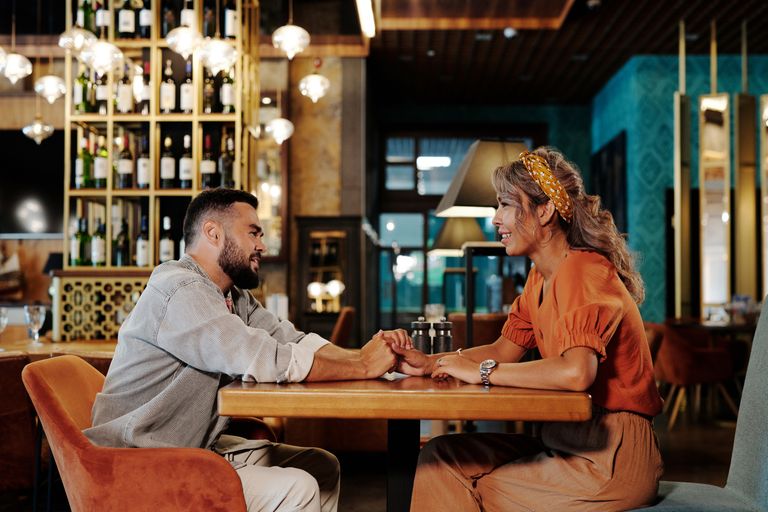
Roughly one in four married Americans, 26%, is currently sleeping next to a spouse who practices a different religion, or no religion at all, according to Pew Research Center’s 2025 analysis of religious intermarriage. That share climbs sharply once you look at younger unions: among Americans who got married since 2010, nearly 39% married someone from a different faith tradition, compared with just 19% of people who wed before 1960. Falling in love outside your own religion has gone from a genuine outlier to something close to routine.
The overall interfaith rate hasn’t moved much in the last decade, Pew found 25% of married Americans had a different-faith spouse in 2014, essentially the same as today’s 26%. But that stability masks a bigger generational shift happening underneath it: as older, more homogenous marriages end through death and divorce and get replaced by newer ones, the newer ones look dramatically more religiously mixed. The country’s overall interfaith-marriage rate is a snapshot of two very different eras of dating layered on top of each other.

Which Faiths Are Most Likely to Marry Outside Themselves
The odds of ending up in an interfaith marriage vary enormously depending on which religious group you start in. Pew found that members of the Church of Jesus Christ of Latter-day Saints are the least likely to marry outside their faith, with 87% married to another Latter-day Saint. Protestants follow at 81% same-faith, then Catholics at 75%. Jewish Americans and the religiously unaffiliated sit at the other end: only 65% of married Jewish Americans have a Jewish spouse, and just 68% of unaffiliated Americans, those who identify as atheist, agnostic, or “nothing in particular”, are married to another unaffiliated person.
The single most common form of religious intermarriage isn’t two different organized religions colliding at the dinner table. It’s a Christian married to someone with no religious affiliation, which accounts for 13% of all U.S. marriages on its own, according to Pew. Interfaith unions between two different Christian traditions, say, a Catholic and a Protestant, make up another 7%, and every other combination of faiths accounts for the remaining 6%.
What Changes Inside the Marriage When Faiths Don’t Match
Sharing a religion with your spouse correlates with more than just matching holiday calendars. Pew’s data shows people married to a same-religion spouse are considerably more religious themselves: 62% of Protestants married to another Protestant qualify as highly religious, compared to only 27% of Protestants married to someone of a different faith. Same-faith couples also talk about religion far more often, 43% discuss it weekly or more, versus just 16% of interfaith couples. Overall, 51% of married Americans describe their religious beliefs as “very similar” to their spouse’s, meaning nearly half don’t.

None of that means interfaith couples are quietly failing to communicate, or that they love each other less. It means a meaningful share of American households are running two religious operating systems side by side, deciding holiday by holiday, baptism by bar mitzvah, which traditions get merged, which get alternated, and which get set aside entirely. It also means, practically, that a rising number of parents are raising kids who will grow up seeing two faiths modeled as equally valid at home rather than one.
Why the Trend Line Matters More Than the Snapshot
The generational gap Pew found, 19% interfaith before 1960 versus 39% since 2010, is the real story here, more than the flat headline rate. Even the specific pairing of Christian and religiously unaffiliated has more than tripled, from 5% of pre-1960 marriages to 18% of marriages since 2010, per that same Pew analysis. As the ranks of religiously unaffiliated Americans have grown, they haven’t simply stopped dating religious people; they’ve been marrying them at a rate their grandparents’ generation would have found remarkable.
What that means for the next generation of American marriages is straightforward: the assumption that a spouse will share your religious background is quietly becoming the exception rather than the rule. Couples aren’t necessarily resolving their differences by picking one faith and dropping the other. Increasingly, they’re building marriages, and families, that hold two belief systems at once, and figuring out the logistics as they go.
That logistical work shows up in small, recurring decisions most same-faith couples never have to negotiate: whose parents host which holiday, what a child gets told about death or an afterlife when both sets of grandparents have different answers, whether a wedding, a funeral, or a baptism happens in a church, a synagogue, or neither. Pew’s numbers suggest those conversations are no longer a niche experience confined to a handful of unusually adventurous couples. They’re becoming a standard feature of American married life, one dinner table, one December, one generation at a time.