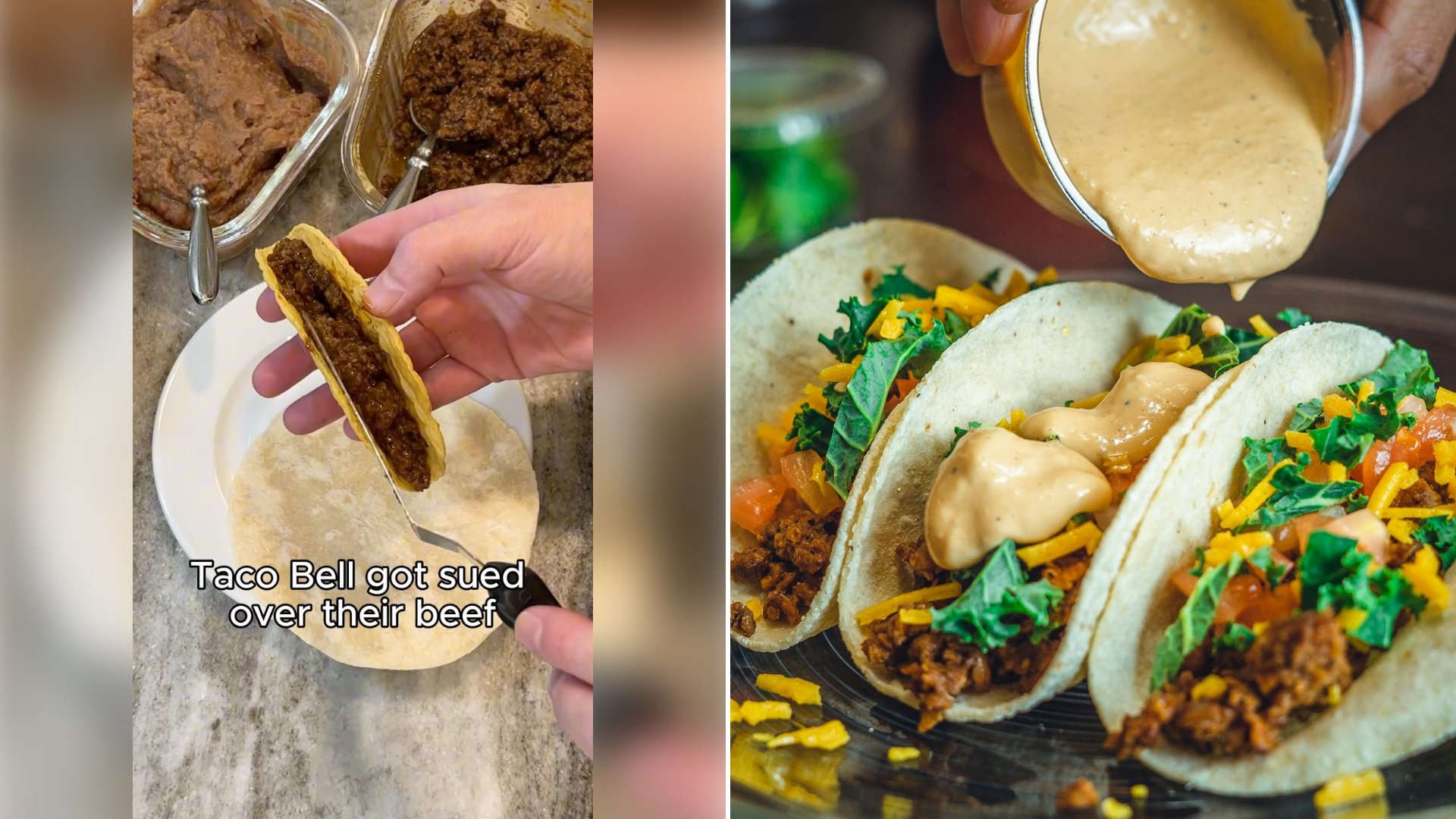
Home cook @pisomakitchen opens her Instagram reel with a claim in white text over a taco in her hand: a major fast food taco chain “got sued over their beef,” and she “used their own defense to copy it.” That history is her account. The reel shows no court papers and this article has not verified it, so what follows sticks to what she demonstrates in her kitchen.
The reel runs about a minute, and the teaching arrives as on screen text over her hands at the counter, sorted into numbered tips. The text gives no measurements, so the value is in the logic of each tip. Tip one is what she calls “the real ratio.”
According to her text, the chain’s ad campaign “disclosed the actual number: 88% beef, 12% secret blend, which includes oat flour.” A canister of rolled oats sits on the counter as that line appears. The reel does not show the ad itself, so the figure is the creator’s retelling and this article has not checked it.
Tip two is “the umami trick.” She says the chain’s blend “uses flavor enhancing compounds to get a meatier flavor without adding meat,” and that her version “uses three ingredients including MSG to mimic its savoriness.” The frames show a jar of dark, concentrated broth paste, a bottle of liquid smoke and a bag of MSG, stirred into a small dish of spices or a measuring cup of water. The reel gives no amounts for any of them.
Tip three is cocoa powder, and she is blunt about its job: “It’s there for color not taste.” A tiny pinch, she says, “deepens the reddish brown tone with zero chocolate flavor,” and “you’ll never guess it’s in there.” Then the pan: raw ground beef goes into a skillet, water is poured over it, and the text reads “Cook the meat in water.” She mashes the meat as it simmers for the “final texture,” then finishes with a cornstarch slurry.
Her husband says the texture is right, she says, but “if yours feels too toothsome,” she suggests hitting part of it with an immersion blender. The last frames show the beef spooned onto a flat shell, then a plate of finished tacos topped with lettuce, tomato and sour cream, one of them in a puffed fried shell. She closes with a personal note: the chain is where her husband goes when he is on his own for dinner, she is “not a big fan,” but she ate the leftovers on this one.
A few primary sources bear on her three tips. The U.S. government’s rule for ground beef, 9 CFR 319.15, says ground beef consists of chopped beef “with or without seasoning” and “shall not contain added water, phosphates, binders, or extenders.” That rule describes raw product sold under the name ground beef. It does not govern what a home cook does with plain ground beef in her own kitchen, such as seasoning it, simmering it in water and thickening it with cornstarch.
On the MSG tip, the U.S. Food and Drug Administration says on its MSG questions page that it considers added MSG generally recognized as safe, that glutamate occurs naturally in foods such as tomatoes and cheeses, and that ingredients like yeast extract and hydrolyzed vegetable protein also contain free glutamate. A concentrated broth paste may therefore bring savory depth of its own. If you copy her approach, start with less of each seasoning than you think you need and taste the pan as it simmers, since the reel gives no quantities to follow.
Because her method simmers and mashes the beef, color is a poor way to judge it. The USDA Food Safety and Inspection Service says in its ground beef guidance that ground beef should reach a safe minimum internal temperature of 160 degrees Fahrenheit, checked with a food thermometer. The same page says cooked ground beef should be refrigerated within two hours, or within one hour if the air is above 90 degrees, and kept three to four days in the refrigerator or about four months in the freezer. Leftovers, which she mentions eating, should be reheated to 165 degrees.
For a taco night of your own, her order of operations is easy to borrow: season the water with the savory and color ingredients first, cook the beef in that liquid, mash as it simmers, thicken at the end with a cornstarch slurry, and use an immersion blender on part of the pan only if the texture still feels too chewy. Taste before you add the cocoa, since her point is that it should change the shade and nothing else.
More from Cultivated Comfort
- Husband Cooks Double Gouda Burgers With a Garlic Parmesan Cream Sauce for His Pregnant Wife’s Craving and Posts the Whole Recipe With Her First Bite on Camera
- Home Cook Shares a Steak Reveal Video, Then Her Comment Section Questions Why the Meat Was Wrapped in Paper and Whether It Had Any Seasoning at All
- Woman Says Her Czech Grandmother Cooked Onions Low for Ten Minutes, Finished Soup With Vinegar and Kept Noodles Out of the Pot, Habits She Lists in One Short Reel Caption