The whole message in a 12 second video from @thebeeingtony, who goes by Beeing Tony, fits in about ten seconds of talking, and he says it while lying back against a patterned pillow in a dark green shirt and a black durag. “Teach your partner this,” he begins. Then comes the part to hand over: “Say the hard thing gently and I can hear all of it. Say it harsh and I only hear the tone. Same truth. Two completely different landings.”
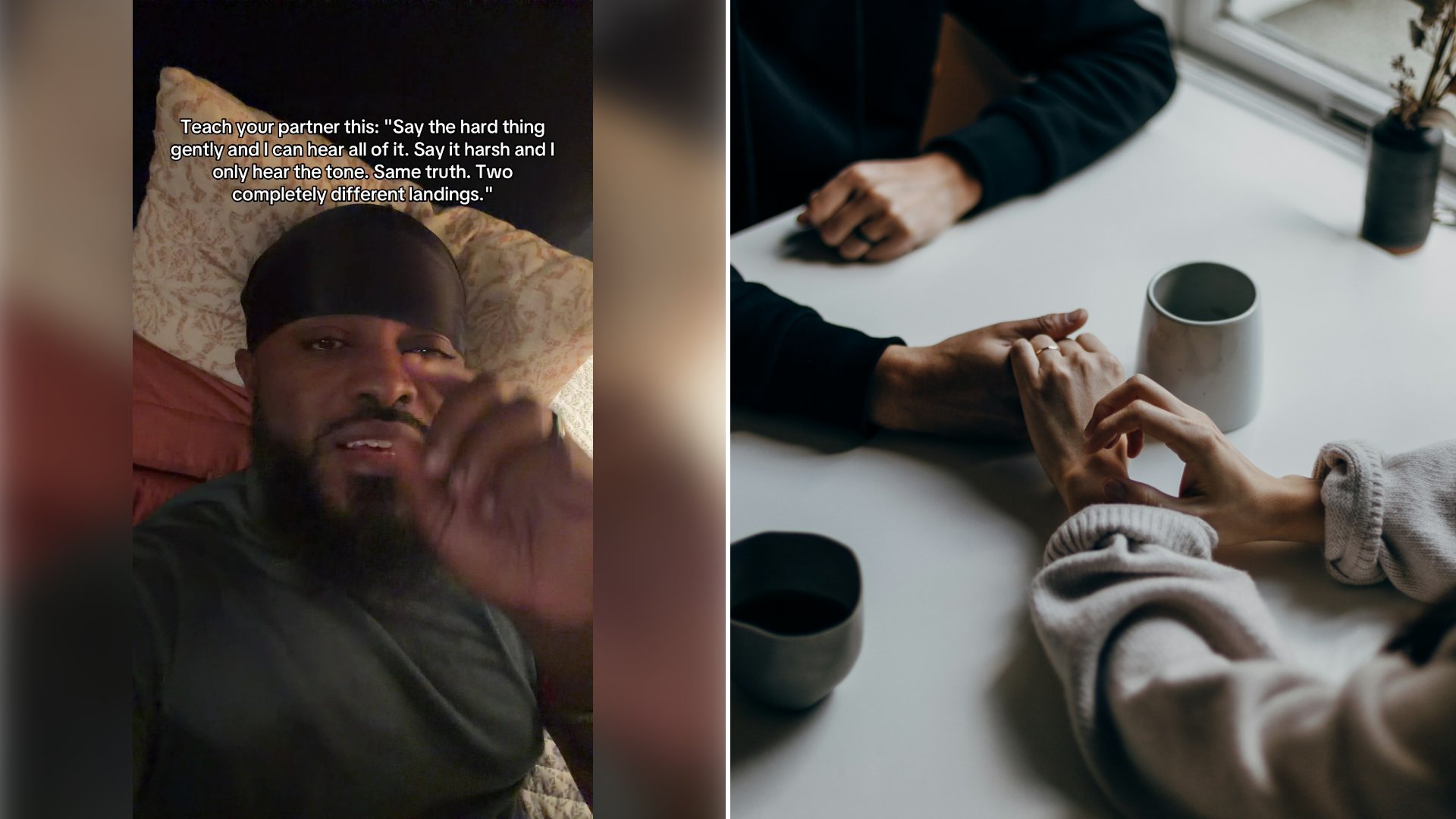
The same words appear as on-screen text across the top of the clip and in his caption, which ends with the hashtag love. He speaks directly to the camera and gestures with one hand as he goes, pointing and pressing his fingers together on the key lines. A wedding band is visible on his hand. He says nothing about who he is talking to or what prompted the video, and he does not tell a story. The entire clip is the instruction.
He is not asking a partner to hold back the truth. He says it as a description of how he listens, not as a rule for everyone: a harsh delivery leaves him hearing “only the tone,” while a gentle one lets him take in “all of it.”
The delivery follows the order of the words. He opens with the instruction, “Teach your partner this,” in the first second. The gentle half of the sentence arrives next, and the harsh half does not start until about the five second mark, so the two halves take roughly equal time. The closing line, “Same truth, two completely different landings,” begins near the eight second mark and runs to the end of the 12 second clip. His hand movements stay in rhythm with the phrases, and the platform’s auto generated captions match the text printed on screen word for word.
Published research on couples points the same way. A 1999 study by Dr. John Gottman and Sybil Carrère of the University of Washington, published in the journal Family Process, followed 124 newlywed couples for six years. The researchers coded the couples’ conflict discussions, and the first three minutes predicted how the marriage turned out: couples who later divorced had opened with more negative emotion and fewer positive expressions than couples who stayed married.
The Australian government’s Healthdirect service describes communication in a relationship as “talking and listening with respect.” It advises people to be clear about what they mean, to check that they have understood their partner correctly and to try to see the situation from the other person’s point of view. It also says tone of voice, facial expressions, eye contact and posture all carry meaning, and that disagreements are normal when they are handled with kindness, compromise and clear communication. That is the same split the video draws between what is said and how it lands, with tone treated as part of the message and not decoration around it.
A practical way to try this at home is to share the video’s sentence before the next difficult conversation, not during it. Saying “say it gently and I can hear all of it” in the middle of an argument can sound like another criticism of how your partner talks. Offering it ahead of time, as a statement about how you listen, matches how he frames it: as something he is asking to be taught.