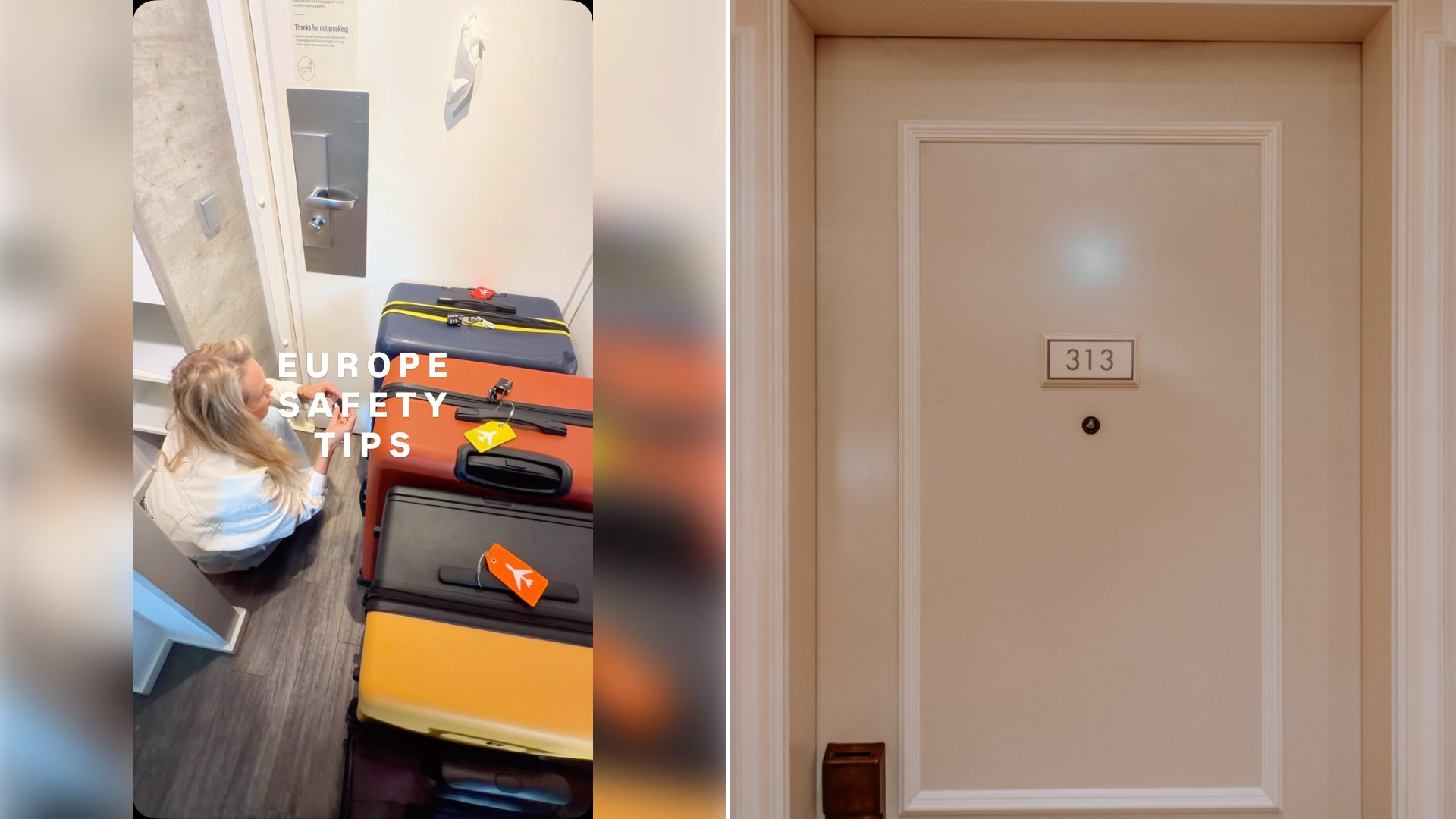
@victorias.way_ posted a 61 second video on September 18, 2026 with no spoken explanation, only a few lines of on screen text and a caption: “A few simple safety habits I always follow when staying at hotels in Europe and before heading out to explore the city.” The first title card reads “The first thing I do for safety in a hotel.” The second, partway through, reads “First thing I do before heading into the city.” Everything in between is shown, not said.
The hotel half starts at the room door. She starts at the door handle, then pulls her suitcases, a navy one, a rust orange one, a yellow one and smaller bags, into a stack against the inside of the door. Next she kneels and sets a red device at the foot of the door, its base resting on the floor, and holds up a small black unit with a red light. She finishes with a close look at the metal plate by the handle, then steps back and checks the result in the mirror with the suitcase wall in the frame.
Then she goes to the room safe. She holds up a stack of blue passports and a wallet with folded bills, and the camera follows as she puts her valuables in the safe and presses the keypad to lock it.
The second half is about what she carries out the door. She sits on the room’s armchair, pulls off a navy sock, folds US bills and slides them into a sock that has a zipper pocket in the cuff, and puts it back on. Her phone is next: she attaches a flat tether tab to the back of the case, clips on a crossbody lanyard, and wears the phone under her jacket. Last, she slides a bank card into a small zippered pouch that straps to her wrist and closes it around her forearm.
The U.S. Department of State publishes related advice in its crime and travel guidance. On its page about crime abroad it tells travelers to lock doors and windows whenever they are in their room, keep keys, IDs and other personal items secure, avoid displaying valuable items and keep a personal alarm or whistle handy.
Its country pages are more specific about what she does with her passport and cash. The State Department’s Spain advisory, issued on August 1, 2026 at Level 2, “Exercise increased caution,” says pickpocketing and other theft are very common in Spain, with street crime usually reported in tourist areas, airports, train stations and urban and beach areas. It advises travelers to keep valuables out of outer pockets and off tables and floors, to carry a copy or photo of the passport’s bio page instead of the original unless it is needed for travel, and to consider leaving the passport in a hotel safe. Spain is one example; her caption refers to Europe, and the video does not name a country.
For a reader packing for a European trip, her habits split into two jobs. At the room, the door stack and the red device sit between the door and the rest of the room, and the safe holds the passports and a wallet with cash. Out in the street, the valuables she does take move out of outer pockets and bags: bills in a sock pocket, the phone on a tether, and the card in a wrist pouch.
The State Department suggests carrying a copy or photo of the passport’s bio page instead of the original unless the passport is needed for travel. A copy is easy to prepare before a trip and can ride in a pocket while the passport stays in the room safe.
More from Cultivated Comfort
- Traveler Peels Cardboard Off the Shower Wall at a Crete Resort to Show an Open Vent Into a Maintenance Corridor and Says Management Told Him It Was the Room Type He Booked
- 8 Things You Should Never Assume About Your Hotel’s ‘Free’ Amenities
- Client Asks Her Hairstylist to Braid an AirTag Into Her Hair Before a Solo Trip and the Reaction Says It All