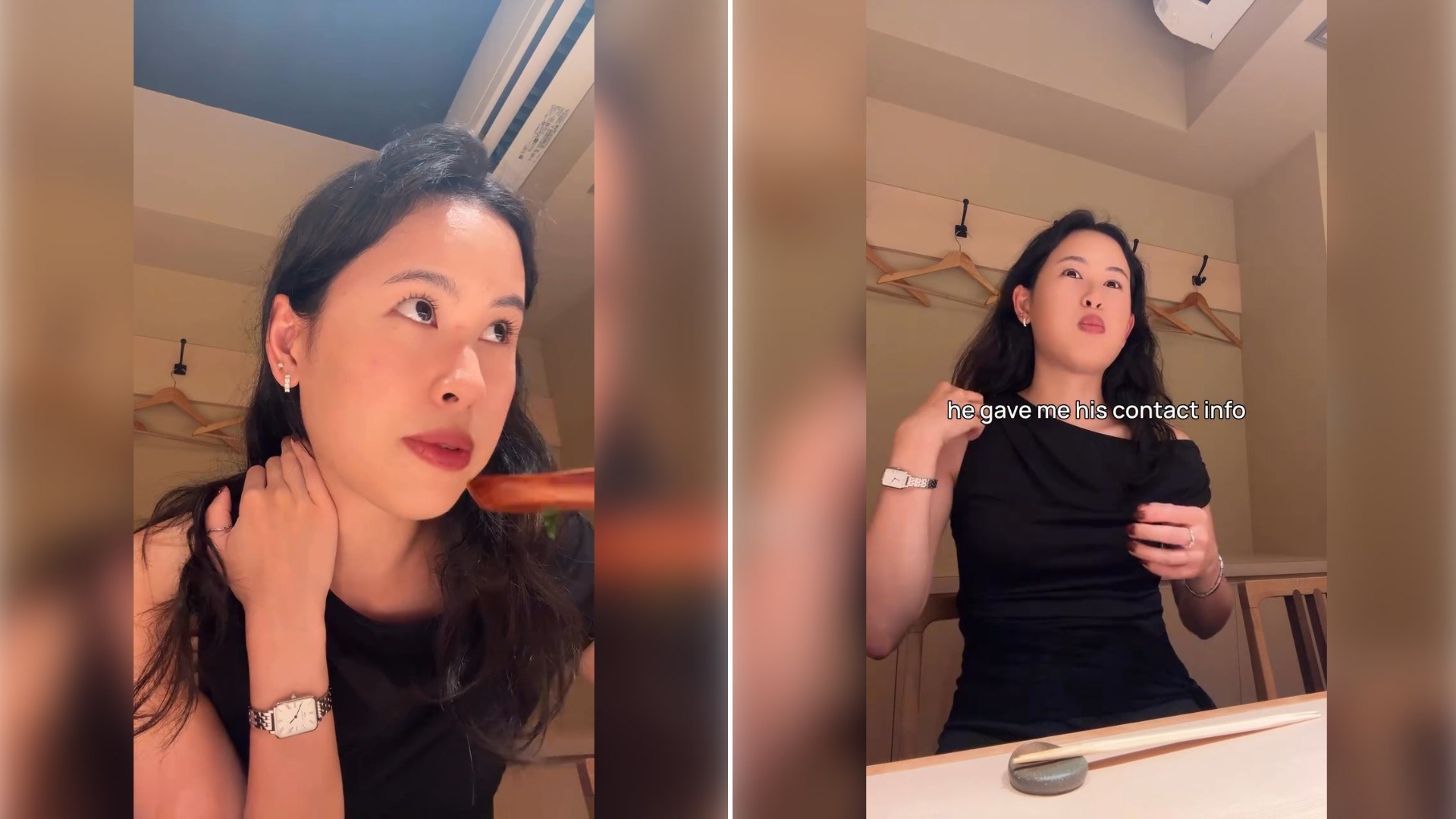
Dining alone abroad usually means exactly what it sounds like: a quiet meal, some people-watching, maybe a journal entry afterward. One woman’s solo dinner at a Tokyo omakase counter took a considerably more interesting turn.
The creator, @time.w.toni, recounts the evening as a “digital diary” entry, alternating between talking-head narration and restaurant b-roll as she describes what was supposed to be a quiet solo dinner turning into a flirtatious, nervous-excitement-inducing exchange with the chef preparing her meal. True to the diary format, she leaves the story as a cliffhanger, teasing a follow-up rather than resolving exactly what happened next.
View this post on Instagram
Omakase counters, by design, put diners in unusually close proximity to the chef preparing their food, course by course, with far more direct conversation than a typical restaurant meal allows. That format practically invites a different kind of connection than most solo dining experiences, less anonymous, more personal, and occasionally, apparently, a little charged.
Part of what makes an omakase counter such fertile ground for this kind of unexpected connection is the pacing built into the meal itself. A traditional restaurant experience moves in large chunks, an order placed, a wait, a plate delivered, minimal ongoing interaction with the person actually cooking. An omakase counter instead unfolds course by course, often over an hour or more, with the chef working directly in front of the diner and frequently narrating what’s being served. That structure creates dozens of small natural openings for conversation that a typical dinner simply doesn’t offer, openings that, over the course of a multi-course meal, can accumulate into something considerably warmer than a few polite exchanges about the fish.
Solo travel, and solo dining specifically, has its own particular psychology worth naming here. Traveling and eating alone strips away the social buffer of a companion, the person who might otherwise absorb some of a stranger’s attention or run interference in an unexpected exchange. Without that buffer, a solo diner is, by necessity, more directly present in whatever conversation develops, which can make an ordinary friendly exchange with a chef feel more immediate and more personal than it might if she’d been seated with a friend. The vulnerability of doing something alone in an unfamiliar country seems to have opened a door that a group dinner might have kept closed.
The digital diary format itself deserves some credit for how well this story translates to an audience. Rather than a polished, after-the-fact retelling, the alternating talking-head and b-roll structure mimics the experience of a friend calling you immediately after something happened, still working through exactly how they feel about it. That immediacy, paired with the explicit choice to hold back the ending, creates a kind of parasocial serialization: viewers aren’t just watching a story, they’re being pulled into an ongoing one, invited to wait alongside the creator for whatever comes next, the same way they might wait for a friend’s group chat update.
Solo travel content built around unexpected human connection tends to resonate specifically because it pushes back against the assumption that traveling alone means being alone the entire time. A counter seat meant for quiet, solitary dining became, in this telling, the setting for a genuinely memorable night, proof that solo doesn’t have to mean solitary. That reassurance matters to a specific, growing audience of people considering solo travel for the first time, often nervous about the isolation they assume comes with it. Stories like this one function almost as evidence for the case that traveling alone doesn’t foreclose connection, it can, in the right circumstances, actually create more room for it.
There’s also something specific about the setting, Tokyo, that’s worth acknowledging as part of the story’s appeal. For many travelers, Japan carries a certain reputation for reserved, formal social interaction, which makes a genuine, flirtatious spark feel even more notable against that backdrop. A story like this one plays against that expectation, suggesting that beneath the more reserved surface of a culture often described from the outside as buttoned-up, the same universal, slightly awkward, slightly thrilling human dynamics are still very much alive at a sushi counter on a random weeknight. That contrast between expectation and experience is part of what makes the story land as genuinely surprising rather than just another travel flirtation anecdote.
It’s also worth noting how differently this story would read if told in a single, polished monologue after the fact rather than in this half-processed, still-unfolding diary format. A neatly resolved story tends to close a loop for the viewer; a story deliberately left open invites them to keep thinking about it, to form their own theories, to check back later for the resolution. That open loop is a well-established technique across serialized storytelling generally, but it carries extra charge here because the subject matter itself, an unresolved flirtation, is already built around suspense and uncertainty. The format and the content reinforce each other, each amplifying the unresolved tension of the other.
Cliffhangers are a calculated choice in diary-style content, and this one leaves an obvious question hanging in the air: what happened after the check came? Until the follow-up arrives, viewers are left exactly where she was, replaying the exchange and wondering what comes next, caught in the same suspended, slightly giddy uncertainty that apparently followed her out of the restaurant and into whatever came after. For now, the only honest ending available is the one she gave it herself: to be continued.