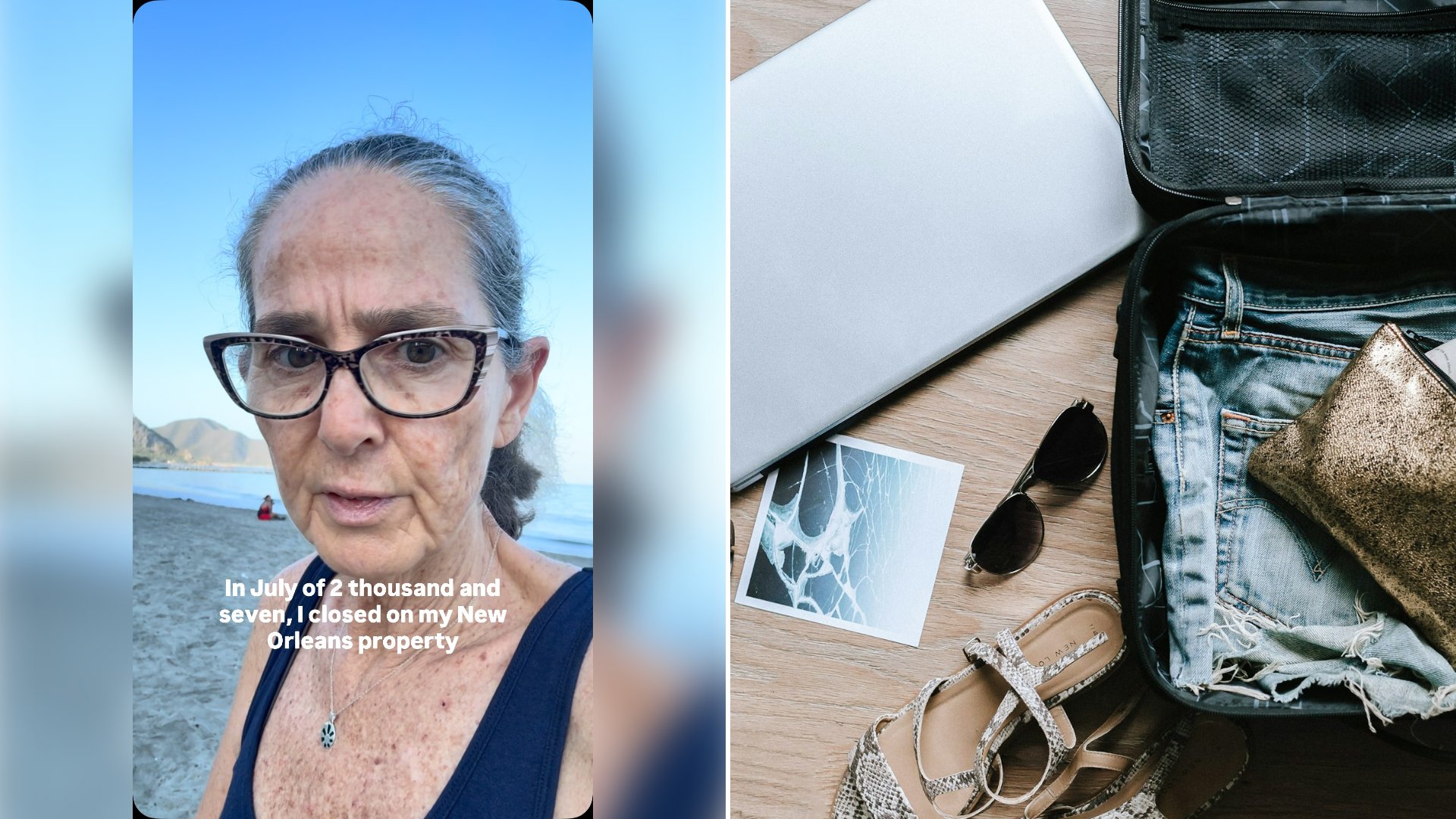
@iamjodibrown films herself on a beach in a navy tank top and dark framed glasses, with white high rise buildings along the shore behind her, and delivers a nearly three minute talk with captions burned in. Her written caption opens with two lines: “I sold 99% of everything I owned in 2007. And I never went back.” The video, which she posted in September 2026, explains what those lines mean and ends with a request to her audience.
She starts with the date. “In July of 2007, I closed on my New Orleans property,” her captions read, and “I packed up 99% of everything I owned.” In the same breath she mentions a small five by five foot storage unit. Then she says what she did next: “I left the country with a backpack and a promise to myself that I was going to try and find somewhere else to live.” She says she was “an angry American,” furious over what she describes as having witnessed happen to US citizens in New Orleans after Katrina, and that she wanted to take the money she had and try to settle in another country.
She does not claim it all worked. “A lot of things don’t work out the way I hope,” she says, “but here’s what I took away from that whole experience.” The lesson comes from the two years she says she kept living in New Orleans after the storm. “As I drove through New Orleans,” she says, all she saw on the side of the street was the things we buy and don’t need, “things that we consume that don’t do anything but weigh us down.” Her caption puts it in a list: “PEOPLE. PLACES. EXPERIENCES.” In the video she says those are the things that matter most to her, and that the rest does not count for much once the storm is over and belongings are lying around the yard, “wet and damaged.”
Her current life is the evidence she offers. She says she has lived in studio apartments since 2007, “almost 20 years,” and has “never gotten into acquisition mode again.” The benefit, in her words, is that it keeps her “limber” and “able to adjust and move” and to accommodate new environments quickly because she is “not trying to liquidate everything I have.” The caption names the same payoff: “the ability to MOVE. Change direction. Adjust when circumstances change.” It also says she can make decisions “without first figuring out” what to do with a house full of stuff.
Then she turns to the viewer. She says she is putting out an offer to everyone as “things are starting to change in our later years and we’re surrounded by all of our stuff,” and asks people to look at what surrounds them and decide what they need and what they do not. Stuff that is “weighing you down,” she says, is “keeping you from being able to make more fluid choices.” Her instruction is to make a list of the things you need and get rid of the rest. Her caption adds the test: “WHAT DO I ACTUALLY NEED?” And her last practical line is about money. “You need a little bit of money?” she asks, and suggests selling some of it on Facebook Marketplace, Etsy or other platforms.
The storm she is describing has public records behind it. According to the National Weather Service, Hurricane Katrina made landfall on August 29, 2005 near Buras, Louisiana as a Category 3 hurricane with maximum winds of 125 mph. The agency says storm surge overtopped the federal levee system in Orleans and St. Bernard Parishes, causing levee failures and extensive flooding of homes, and puts the damage at $125 billion in unadjusted 2005 dollars. It reports 1,392 fatalities across the storm’s full impact area.
Her last suggestion, selling things online, carries a tax rule that the IRS spells out for personal items. In its fact sheet on selling items through payment apps and online marketplaces, the IRS says “All income, no matter the amount, is taxable unless it’s excluded by law,” whether or not a Form 1099-K is sent. If you sold a personal item for more than you paid, the gain is taxable and goes on Form 8949 and Schedule D. If you sold it for less than you paid, the IRS describes either reporting the amount and offsetting it on Schedule 1 or reporting the loss on Form 8949. The page points readers to IRS Publication 551 for working out an item’s basis when they no longer know the original price.
Her method is a sequence rather than a purge. She names what she needs, which for her is people, places and experiences. She looks at the possessions around her and asks whether each one is one of those or something that limits her options. And she sells what is left over, which she says can pay for what comes next.
More from Cultivated Comfort
- Man Who Moved Across the World to Start a New Life in New York Says He Was Broken Up With Two Hours After He Arrived, Then Talks It Through From His Fire Escape
- Couple Says They Moved Next Door to an Elderly Man With No Family Nearby and Became Besties, and Their Video Shows Ice Cream, Pottery Painting, Christmas Pajamas and a Photo Shoot
- Woman Says Her Loud Upstairs Neighbor Became Her Best Friend, Then Shares the Tearful Night She Was Stuck Saying Yes to Everyone and Says the Friendship Does as Much for Her