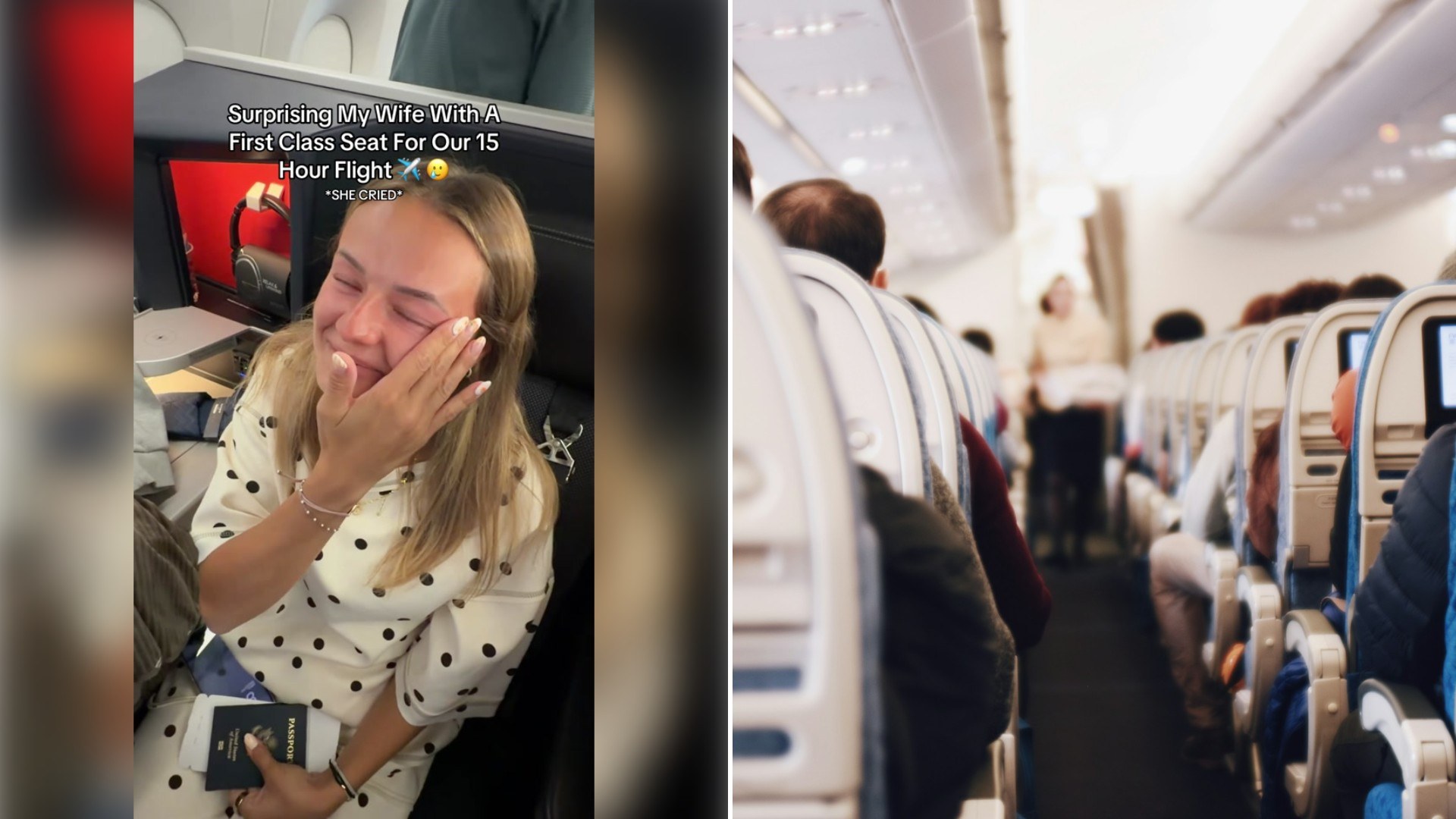
A fifteen-hour flight is a long time to sit in any seat, but the difference between economy and first class on a haul that long is not a small upgrade, it is a completely different way of experiencing the same journey. One husband understood that well enough to turn it into a surprise, and the resulting reaction has resonated with viewers far beyond the couple’s own circle.
The creator, @brock_and_kesley, filmed the moment his wife realized what he had arranged, alternating in the video between his own explanation to the camera of the planning behind the surprise and her raw, unscripted reaction once she understood what was happening in the airplane seat next to him. The tears were immediate and genuine, the kind of response that cannot be manufactured on command, and it is that authenticity that carries the video.
Surprises built around travel tend to land differently than material gifts, and this one is a clear example of why. A first-class seat on a long-haul flight is not just a more comfortable place to sit. It is hours of a person’s life spent in a state of relative ease rather than cramped discomfort, and on a fifteen-hour flight, that difference compounds hour after hour. He was not just buying her a nicer seat. He was buying her a version of the next fifteen hours that she would not have chosen to give herself.
That distinction matters, and it is worth pausing on why gestures like this tend to hit as hard as they do. Thoughtful surprises generally work best when they solve a problem the recipient did not ask anyone to solve for them. Long flights are uncomfortable for almost everyone, but most travelers simply accept that discomfort as the cost of getting somewhere, rarely voicing it as something they wish were different because there seems to be no realistic way to change it. When a partner quietly arranges to change it anyway, without being asked, it reads as a particular kind of attentiveness: noticing what someone tolerates without complaint and deciding to remove it for them.
There is also a planning element that deserves credit, since upgrades of this kind rarely happen by accident. Airlines typically require advance requests, mileage point redemptions, or a willingness to pay a substantial fare difference, and coordinating any of that without tipping off a spouse who books or watches the family’s travel plans takes real effort. The surprise was not just emotional, it was logistical, which is part of why the reaction on camera feels so earned.
For couples looking to create a similar moment without necessarily springing for a full first-class fare, the underlying principle travels well regardless of budget. It is rarely the price tag of a surprise that determines how it lands, but rather how specifically it responds to something the other person quietly endures. That could be a seat upgrade on a long flight, but it could just as easily be handling a dreaded errand before a partner has to think about it, or clearing a task off their plate during a stressful week. The common thread in gestures that produce genuine tears, rather than polite thank-yous, is that they target a very specific discomfort the giver actually paid attention to.
What the video ultimately offers viewers is less a travel story and more a small demonstration of what attentive partnership looks like in practice. Anyone can buy a gift off a list. It takes a closer kind of attention to notice the parts of a partner’s life that go uncomplained about and decide, quietly, to make them better. That is what turned one ordinary long-haul flight into a memory the couple will likely keep replaying long after they landed.
It is also worth noting how this kind of gesture tends to ripple outward once it is shared publicly. A single surprised, tearful reaction on a flight becomes, once posted, something much bigger: a reminder to everyone watching of the kind of attentiveness they might want to bring to their own relationships, or the kind they wish someone would bring to theirs. Comment sections under videos like this one are typically full of people tagging their own partners, only half joking, or quietly noting that they have never had a gesture like this done for them. That reaction says less about the couple in the video and more about how rare truly specific, well-planned surprises have become in general, in an era where a last-minute gift card or a generic bouquet often stands in for the kind of deliberate thoughtfulness this husband put into a single flight upgrade. The bar he set was not really about money. It was about noticing, and that is a bar almost anyone can reach for, regardless of their travel budget.
It is worth remembering, too, that the tears were not really about the seat itself. They were about being seen, clearly and specifically, by the person who knows her best, which is a feeling no amount of legroom could manufacture on its own.
Airline loyalty program data backs up just how differently frequent flyers value this kind of upgrade: a first-class seat on a long-haul route is consistently one of the most expensive redemptions a mileage account can be spent on, often requiring tens of thousands of points saved over months or years, which means a surprise like this one usually represents a deliberate, long-planned sacrifice of resources rather than a spur-of-the-moment splurge.