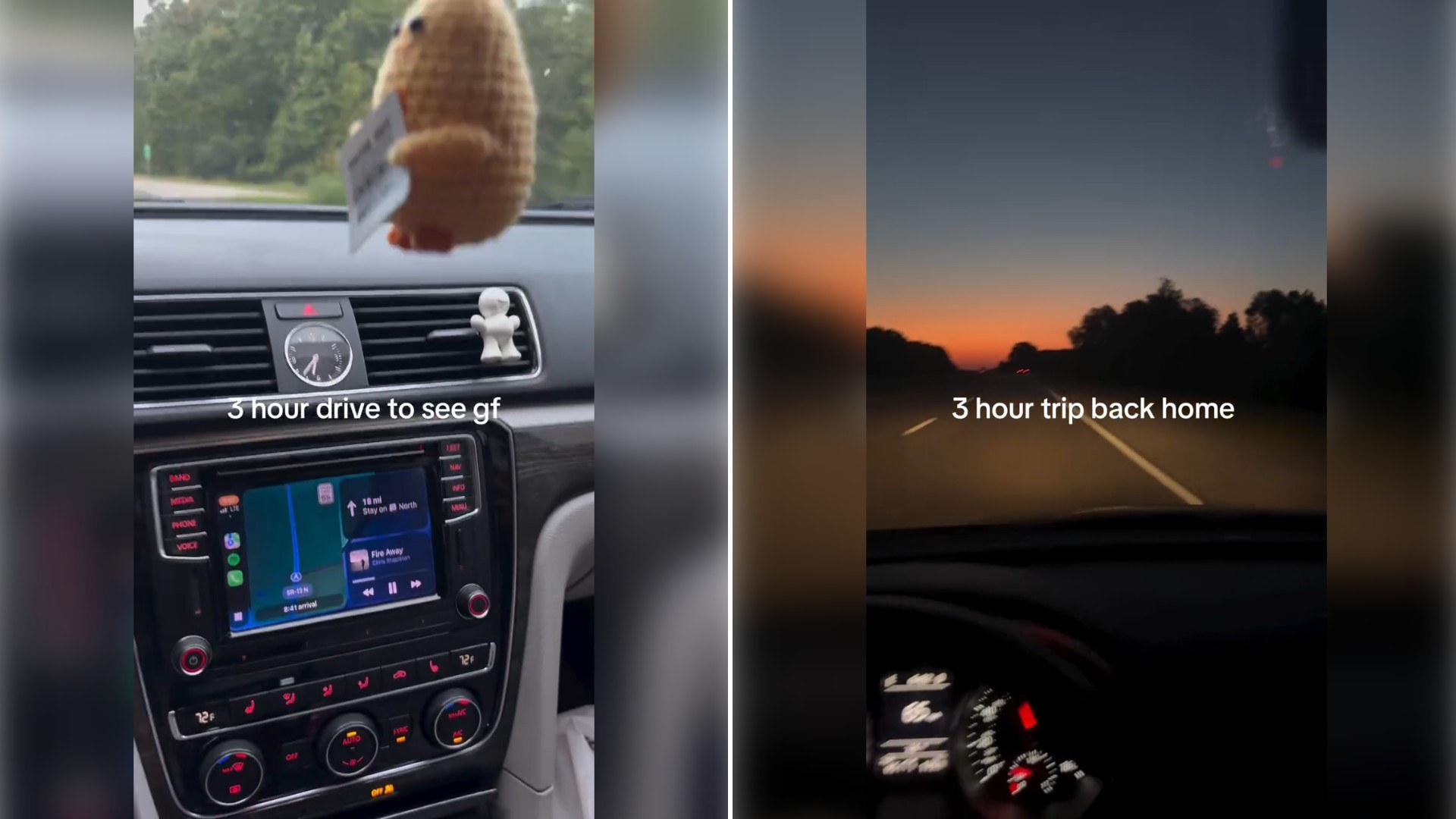
Long-distance relationships run on math that outsiders rarely appreciate: hours on the road, gas money spent without complaint, and a calendar built around whenever the next visit can be squeezed in. One young man recently gave viewers a firsthand look at exactly what that math looks like, turning his own six-hour round trip into a video that captures both the grind and the payoff of loving someone who lives far away.
The creator, @josiahdixon25, filmed the drive using first-person footage from behind the wheel, documenting the trip he regularly makes to see his long-distance girlfriend. A celebratory sound cue marks the moment he arrives, a small but telling detail that signals just how much the destination means relative to the drive it took to get there. His caption frames the full six hours of driving, there and eventually back again, as worth it every single time, for however many hours they actually get to spend together in person.
The math itself is worth sitting with for a moment. Six hours of driving is not a quick weekend detour, it is closer to a full workday spent entirely behind the wheel, and that is before accounting for the return trip that eventually has to happen too. For a lot of long-distance couples, the actual time spent together often ends up being shorter than the time spent traveling to get there, a ratio that can feel discouraging on paper but somehow rarely diminishes the value of the visit itself once it is finally happening.
That disconnect between the effort required and the time gained is really the emotional core of the video, and it is a dynamic that resonates well beyond this one couple. Long-distance relationships ask for a specific kind of commitment that couples who live in the same city simply never have to demonstrate: choosing, repeatedly and deliberately, to spend hours of effort on a visit that a local relationship would never require. There is no accidental run-in, no spontaneous dinner after work. Every visit is planned, and every visit costs something in time, money, or both.
Relationship researchers who study long-distance couples have found, somewhat counterintuitively, that these relationships can function just as well, and in some studies report even higher relationship satisfaction, than geographically close ones, at least for a period of time. Part of the explanation tends to be exactly what this video captures: the deliberate effort itself becomes a form of communication. Driving six hours round trip is not something a person does passively. It is a decision made and remade every time, and that repeated choosing carries its own emotional weight, arguably more than a relationship where proximity makes the day-to-day too easy to take for granted.
There is a practical layer here too, for anyone currently navigating a similar distance. Long-distance couples who manage the arrangement well over time tend to share a few common habits: setting a predictable visiting rhythm rather than leaving trips to chance, being upfront about the actual cost, in time and money, that each visit requires so neither partner quietly builds resentment, and treating the drive or flight itself as part of the relationship rather than simply an obstacle standing between two people. A celebratory sound cue at the end of a long drive is, in its own small way, exactly that kind of reframing, turning the final stretch of a tiring trip into part of the reward rather than just the price of admission.
What the video ultimately offers is a glimpse of the unglamorous, unfilmed reality that underlies most long-distance love stories: not the highlight-reel reunions alone, but the hours of driving that make those reunions possible in the first place. Six hours is a real sacrifice, not a small one, and the fact that he keeps making it, over and over, says more about the relationship than any single reunion clip ever could on its own.
There is also a financial dimension to long-distance driving that rarely gets discussed alongside the emotional one, but which matters just as much for couples trying to sustain a routine like this over the long term. Gas alone for a six-hour round trip adds up quickly over months and years, not to mention wear on a vehicle and the opportunity cost of an entire day that could otherwise go toward work, rest, or other obligations. Couples who make this kind of trip sustainably over time often talk about budgeting for it explicitly, treating the cost of visits as a real, recurring line item rather than an occasional splurge, precisely so the financial strain does not quietly become a source of resentment down the line. Framing the trip as worth it, the way this creator does in his caption, tends to be easier to sustain honestly when the cost has been acknowledged upfront rather than minimized. Six hours is worth it. It is also, undeniably, six hours, and couples who last in these arrangements tend to be the ones who respect both truths at once.
None of that diminishes the sound cue at the end of the drive, the small celebratory flourish marking arrival. If anything, it earns it, since nothing about those six hours was easy, and the reward is exactly as real as the effort that went into reaching it.
Many long-distance couples eventually settle into an unofficial rotation, alternating whose turn it is to make the drive so the burden of travel does not fall permanently on one partner, a small logistical fairness that this creator’s repeated solo trips suggest may still be evolving in his own relationship, depending on what his girlfriend’s own schedule and circumstances allow for on her end.