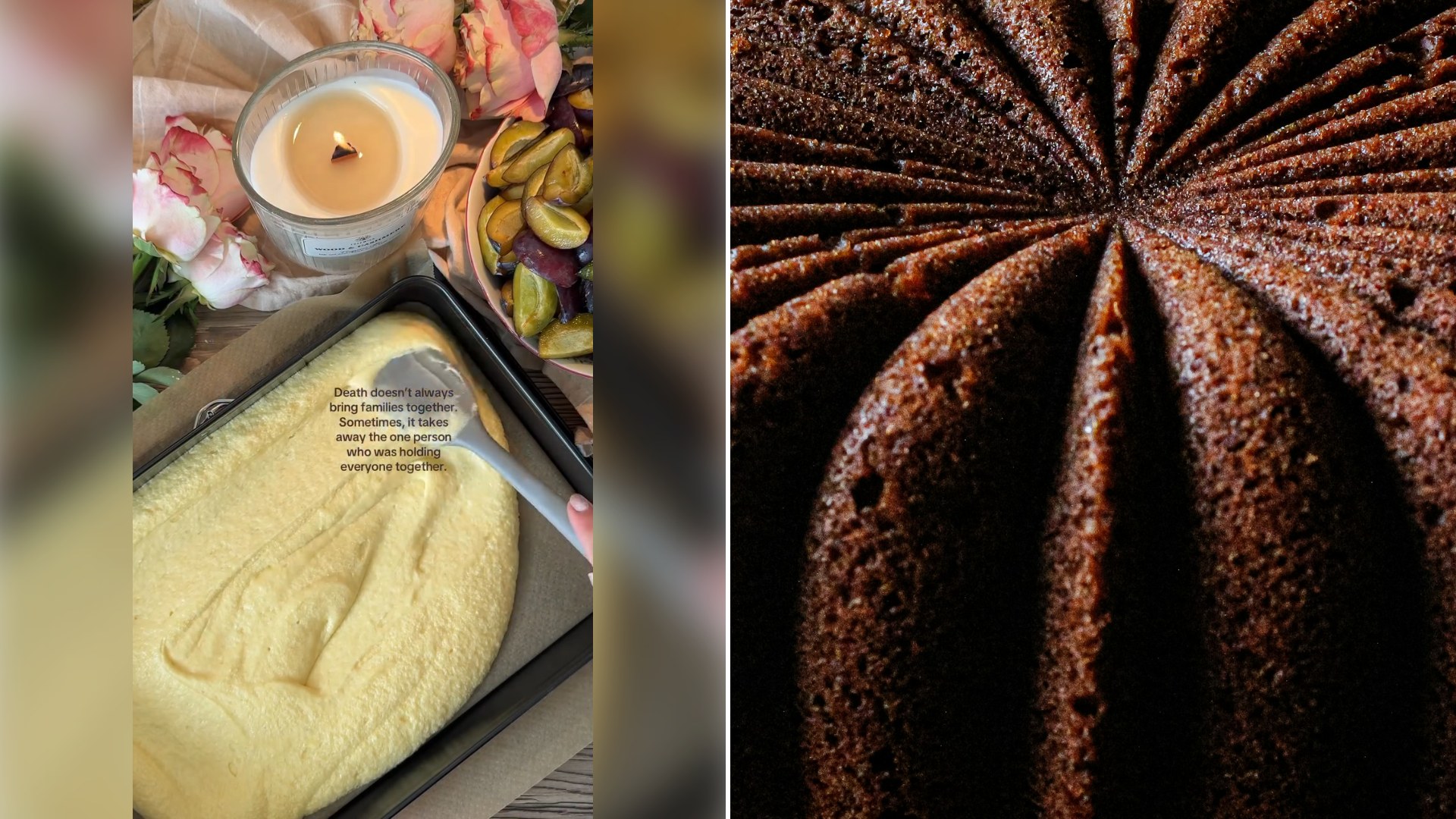
There’s a particular kind of quiet that settles over a kitchen when someone is baking alone for the first time after a loss, and creator @jijis.kitchenn captured exactly that feeling in a reel that has stopped thousands of scrollers mid-swipe. On camera, she’s doing something almost mundane: pouring batter into a pan, smoothing it with the back of a spoon, the kind of motion that becomes muscle memory after enough repetitions. It’s the on-screen caption, though, that turns the clip from a simple cooking video into something far more tender, revealing that this is the first time she’s made this particular family recipe since losing the person who used to make it alongside her.
That single sentence changes everything about how you watch the rest of the video. Suddenly the ordinary kitchen sounds, the scrape of the spatula, the low hum of the oven preheating, feel loaded with meaning in a way they wouldn’t in any other context.
What makes this kind of content resonate so widely isn’t melodrama. There’s no swelling music cue, no dramatic reveal, just a woman doing something she’s done a hundred times before, except this time the absence in the room is as present as anything she’s holding in her hands. Grief researchers have long noted that food and cooking rituals are among the most powerful triggers for memory, precisely because they engage smell, touch, and muscle memory all at once in ways that photographs or keepsakes simply can’t replicate.
Recipes passed down through families carry a strange kind of permanence. A handwritten index card, smudged with decades of flour and spilled vanilla, becomes an artifact as meaningful as any heirloom jewelry, because it represents not just a set of instructions but a shared activity, something that required two sets of hands in the same room at the same time.
This is part of why home cooking content focused on loss and remembrance has found such a devoted audience on platforms like Instagram. In a feed otherwise dominated by polished recipe videos optimized for engagement, a moment of raw, unscripted vulnerability cuts through immediately. Viewers aren’t there for a tutorial; they’re there because they recognize the particular ache of doing something familiar in an unfamiliar, quieter version of their life.
There’s also something to be said about the choice to keep baking the recipe at all, rather than letting it fade away along with the person who taught it. Continuing a tradition after loss can function as a kind of ongoing conversation, a way of saying that the relationship, while changed, hasn’t ended. Each time the recipe gets made again, it reasserts that the bond mattered enough to keep showing up for.
The comment sections on videos like this one tend to become unexpected support groups, filled with strangers sharing their own version of the same experience: the first time they made their grandmother’s pie crust alone, the first holiday they hosted without a parent in the kitchen. There’s comfort in discovering that this particular flavor of loneliness, the specific one that shows up over a mixing bowl, is universal enough that total strangers recognize it instantly.
It also speaks to a broader shift in how home cooking is discussed online. For years, food content leaned almost entirely into aspiration, chasing perfect plating and restaurant-quality technique. Increasingly, though, audiences are drawn to the opposite: the lived-in, emotionally complicated reality of why people cook in the first place, which is rarely just about the food itself.
For anyone who has stood at their own stove holding a recipe written in someone else’s handwriting, this clip won’t need much explanation. It documents a small, private act of courage disguised as an ordinary Tuesday in the kitchen, and that’s exactly why it’s resonating the way it is.
For readers at Cultivated Comfort who spend a lot of time thinking about what actually makes a house feel like home, moments like this one are a useful reminder that the emotional architecture of a home is built as much from absence as from presence. The empty chair, the recipe no longer made by the same hands, the specific brand of coffee that sits untouched in the cabinet, all of it becomes part of a home’s quiet emotional landscape, whether anyone chooses to acknowledge it on camera or not.
It’s worth noting how differently this kind of content ages compared to more trend-driven posts. A viral dance or a seasonal recipe has a shelf life measured in weeks, but a video built around grief and remembrance tends to keep finding new viewers for months or years afterward, surfacing again whenever someone searches for exactly this kind of recognition during their own difficult season.
There’s also a quiet lesson here about documentation itself. Plenty of people instinctively want to look away from hard moments rather than film them, assuming that private grief belongs strictly offline. Choosing instead to document it, carefully and on one’s own terms, suggests a different philosophy, that even painful chapters deserve to be witnessed rather than hidden away entirely.
This kind of storytelling also does something valuable for anyone who happens to be scrolling through a hard week of their own. It offers proof, delivered gently and without any instruction to feel better, that other people are also quietly carrying loss through their everyday routines, which can make an isolating experience feel slightly less isolating.
What’s striking, too, is how this kind of video changes the way an entire comment section behaves. Rather than the usual mix of jokes, tags, and quick reactions that fill most comment sections, posts like this one tend to draw long, thoughtful replies from strangers describing their own losses in careful detail, as if the tone of the original video gives permission for that same honesty in return.
In the broader context of home and lifestyle content, this kind of post is a useful corrective to the idea that a ‘cozy’ or comforting feed has to mean only soft lighting and finished results. Real comfort, the kind this niche is actually built around, often includes space for grief, memory, and the complicated feelings that come with loving people who are no longer physically present, and content willing to sit in that space tends to feel far more genuinely comforting than anything purely aspirational.