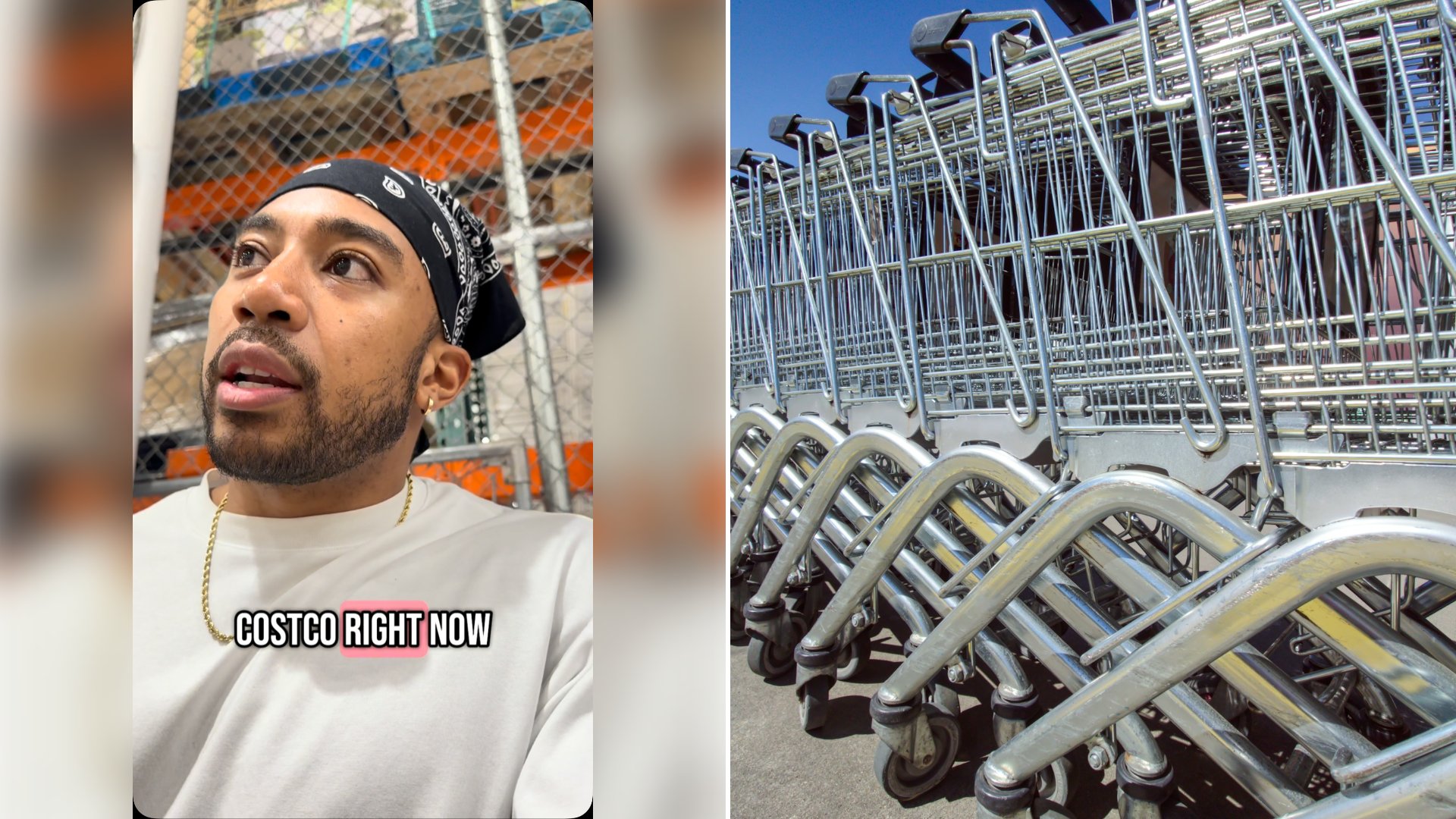
A woman who posts as @_cinque_ says watching a stranger’s grocery total ring up at Costco left her grateful for her own, much smaller bill. “$1300 at Costco is absurd, but I get it,” she writes in the caption, tagging the post #singlelife and #nokids.
She does not say in the caption whose total she watched or how many items were in the cart, but the framing, paired with those hashtags, makes clear the contrast she is drawing: a bill that size looks normal once you assume it belongs to a family feeding several kids, and abnormal once you imagine it belongs to just one person.
Her comment section turned into a running tally of other people’s own Costco bills. One commenter wrote that they are glad they only have to feed themselves, joking that for someone with kids, $1,300 is the rough equivalent of a plane ticket and a hotel room. Another defended the spending, joking that having kids is “a business that only takes losses” and one you cannot write off. A third commenter asked outright whether the cart belonged to her own husband, noting that she has seven kids with an eighth due later this month, a detail that drew its own wave of replies from other large families comparing notes.
Large hauls like the one described in the comments track with how government researchers say food spending actually works for bigger households. In its last full accounting of child-rearing costs, for a middle-income family raising a child born in 2012, the U.S. Department of Agriculture put the total cost of raising one child to age 17 at about $241,080, with food making up 16 percent of that figure. The agency also found that per-child costs drop as families add more children, with households raising three or more kids spending 22 percent less per child than households with two. USDA researchers attributed part of that drop directly to bulk buying, noting that larger families are able to purchase food “in larger and more economical quantities,” the same dynamic a warehouse store like Costco is built around.
Annual per-child costs in that same USDA estimate ranged from about $12,600 to $14,700 depending on the child’s age, with the higher end applying to teenagers, who eat more and cost more to clothe and transport. A family feeding several children of different ages at once, the kind of cart that could plausibly produce a $1,300 total, would be drawing from several of those age brackets in a single trip rather than one.
That means a single big-box receipt is not a reliable way to judge whether a family is spending more or less per person than a smaller household. A $1,300 cart feeding a family of seven or eight for a stretch of weeks can work out to less per person than a few hundred dollars spent feeding two or three, simply because bulk pricing rewards the larger order.
The USDA figures are more than a decade old and the agency has not published an updated version of the full report since, so the dollar amounts themselves have not kept pace with current grocery prices. The underlying pattern researchers found, that per-child costs shrink as household size grows, is the part of the data that still applies directly to a receipt like the one that prompted @_cinque_’s post.
@_cinque_ never names or shows the other shopper in the clip, keeping the comparison to her own single-person perspective on grocery spending rather than a critique of anyone else’s cart.
More from Cultivated Comfort
- Woman Filming Herself in a Store Parking Lot Says a Stranger Called Her Obnoxious, Replies That She Makes $500,000 a Year, Then Sits in Her Car and Says She Is Shaking
- Woman Says a Relative Paid for Her Birthday Thai Lunch in Exact Cash With No Tip, Then the Server Told Them to Order Takeout Next Time and Refused the Tip She Offered on Her Card
- Traveler Says Her 15 Minute Uber to a Miami Cruise Terminal Took Two and a Half Hours, and Partway Through the Driver Told Her to Look Away Because He Had an Emergency