

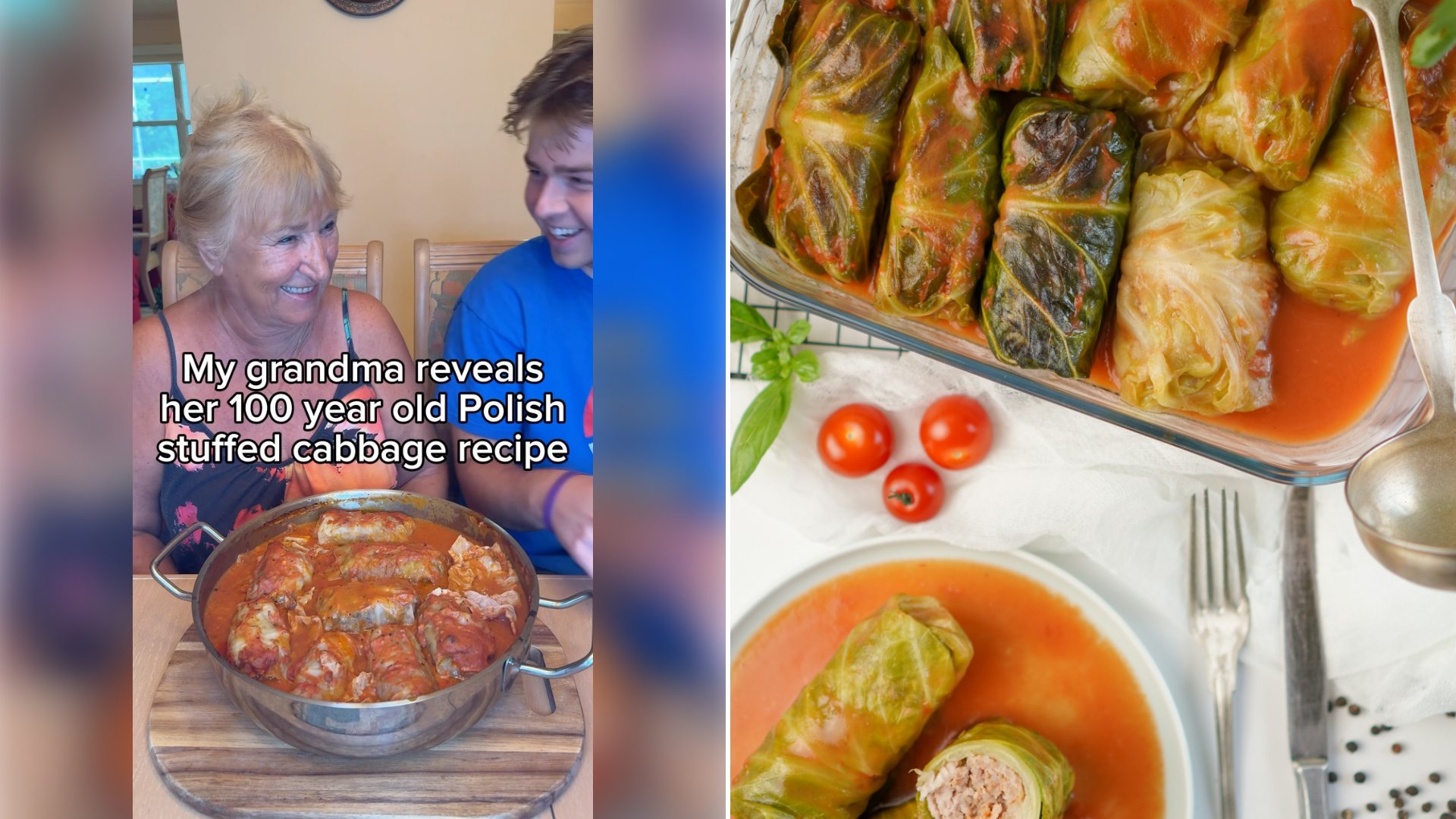
The first frame of the reel from @hkblumes shows a smiling woman seated behind a steel pot of stuffed cabbage rolls in red sauce. The text over her reads “My grandma reveals her 100 year old Polish stuffed cabbage recipe.” The caption calls it “my grandmas secret polish Golabki” with meat and rice, and it asks viewers whether they would want to try it. The whole reel runs about 70 seconds.
After that opening shot the camera moves to the counter and stays on the hands. Cooked white rice goes into a steel bowl of raw ground meat, with a text label saying the rice is “cooked halfway.” Caramelized onion follows, then chicken bouillon powder, and the whole bowl is mixed by hand. Another label tells the viewer what is being added at each point, so the recipe can be followed without sound.
The caption writes out the filling in full: one pound of ground beef, one pound of ground pork, five cloves of garlic, one diced cooked onion, one cup of half cooked white rice, one teaspoon each of paprika, black pepper, salt and garlic powder, and two teaspoons of chicken bouillon. It is a lot of meat for a pot of cabbage, and the rice is the part that surprises, because it goes in only partly cooked.
The cabbage method comes next. According to the caption, you core a green cabbage and set it in hot water over the stove, and once it heats up the leaves come off one at a time without ripping. In the video, tongs lift a pale leaf out of the water. A handful of filling goes in the center and the leaf is folded “like a burrito,” in the caption’s words, so there are no holes. The rolls are then laid into a wide pan in a tight layer.
The sauce is where the video and the caption differ, and both are worth knowing. The caption lists one can of cream of mushroom soup and one jar of tomato sauce, mixed and warmed on the stove. On screen, a jar of tomato sauce is poured into a saucepan, a creamy white mixture is stirred in until the sauce turns orange, and the label reads “Tomato sauce (Use homemade, we didn’t have any).” The rolls go into the pan, and the sauce is poured over them under the label “Cover all the rolls with sauce.” The caption adds that a small amount of sauce goes in the dish before the rolls, and that if there are two layers, sauce goes between them.
The final instruction is the one that makes the dish: cover the pot with foil or a lid and bake at 350 degrees Fahrenheit for three hours, or until the cabbage is soft, and “put in longer if the cabbage is not soft.” The video shows the woman sliding the covered pan into the oven. At the end, a lid comes off to reveal rolls sitting in orange sauce, and one is cut with a fork.
The long, covered bake does useful work beyond softening the cabbage. The U.S. Department of Agriculture says ground beef and ground pork should reach a safe minimum internal temperature of 160 degrees Fahrenheit, and that casseroles should reach 165 degrees. Rolls stuffed with a pound of each meat are a hand mixed ground meat dish, so a food thermometer pushed into the center of a roll, not the sauce around it, is the reliable way to check, whatever the clock says.
Golabki is also a recipe that almost always makes too much, which brings storage into it. The USDA’s Food Safety and Inspection Service says leftovers should be refrigerated within two hours, divided into shallow containers so they cool quickly, kept for three to four days in the refrigerator or three to four months in the freezer, and reheated to 165 degrees. It adds that sauces, soups and gravies should be brought to a rolling boil when reheated. For this dish that means packing the rolls with their sauce into shallow containers before freezing, and reheating them covered so the cabbage does not dry out.
If you try the recipe, use the caption as your shopping list and the video as your timing guide. Measure the filling the way the caption lists it, cook the rice only halfway, and decide on your sauce before you start, since the caption and the video name different ones.
More from Cultivated Comfort
- Grandmother’s Controversial Mac and Cheese Recipe Becomes a Family Tradition as a Recipe Built Around One Unlikely Processed Cheese Became an Unshakable Family Tradition
- Woman Spreads Batter Into the Pan for a Family Recipe and the Caption Reveals She’s Baking It for the First Time Since Losing Them
- Woman’s Turkish Red Lentil Soup Wins Over Her Husband’s Entire Family as No Matter the Season, Her Husband’s Turkish Family Can’t Get Enough of This Soup
