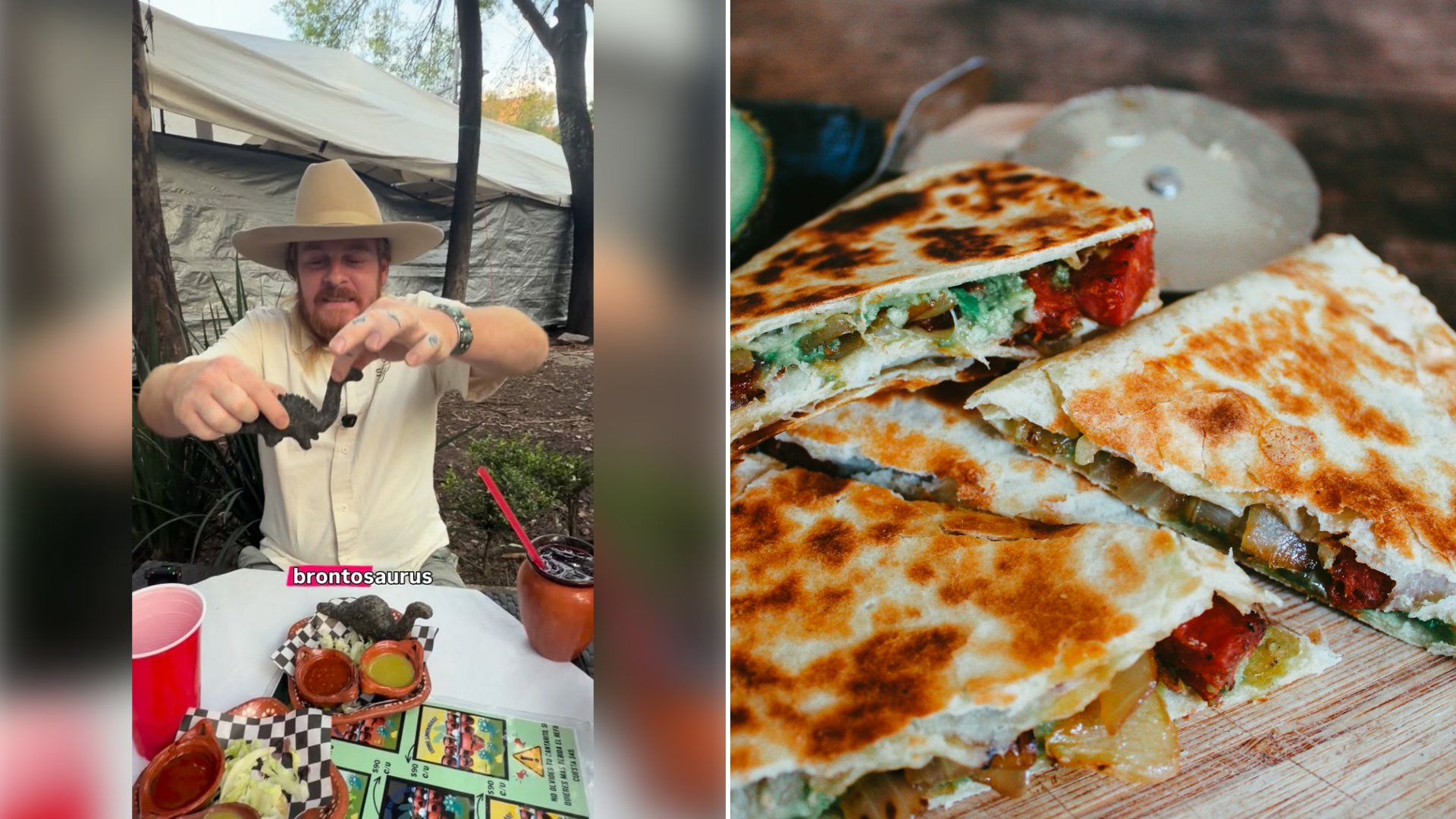
“Mexico City’s known for its food, but if you look hard enough, you’re able to find this legendary place.” That is how the subtitles open in a 50 second Instagram reel from @destinationdaily_, posted on September 11, 2026 and tagged Roma Sur, Mexico City. The caption describes a stall in a small market there serving “a surprisingly delicious treat”: quesadillas pressed into the shapes of dinosaurs.
The reel starts with a woman in a black cap handing a plate to a seated diner, over a table printed like a dinosaur trading card board. Then the host, in a tan hat and a cream shirt, says, in the subtitles, “These are quesadillas in the shapes of dinosaurs.” The stall is shown under a white tent with an orange sign featuring cartoon dinosaurs. The video does not show the stall’s address, and this article does not name the stall or its staff.
The ordering system is the hook. A green menu board, headed in Spanish with the line “Dino escobe tu dinosaurio,” shows a grid of dinosaur pictures to pick from, and a list of fillings that includes cheese and chicharron prensado, with a price of $40 printed beside it. The video does not state the currency. As the host explains it: “First, you got to decide what shape,” then “dinosaur that you want in your filling.” Next, the cook is shown in gloves and a black cap shaping each piece of dough on a mat. The subtitles say it is made “by hand,” and that “this is a loving process.”
The host orders a brontosaurus. He holds up the dark, finished dinosaur and jokes, “I wanted to snap the little neck off,” then describes the filling as chicharron prensado, and says the group agreed it was fantastic. Two others at the table try their own. “Now, obviously, we had to go with the prensado,” a subtitle reads, followed by “and cheese, that is the perfect combination.”
The second dish is a basket of golden fried dinosaur shapes on a checkered liner, with a white dinosaur shaped holder for sauce, labeled on screen “Jurassic Papas.” The host says they are “so fat, you get so much filling,” and then holds a split dinosaur up to the camera to show the chicharron inside, calling it “absolutely insane.” He pulls a cheese stretch from another piece and says that because it is a hawker stall, the coordinates are below. The caption gives a map location and recommends “the chicharron prensado quesadillas and the cheesy potatodinos.”
The caption adds a little more of the host’s account. He says his local friends laughed when he mentioned the spot, and only came “to satisfy my need for dinosaur shaped foods,” but he writes that “to everyone’s surprise it was actually delicious.” The reel closes with the host’s statement that he is traveling, eating at “every food spot my little heart desires,” over a sunset shot of an overland truck on sand dunes.
The dinosaurs are novel, but the base of the dish is not. UNESCO inscribed traditional Mexican cuisine on its Representative List of the Intangible Cultural Heritage of Humanity in 2010. Its decision says the system rests on corn, beans and chili, and describes nixtamalization, the process of hulling maize with lime, which increases its nutritional value. It names tortillas and tamales, both made of corn, among the foods tied to community traditions.
A reader who plans to follow a map pin to a market stall should also read the U.S. Centers for Disease Control and Prevention’s guidance on eating abroad. The CDC advises limiting street food, and says that if you eat it, you should choose food cooked and served steaming hot, because germs grow quickly between 40 and 140 degrees Fahrenheit. It also advises skipping raw vegetables, cut fruit and salads, avoiding ice and drinks made by others, and washing hands with soap and water or using a sanitizer with at least 60 percent alcohol before eating. The fried and pressed dishes in this reel fit the hot food part of that advice, and sauces and any raw toppings are where the CDC’s caution applies.
The practical steps are short. Pick a filling from the board before the cook starts, since each shape is made after you order. Ask what the price covers, because the board shows a number without a currency. Order the dishes that are served hot, and eat them as soon as they arrive. And save the map location from the caption before you go, because the host says the stall is a small one that takes some looking to find.