
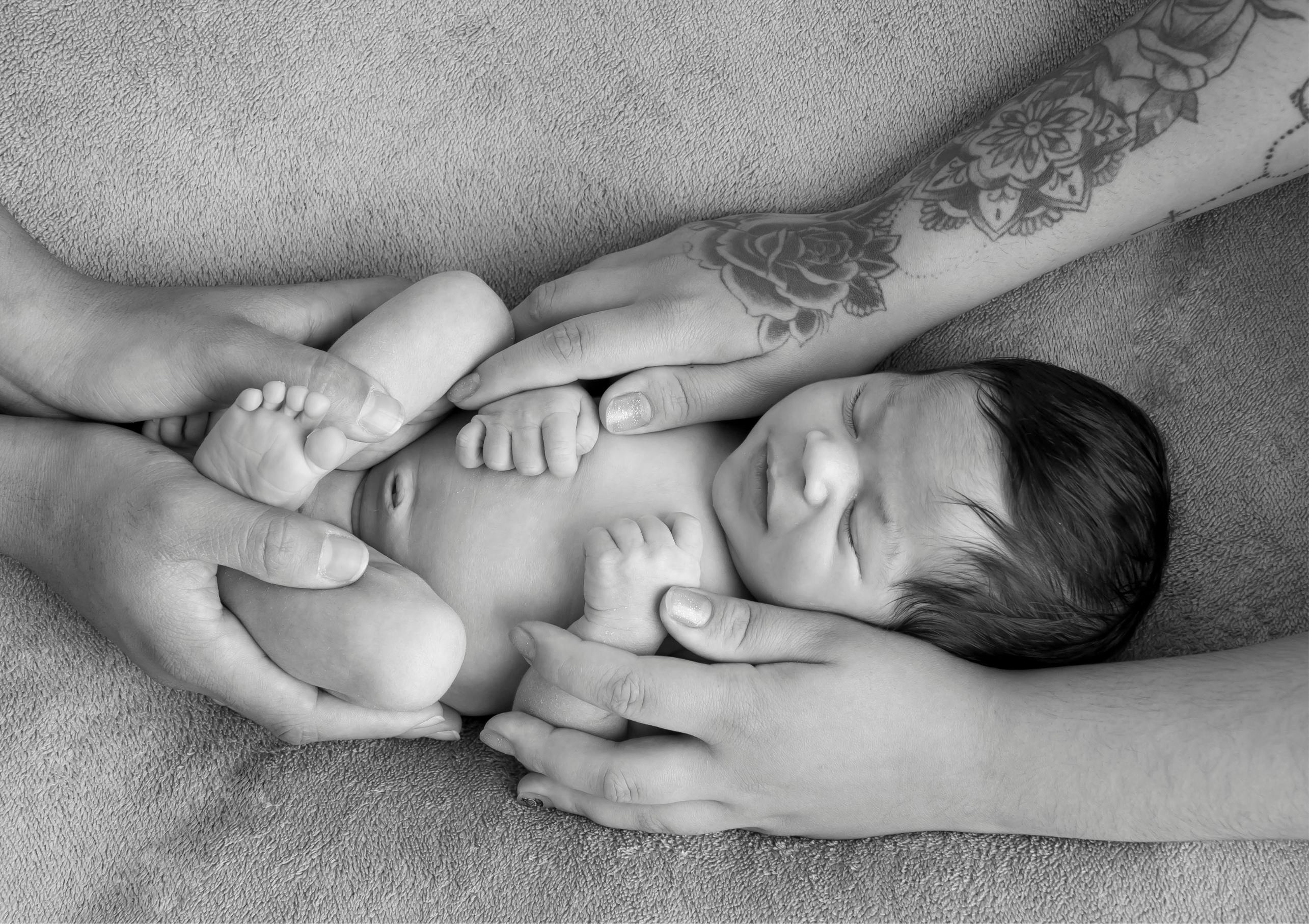
New parents are usually warned that a baby will change their relationship. What’s less understood is how contagious that change actually is between two people. A peer-reviewed meta-analysis published in Frontiers in Psychology in July 2022, pooling data from 49 studies and more than 145,000 participants, found that marital satisfaction drops significantly for both partners in the first year after a baby arrives — and that one partner’s decline measurably predicts the other’s. It isn’t two separate struggles happening under the same roof. It’s one dynamic, moving through both people at once.
What the Research Actually Found
The Frontiers in Psychology meta-analysis, which combined 106 independent samples across the 49 studies — 97 samples of new parents and 9 comparison samples of couples without children — found a meaningful drop in marital satisfaction for new parents between pregnancy and the twelve-month mark. Researchers classified the decline as medium in size for both partners, with an effect size of -0.31 for mothers and -0.29 for fathers on the standardized scales used across the pooled studies. Couples without children showed a much smaller decline over a comparable period, with effect sizes closer to -0.12 to -0.13, underscoring that this isn’t just relationships naturally cooling over time; the arrival of a baby specifically accelerates it. The decline continued into the second year, though more slowly, with mothers showing an effect size of -0.16 and fathers -0.14 between the twelve- and twenty-four-month marks — still a real drop, but roughly half the size of what happened in year one.
One limitation the researchers themselves noted is worth flagging: the pooled sample skewed heavily toward mothers, with roughly 139,956 women represented across the studies compared with about 4,790 men, reflecting how much more postpartum relationship research has historically surveyed mothers than fathers. Even with that imbalance, the fathers who were studied showed a decline nearly identical in size to mothers’, suggesting the postpartum dip in satisfaction isn’t a gendered experience so much as a shared one that research has simply been slower to measure on the father’s side.

The “Contagion” Effect Between Partners
The more striking finding is about how the two partners’ experiences interact rather than run in parallel. The meta-analysis found that when one partner’s satisfaction dropped steeply, the other partner’s satisfaction was statistically more likely to drop steeply too — a cross-partner effect confirmed through meta-regression that held for both husbands and wives. In practice, that means a new parent struggling with sleep deprivation, identity shift, or resentment over the division of labor isn’t containing that struggle to themselves. It tends to pull their partner’s satisfaction down with it, and vice versa, creating a feedback loop rather than two isolated adjustment periods.
That pattern lines up with older, well-known findings from relationship researchers John and Julie Gottman’s Bringing Baby Home program, which has reported for years that almost two-thirds of couples experience a decline in relationship satisfaction within three years of having a baby. The Gottmans’ own research identified what separated the couples who avoided that decline: they maintained a strong sense of friendship with each other, practiced healthy conflict management, and approached the demands of a newborn as a shared project rather than two separate jobs — a description that fits neatly with the newer meta-analysis’s finding that the two partners’ trajectories move together rather than independently.
Why This Matters More Than the Individual Numbers
The practical takeaway isn’t just that new parents should expect their own satisfaction to dip — most already brace for that. It’s that supporting a struggling partner isn’t a favor extended to them separately from your own well-being; the research suggests it’s directly tied to your own trajectory too. A partner who feels alone in the adjustment, unsupported, or resentful is statistically more likely to drag both people’s satisfaction down together, while a partner who feels backed up appears to buffer the decline for both of them. That reframes postpartum relationship strain less as an individual mental-health issue to manage solo and more as a shared system that either reinforces itself downward or gets actively interrupted by both people.
What Couples Can Take From It
None of the researchers behind the meta-analysis frame a satisfaction dip after a baby as abnormal — it showed up across the overwhelming majority of the 49 studies reviewed, regardless of culture or sample, and the second-year data suggests the sharpest part of the adjustment tends to ease somewhat rather than compound indefinitely. The finding worth sitting with is the interdependence: because one partner’s struggle spreads to the other, checking in on a partner’s adjustment isn’t separate from protecting your own. The couples most likely to weather the first year intact appear to be the ones who treat the dip as something happening to the relationship, not to one person inside it.