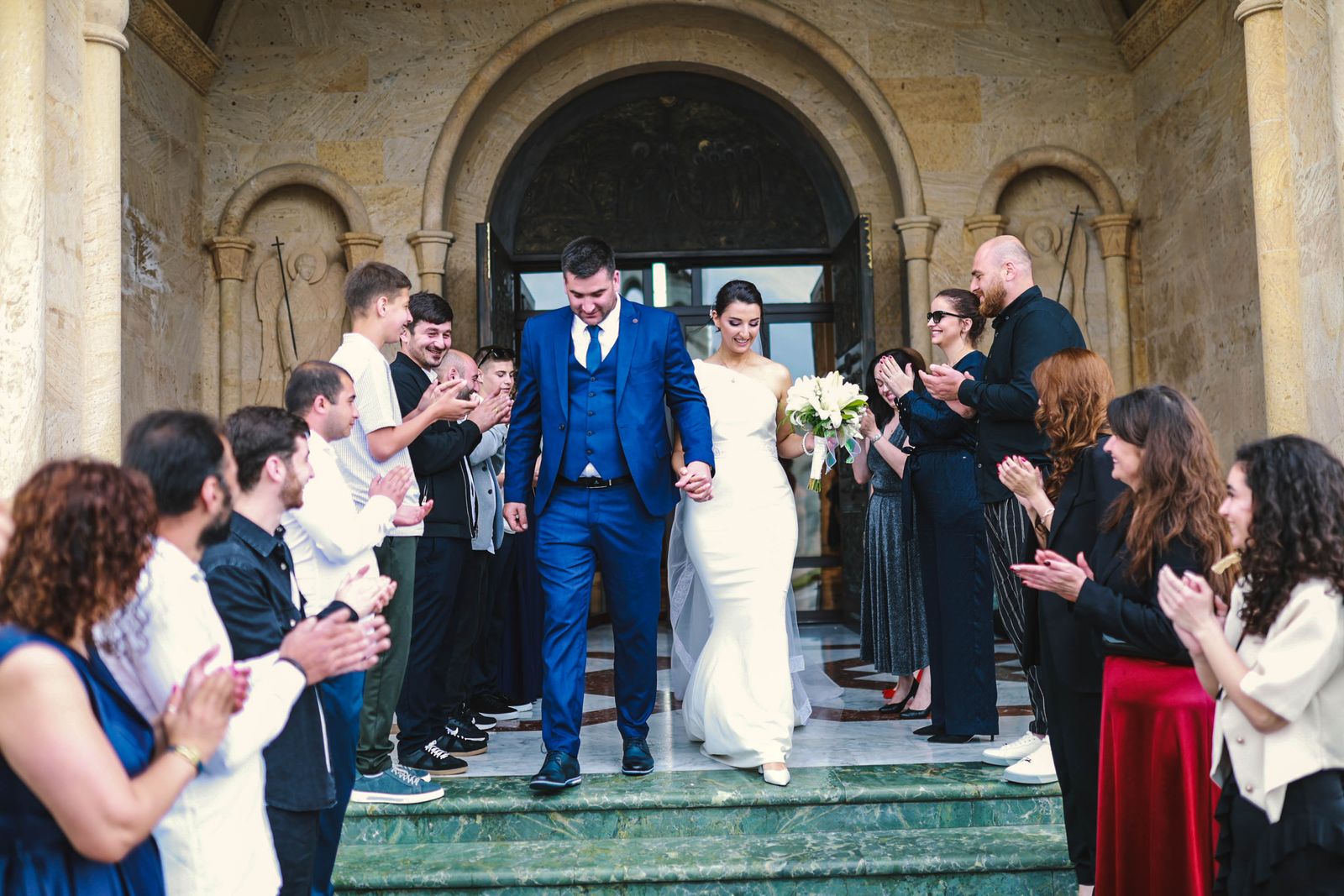
The average U.S. wedding cost $34,200 in 2025, according to The Knot’s 2026 Real Weddings Study, which surveyed more than 10,000 couples married that year. Cost per guest actually rose, climbing from $284 to $292. Eighty-five percent of couples told The Knot the economy directly shaped how they planned, and yet 77 percent of the couples who adjusted their budgets ended up spending more, not less, according to The Knot Worldwide’s press release.
Where the Money Actually Goes
Reception venues remain the single biggest line item, averaging $12,900, per The Knot’s cost breakdown. A live band runs $4,500 on average against $1,800 for a DJ, flowers average $2,800, and catering alone runs about $80 per person — which on a typical 117-guest wedding adds up to more than $9,000, as AOL’s breakdown of the same study pointed out.
Where you get married changes the math dramatically. A hometown wedding averages $32,600, but a domestic destination wedding jumps to $41,700, and an international one runs $43,700. New York City weddings average a striking $88,000, more than five times what couples spend in Wyoming, Idaho, or Utah.
Generation matters too. Gen Z couples are spending the least at $30,000 on average, Gen X couples come in even lower at $23,000, and millennials sit well above both at $39,600. Who pays shapes the number as well: weddings the couple fully self-funds average $25,500, versus $39,600 when parents cover the minority of costs.
Couples Are Rethinking the Math, Not Cutting the Wedding
Esther Lee, The Knot’s Editorial Director, said in the press release that “no matter the economic climate, couples continue to prioritize celebration and are investing accordingly.” Three in four couples told researchers their wedding was financially worth the investment.
What’s changing is where the spending gets trimmed and where it gets protected. Lab-grown diamonds, now in 61 percent of engagement rings sold, are part of the same pattern of trading down on one category to protect spending in another. Gen Z couples now make up 41 percent of the wedding market.
What This Means If You’re Planning One
Guest count moves the needle more than almost any other decision: a wedding under 50 guests averages $17,100, while one over 100 guests averages $43,300, a gap of more than $26,000 driven almost entirely by headcount rather than venue or vendor choice.
Even within a single budget tier, the range is enormous. Couples spending under $15,000 total average $8,900, the study found, while those in the $15,000-to-$40,000 bracket average $26,400 and couples spending above $40,000 land closer to $70,300 — a reminder that “a wedding” describes wildly different events depending on who’s paying and what they’re prioritizing, and that the $34,200 national average obscures more than it reveals about any individual couple’s actual budget.
Couples in 2026 aren’t spending less because they’ve lost enthusiasm for the day. They’re spending more deliberately, protecting the parts of the wedding that matter most and cutting everywhere else, which is a very different story than the one “wedding costs are exploding” headlines usually tell.
That distinction matters for anyone currently budgeting their own wedding against a number they saw in a headline. The $34,200 average is built from thousands of very different weddings — small backyard ceremonies, sprawling 200-guest affairs, destination weddings on another continent — and using it as a target rather than a data point risks either overspending on a wedding that doesn’t need to hit the average, or feeling like a modest, guest-count-conscious wedding somehow falls short of a “real” one. The data says neither assumption holds up.
The most reliable way to use The Knot’s numbers, according to the study’s own framing, is to work backward from the specific line items that matter most to a given couple — venue and catering for some, photography and videography for others — rather than starting from a single national average and trying to make every category fit under it proportionally. Couples who build a budget around their own priorities, the data suggests, tend to report higher satisfaction with the day than those chasing a national benchmark that was never built with their specific wedding, guest list, or region in mind in the first place.