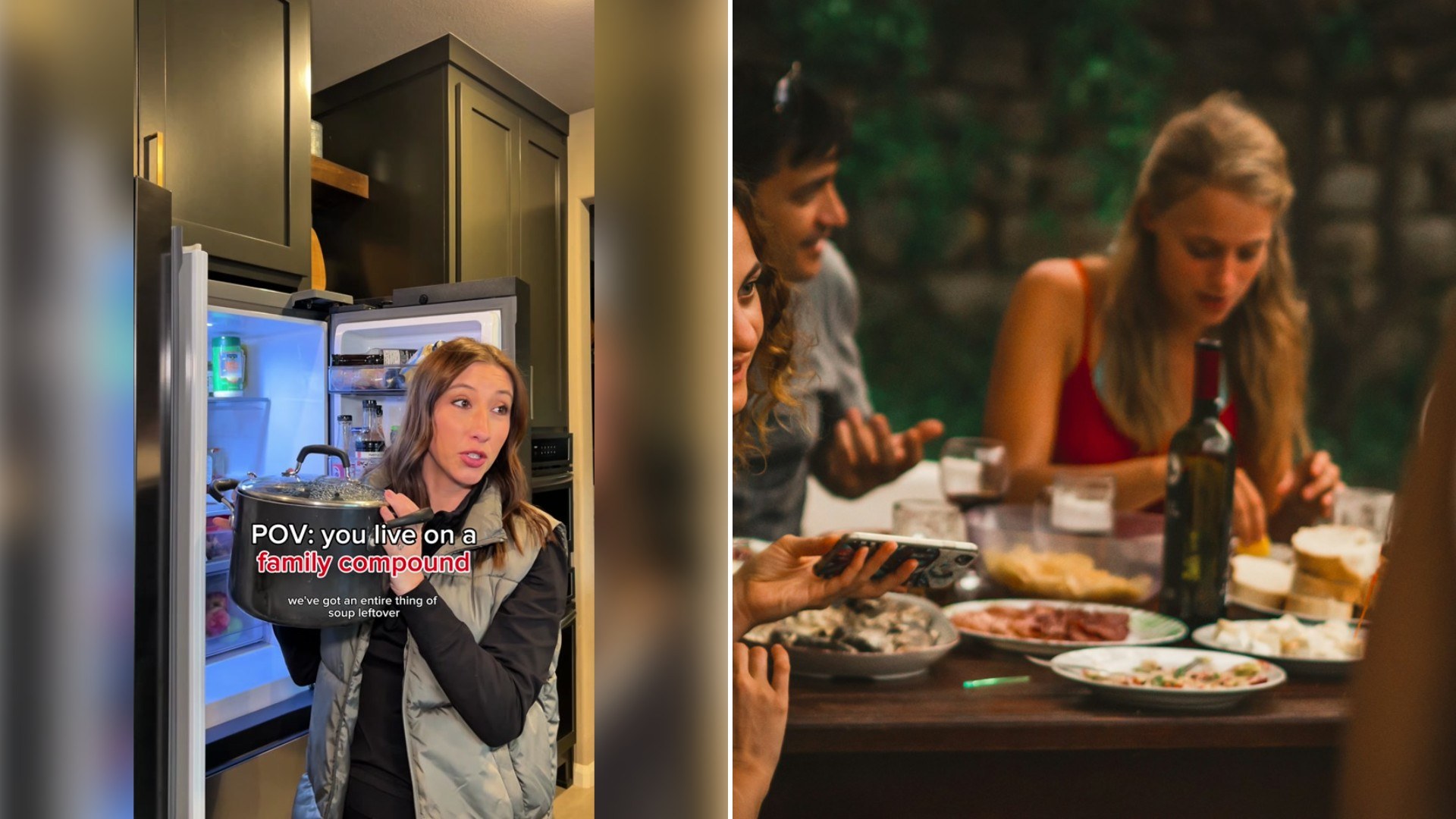
Most people are stuck with whatever’s on the menu at their own kitchen table on any given night. One man living on a multi-generational family compound apparently has options, and he uses them shamelessly.
The creator, @hook_ranch, lives on a property with several relatives’ homes clustered together, and the video follows him walking door to door, asking each household what they’re making for dinner that night, holding out until he finds an option that actually appeals to him. The bit plays up the close-knit, food-centered dynamic of a family that all lives within walking distance of each other.
@hook_ranch The walk was worth it 🤣 would you live like this?? #familycompound #hookranch #familyhumor @carm_grubb @Hayley Molina @Mo Molina @Trevor Grubb ♬ For Comedy – Andromeda
Multi-generational family compounds, where several related households share a single property, remain relatively rare in a lot of modern housing arrangements, but they carry obvious practical upsides beyond shared land, including, apparently, a built-in dinner-shopping system that no single-family household could replicate. Being able to canvas multiple kitchens before committing to a meal is a genuinely unusual luxury.
It’s worth naming exactly what has to be true about a family for a bit like this one to work at all, let alone read as charming rather than intrusive. Walking up to a relative’s door uninvited, specifically to ask what’s cooking with the implicit goal of possibly eating there instead of at home, only works in a family where that kind of casual, boundary-free wandering between houses is already the norm, not the exception. A more formal or reserved extended family would find that kind of unannounced dinner-scouting mission mildly rude at best. That it plays here as an obviously familiar, well-worn routine says a lot about just how thoroughly the usual boundaries between separate households have been dissolved on this particular property.
There’s also something worth thinking about regarding the specific logistics of a compound like this, several related households clustered close enough together that walking between them for a dinner survey is a realistic option rather than requiring a car. That kind of physical proximity, several generations or branches of a family choosing to build or buy property near enough to each other to make casual daily visits easy, reflects a deliberate decision somewhere along the line to prioritize closeness over the kind of geographic spread that pulls a lot of extended families apart as each generation moves on to wherever work or opportunity happens to take them.
The specific comedic structure of the bit, going door to door and holding out for the best option rather than settling for the first house he checks, also does real work. It frames dinner not as a fixed obligation tied to his own household but as a genuine marketplace of options, each house effectively competing, however unintentionally, for his evening meal. That framing turns an ordinary, mundane question, what’s for dinner, into a small game with real stakes and a satisfying payoff once he finally lands on the house serving something he actually wants.
The bit works specifically because it treats an unusual living arrangement with total casualness, presenting the door-to-door dinner survey as a perfectly normal Tuesday activity rather than something worth remarking on. That casualness is exactly what makes the format land as funny rather than as a commentary on family closeness. There’s a specific comedic effect that comes from underselling something genuinely unusual, treating an arrangement most viewers have never personally experienced as though it’s the most ordinary thing in the world, which lets the humor emerge naturally from the gap between how strange the setup would sound described out loud and how completely normal it clearly is to everyone actually living it.
There’s also an implicit comment on food and generosity built into the bit, even if it’s never stated outright. For a dinner-shopping strategy like this one to actually work, every household on the property has to be the kind of place where showing up unannounced and getting fed is an accepted, unremarkable possibility rather than an imposition. That’s its own quiet marker of a family culture built around abundance and hospitality, where feeding a wandering relative, even one who’s clearly there specifically because he didn’t like the smell coming from his own kitchen, is simply part of how the whole arrangement functions.
Videos like this one also tend to resonate with viewers who grew up in, or wish they’d grown up in, exactly this kind of tightly clustered extended family, one where doors are functionally always open and dinner is as much a communal resource as it is an individual household’s responsibility. For anyone whose own extended family is scattered across different cities or states, the sheer convenience on display, multiple dinner options within a short walk, several generations close enough to drop in on casually, reads as an almost aspirational version of family life that a lot of modern living arrangements have made increasingly rare.
There’s also a small, unspoken social calculus playing out beneath the humor, the kind every family compound like this one probably navigates without ever discussing it directly. Some houses are presumably known, over time, for consistently good cooking, others for a more hit-or-miss track record, and a running, informal ranking of whose kitchen is worth checking first likely exists in the back of everyone’s mind on a property like this, whether or not it’s ever said aloud. Making that unspoken ranking visible, turning it into an actual door-to-door circuit, is part of what gives the bit its specific charm, putting a playful spotlight on a dynamic that surely already existed quietly before a camera ever got involved.
Whichever house ultimately won his dinner vote that night, the bigger takeaway is the setup itself: a family living close enough, and open enough, that going door to door for a better dinner option is simply how things work around there, a small, funny bit built entirely on the foundation of an unusually close-knit way of life.