A standard smash burger wasn’t ambitious enough for @meatlicious_, who instead built a jalapeno popper stuffed version completely from scratch, walking through every over-the-top component on camera. The video breaks down the full build, from the stuffed patty itself to every topping layered on afterward, turning what could be a simple burger video into a genuinely elaborate comfort-food project.
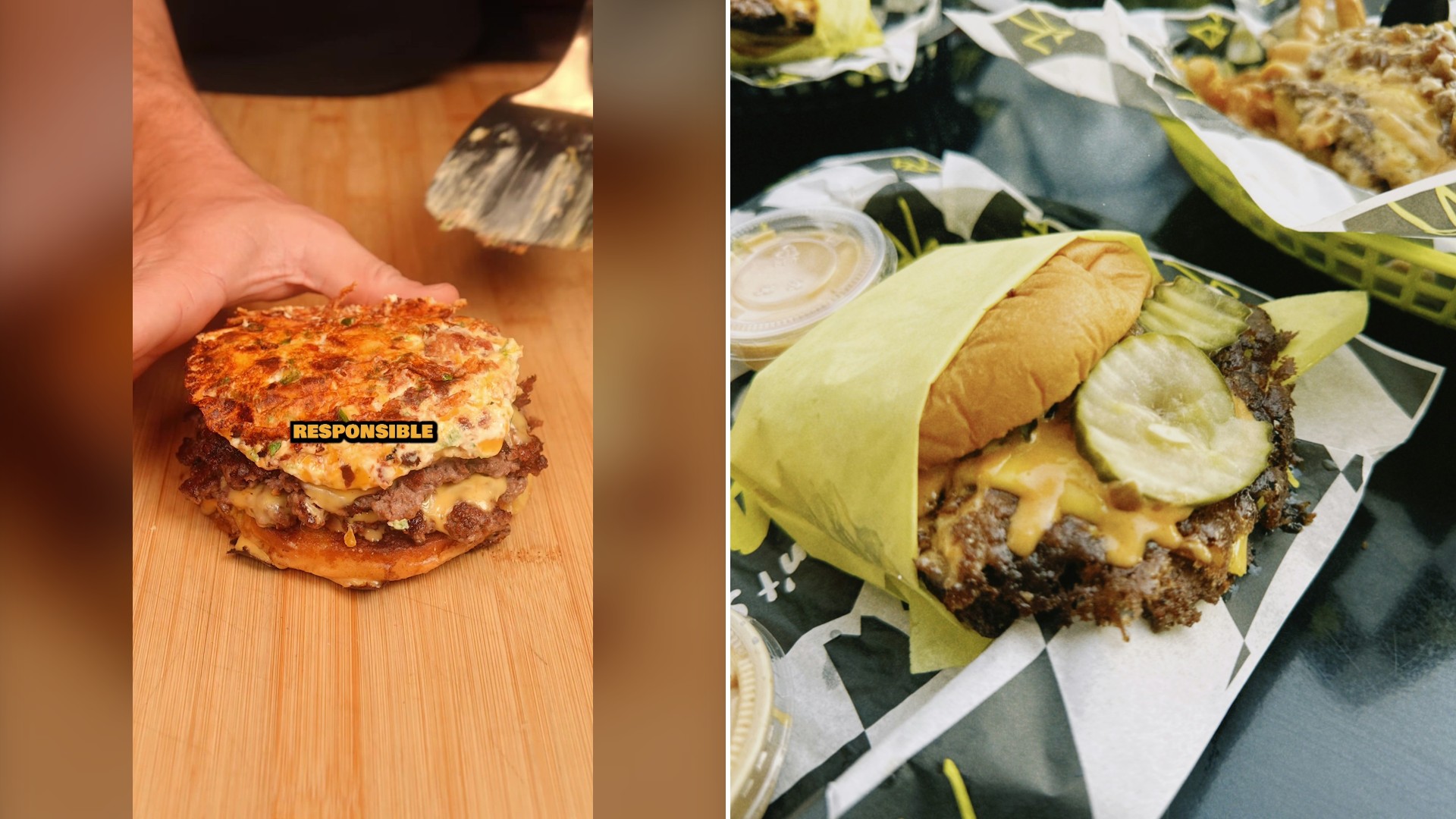
@meatlicious_
Smash burgers have become one of the most popular burger techniques in home cooking over the past several years, prized for the deep, caramelized crust that forms when a loosely packed ball of ground beef is pressed flat against a screaming-hot griddle or cast iron pan. That high-heat contact triggers the Maillard reaction more aggressively than a thicker, slower-cooked patty, producing a lacy, crisp edge that traditional burger-flipping methods rarely achieve.
Stuffing a smash patty with a jalapeno popper filling, typically a blend of cream cheese, shredded cheddar, and diced jalapenos, adds real technical difficulty to an otherwise simple format. The filling needs to be fully enclosed inside the patty before it hits the heat, since any exposed filling will leak out and burn against the hot surface rather than staying contained inside the meat as it cooks. Getting that seal right, without the patty falling apart during the smash itself, is one of the trickier parts of this kind of build.
Elaborate, stackable burger builds consistently perform well as a content format because of the visual payoff at each stage. Every added component, a second stuffed patty, a specialty sauce, pickled jalapenos, a toasted bun, gives the video another distinct, satisfying moment, which keeps viewers watching through to the final build rather than losing interest partway through a single-step recipe. That step-by-step structure is part of why elaborate burger content tends to outperform simpler versions of the same dish despite requiring more watch time to finish.
From a food safety standpoint, stuffed burgers carry a slightly higher risk than a standard patty, since the filling and the raw edges folded around it need to reach a safe internal temperature throughout, not just at the surface. Ground beef should reach an internal temperature of 160 degrees Fahrenheit according to USDA guidance, and that standard applies to the thickest, most insulated part of a stuffed patty just as much as the exterior, making a meat thermometer a more reliable check than visual doneness alone for this particular build.
For home cooks inspired to attempt their own version, starting with a smaller, well-sealed test patty before scaling up to a full multi-component build is a reasonable way to work out the technique without wasting a large batch of ingredients. Chilling the stuffed patties briefly before cooking also helps the filling hold its shape during the initial smash, giving the burger a better chance of staying intact through the full cooking process rather than falling apart on the griddle.
More from Cultivated Comfort
- Food Vlogger Says His Local Friends Laughed at a Mexico City Stall Selling Hand Made Dinosaur Quesadillas, Then Calls the Chicharron Prensado Filling Absolutely Insane
- Woman Says She Spent 24 Hours in a Luxury Seafood Spa Buffet in China and the Video Shows Red Crustaceans Piled on Ice, a Tablet Menu, a Makeup Counter and a Room With a Minibar
- Man Filming Inside Costco Says a $330 Disneyland Bundle With a Two Day Park Hopper, a Lightning Lane Pass and a $60 Dining Credit Saves a Family of Four $980, Then Shows the Math