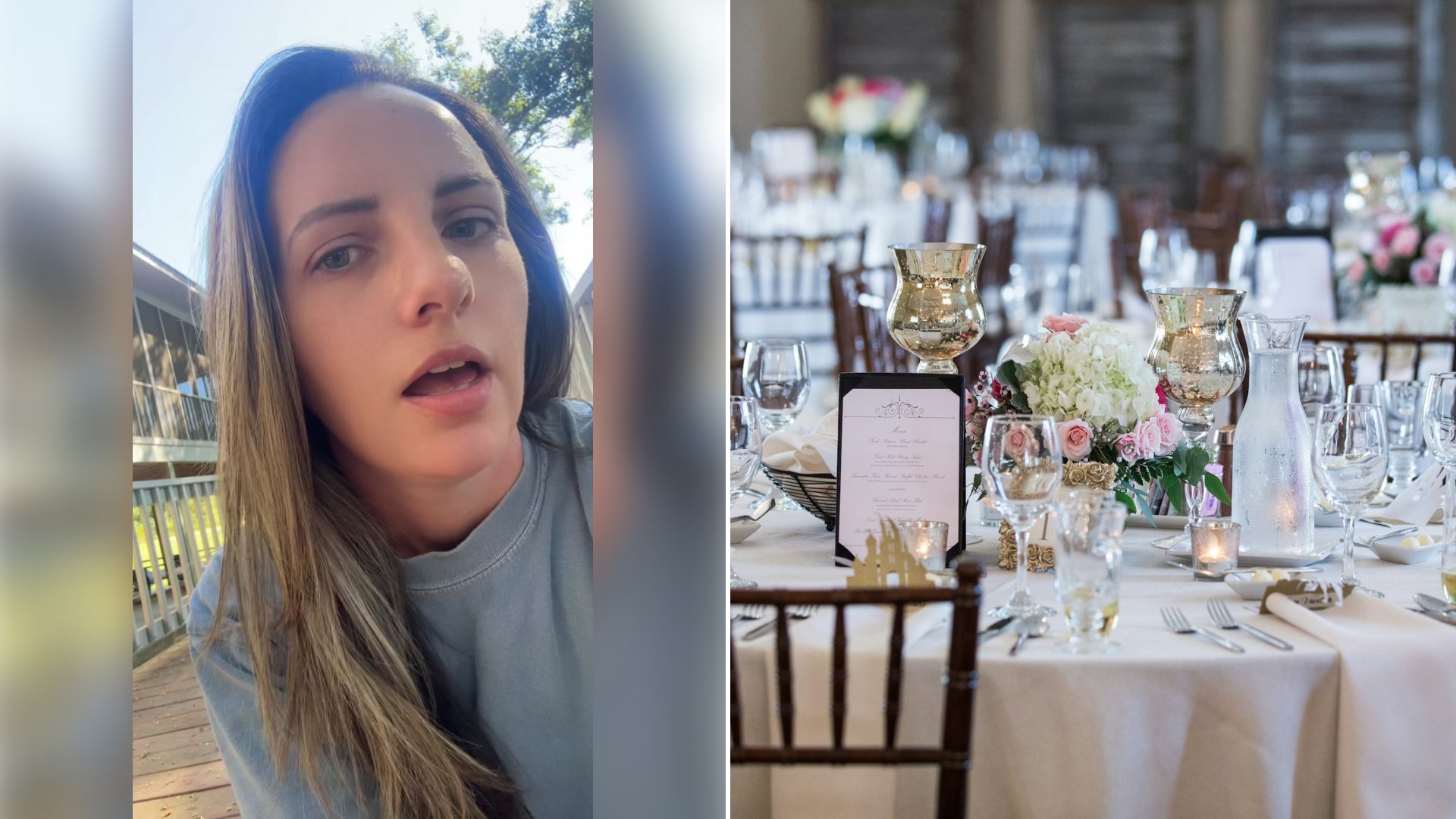
The Venmo request was for $350, and it came from the bride. “I thought that it was a mistake at first,” says the woman who received it, “so I wrote her, and I’m like, hey, what is this request for?” The answer, she says, was four words: “That’s your wedding fee.”
She posts as @.hunter0327 under the name Hunter, and she told the story on September 28, 2026, standing outside on a wooden deck in a gray tee with the words “Wedding Fee?” on screen. Her first sentence gives away the outcome: “I won’t be attending my best friend’s wedding after she sent me a Venmo request for $350.”
She gets two clarifications in early. “This isn’t a destination wedding.” And the request did not go only to the bridal party: “She sent it to everybody that’s attending.”
Her reply to the bride, as she recounts it, was a list of what the wedding had already cost her. “I’ve already bought my shoes,” she says. She is paying for hair and makeup. “I’ve taken time off work. I have a hotel.” Then she asked again: “What do you mean, my wedding fee?”
The bride’s explanation, in Hunter’s telling, was that “things are just getting really out of hand, so that’s your share for the decorations, the food, the venue, the band.” Hunter asked whether everyone was getting the same request and was told yes. She asked whether that was “a little much.” The reply she reports: “Well, you’re the one that’s choosing to attend.”
That is the line she answers to the camera, twice over: “You invited people. You invited people, and now you’re gonna send them a request for $350?”
According to the video, the bride then offered a trade. “I haven’t received your wedding present yet, so just don’t send it,” Hunter quotes her as saying. “And just think of that as the money you would have spent on the wedding present.” Hunter’s last words are “I can’t do it,” and her caption adds that $350 “is a lot to charge someone.” The bride is not named, and the video gives only Hunter’s side of the exchange.
A guest who receives a request like this can start where she started. Do not pay it and do not ignore it. Ask what it is for. Her questions got the full picture in one exchange: what the charge was, what it covered and whether every guest was being sent it.
Next, make the list she made, and add a column she does not mention: what can still be undone. Start with the hotel, because a cancellation has a deadline. Then the hair and makeup booking, the return window on the shoes, and the time off work. Have that total in front of you before you answer, because staying home does not bring back money that is already spent.
Weigh the bride’s trade with a real number. She proposed that the $350 take the place of the present. Put the amount you had planned to spend on a gift next to $350. If the two are close, the request changes the form of your gift more than its cost. If you had budgeted far less, reply with a figure: “I can send $100 toward the day in place of a gift.”
Answer once, in writing, and keep screenshots of the request and the messages. A short reply is enough: “I can’t cover $350 on top of the hotel and the time off, so I won’t be able to come. I hope the day is wonderful.”
For anyone planning a wedding who needs guests to share the costs, the place to say so is the invitation, with the amount and what it covers, before anyone buys shoes or books a room. Hunter’s objection is to the order: the invitation came first and the bill came after.
More from Cultivated Comfort
- Bride Cancels Her Wedding Five Months Before The Ceremony After A $26,000 Catering Quote Pushes The Venue Bill Toward A Shocking $50,000 Total
- Bride Tells Her Bridesmaid She Cannot Wear A Slick Back Bun At The Wedding, Then The Internet Calls Her Controlling And Floods Her With Vicious Messages
- Bridesmaid Catches the Wedding Bouquet and Seconds Later Her Own Boyfriend Drops to One Knee in Front of the Whole Reception