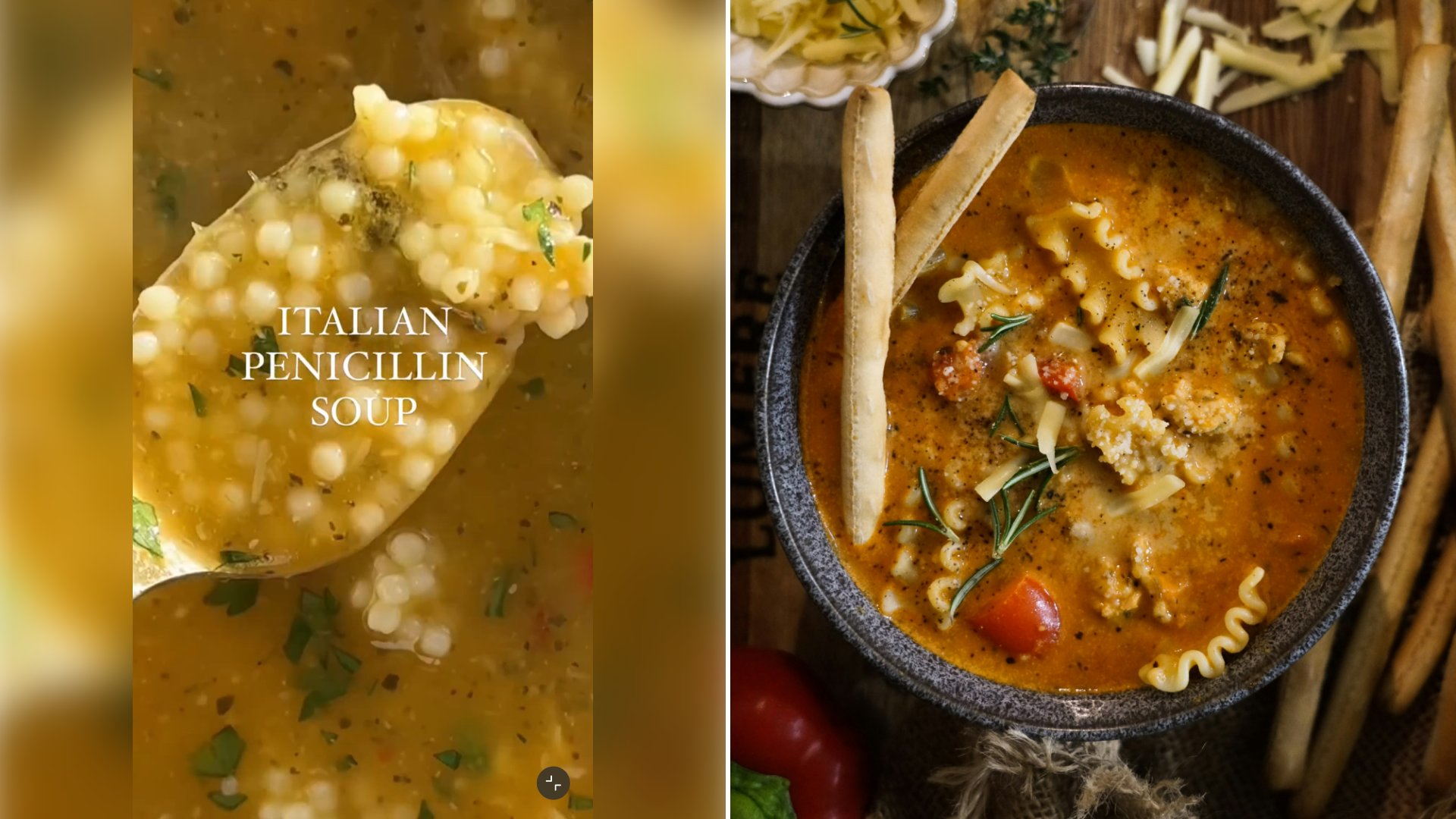
“My Nana’s Italian penicillin soup,” reads the caption on the reel from @blaircoooley, with a note that it is “that time of year for the best soup ever.” The creator adds that she is happy so many viewers love it and say it has helped them feel better. The video, posted on September 30, 2026, runs about a minute and opens on a spoonful of pastina in golden broth under the title text “My Nana’s Italian Penicillin Soup.”
The story is told in small on screen captions as the soup comes together. The first reads “I actually am Italian,” and the next ones say she grew up with her Nana making the soup and that this soup “should stop any sickness dead in its tracks.” She says that when her mom was coming to visit for Thanksgiving, she was asked if there was anything from home she wanted her to bring. The pastina, the tiny pasta in the soup, is the thing she says she cannot find where she lives, and in the kitchen scene she stands in a red fleece holding a pot and pouring out the pasta water. She says the soup is packed with nutrients and vegetables, but that you would not know it because the vegetables are blended, which makes it good for picky eaters. The video closes with her tasting a bowl and a line telling viewers to think of it as a big Italian hug from her Nana.
The caption gives the full recipe. In a large stock pot she combines four cups of bone broth with six cups of water and four teaspoons of chicken bouillon (or one tablespoon if using chicken broth). Into the pot go five large peeled carrots, five celery stalks, one white onion, five cloves of garlic and a couple of sprigs of thyme and rosemary. An optional teaspoon of Calabrian chili paste goes in as well, and the video shows the jar going into the pot.
Everything comes to a boil, then simmers covered on low for about 20 minutes, until the vegetables, mostly the carrots, are tender. While that happens she cooks the pastina according to the box. With a slotted spoon she removes the carrots, onion, celery and garlic, adds a teaspoon of bouillon and a cup or two of the broth, and blends the mixture smooth. She stresses that the stringy parts of the celery must be fully blended, and says to use a mesh strainer if bits remain. The herbs come out and are discarded.
The smooth vegetable purée goes back into the broth along with shredded cooked chicken, which she makes with rotisserie chicken without the skin, and the juice of one lemon, or half a lemon for a milder soup. In the serving bowl, she puts a dollop of pesto first, then a mound of pastina, and ladles the broth over the top. Fresh shaved parmesan, chopped parsley and cracked black pepper finish it. She cooks the pastina separately and pours the broth over it, though she says it can be cooked in the pot if you prefer. Her seasoning note is to taste as you go: add water if the broth is too salty, or more bouillon if it is not salty enough.
On the question of “penicillin,” the claim in her post is that viewers say the soup has helped them feel better. It is a comforting soup, not a treatment. The Centers for Disease Control and Prevention is plain about what actually matters when you have the flu: you can return to normal activities once your symptoms have been improving overall for at least 24 hours and you have had no fever without fever reducing medication. CDC says people with flu are most contagious in the first three days, and that people at higher risk, including young children, adults 65 and older and pregnant people, should contact a health care provider early, because antiviral treatment works best when started within about two days of illness onset.
CDC also lists everyday habits for anyone sharing a kitchen with a sick person: cover coughs and sneezes with a tissue or an elbow, wash hands with soap, use a sanitizer with at least 60 percent alcohol when soap is not available, and clean frequently touched surfaces such as countertops and doorknobs.
The creator mentions in her video that you can keep the soup in the fridge for the week and heat it up as needed. The U.S. Department of Agriculture’s guidance supports the plan with two conditions. Its Food Safety and Inspection Service says leftovers should be refrigerated within two hours, cooled in shallow containers, kept three to four days in the refrigerator and three to four months in the freezer, and soups should be brought to a rolling boil when reheated. A pot this size is best divided into containers on the day it is made, and the pastina is best stored separately, which is how the creator cooks it.
More from Cultivated Comfort
- 15 Genuinely Great Fall Soup Recipes Worth Making the Very Second the Temperature Actually Drops Outside This Year, Zero Boring Basics Allowed
- Woman’s Turkish Red Lentil Soup Wins Over Her Husband’s Entire Family as No Matter the Season, Her Husband’s Turkish Family Can’t Get Enough of This Soup
- Fall Menus Usually Just Mean Bringing Back the Same Predictable Pumpkin Item Every Year, but Panera Just Shocked Fans With a Genuinely Unexpected Cheesy Soup