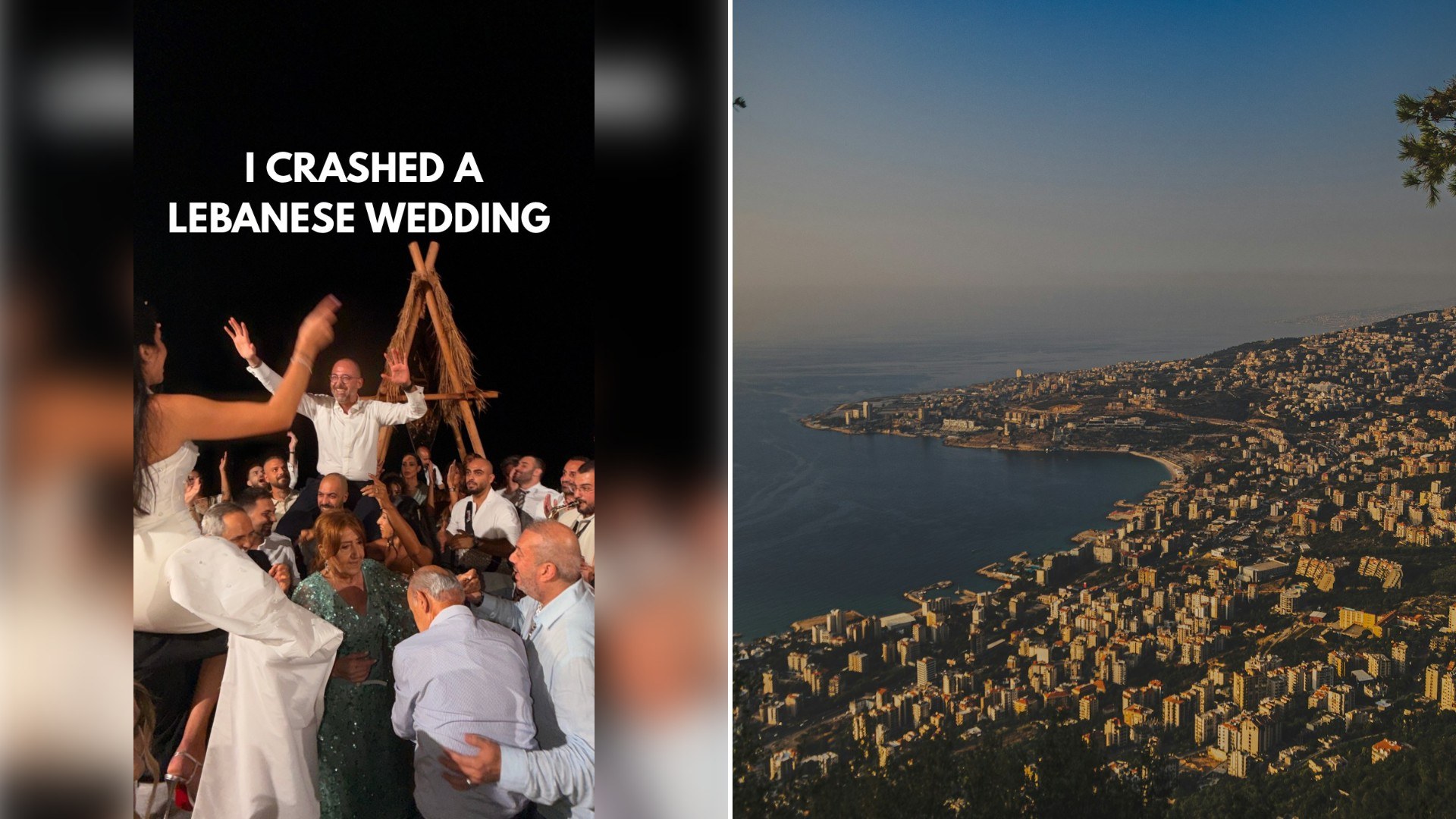
Most conversations struck up with strangers on a flight end at baggage claim. One American traveler’s conversation ended somewhere considerably more memorable: a full Lebanese wedding, hair and makeup included.
The creator, @michellegoesthere, describes meeting a couple on her flight who, somewhere in the course of conversation, ended up inviting her to attend their upcoming Lebanese wedding. She says yes, and the reel follows her spontaneous decision through to the actual celebration, including getting professional hair and makeup done locally before being welcomed into the festivities as a guest.
View this post on Instagram
Weddings are, in most cultures, among the most tightly curated guest lists a family will ever put together, which makes an invitation extended to a stranger met hours earlier on a plane genuinely unusual. That the couple extended it at all speaks to a level of hospitality that goes well beyond polite small talk, and that she actually said yes speaks to exactly the kind of openness that makes spontaneous travel stories worth telling in the first place.
It’s worth thinking through just how quickly this entire chain of events had to unfold. A flight conversation, by nature, is bounded by the length of the trip itself, a handful of hours at most in which two strangers have to move from polite introductions to enough mutual trust and warmth that one party feels comfortable inviting the other into one of the most significant days of their life. That compression is remarkable on its own terms; most friendships take months to build the kind of comfort that would make a wedding invitation feel natural rather than forced, and this one apparently got there somewhere over the ocean, in the space of a single flight.
The choice to actually accept the invitation carries its own significance too. Plenty of people might receive a similarly warm, spontaneous invitation from strangers while traveling and quietly assume it was just polite conversation, never expecting it to be followed up on or meant literally. Saying yes, and then actually following through by getting hair and makeup done and showing up to the celebration, required taking the invitation at face value rather than assuming it was an empty pleasantry, a decision that turned what could have been a forgotten in-flight conversation into a genuinely unforgettable experience.
Travel researchers who study cross-cultural hospitality often note that wedding invitations extended to relative strangers tend to happen far more often in cultures where communal celebration is treated as an extension of hospitality itself, rather than a strictly closed, private affair. Being folded into hair, makeup, and the celebration itself suggests this wasn’t a token gesture; it was a genuine welcome into a family’s biggest day. Lebanese weddings in particular are often described by those who have attended them as expansive, joyful, multi-day affairs built around exactly this kind of generous hospitality, guest lists that stretch to include friends of friends, coworkers, and, apparently, the occasional traveler met on a plane, all treated with the same warmth extended to immediate family.
There’s something worth noting, too, about what it means to be welcomed into the more intimate preparations of a wedding, the hair and makeup that happen before the ceremony itself, rather than simply being seated as a guest once the festivities begin. Those pre-ceremony hours tend to be reserved for the people closest to the couple, a detail that suggests the invitation extended well past a polite seat at the reception and into something closer to genuine inclusion in the day’s inner circle, an extraordinary gesture toward someone the couple had known for only the length of a flight.
Stories like this one circulate as widely as they do because they offer something increasingly rare in a world of heavily planned, algorithm-optimized travel: proof that genuine, spontaneous human connection with strangers is still possible, and that saying yes to an unlikely invitation can occasionally lead somewhere far more memorable than anything a pre-booked itinerary could have produced. It’s the kind of story that makes strangers on a plane feel, for a few hours at least, like far less of a gamble than conventional wisdom would suggest.
It’s also worth acknowledging the specific vulnerability involved in showing up alone to a foreign wedding as essentially a plus-one with no prior relationship to anyone else in the room besides the couple themselves. Every other guest likely has years, sometimes decades, of shared history with the family, inside jokes, old stories, familiar faces. Walking into that as a total outsider, however warmly welcomed, requires a specific kind of social courage, a willingness to be the unfamiliar face in a room full of strangers who all know each other, trusting that the invitation itself will be enough to carry her through an entire day of celebration among people she’s never met.
That kind of leap tends to pay off precisely because wedding celebrations, almost by design, are built to absorb new people easily. The entire occasion revolves around joy, music, food, and dancing, activities that don’t require a shared history to participate in fully. A guest who knows no one can still dance at a wedding, still eat the food, still be swept into the celebration’s energy simply by being present and willing, which likely made the transition from stranger-on-a-plane to welcomed guest considerably smoother than it might have been in a quieter, more conversation-dependent social setting.
What started as small talk on a flight turned into a story most people only get to tell secondhand, a reminder that sometimes the best travel experiences aren’t the ones that were booked in advance at all, but the ones that begin with nothing more than a conversation and the willingness to see where it leads.