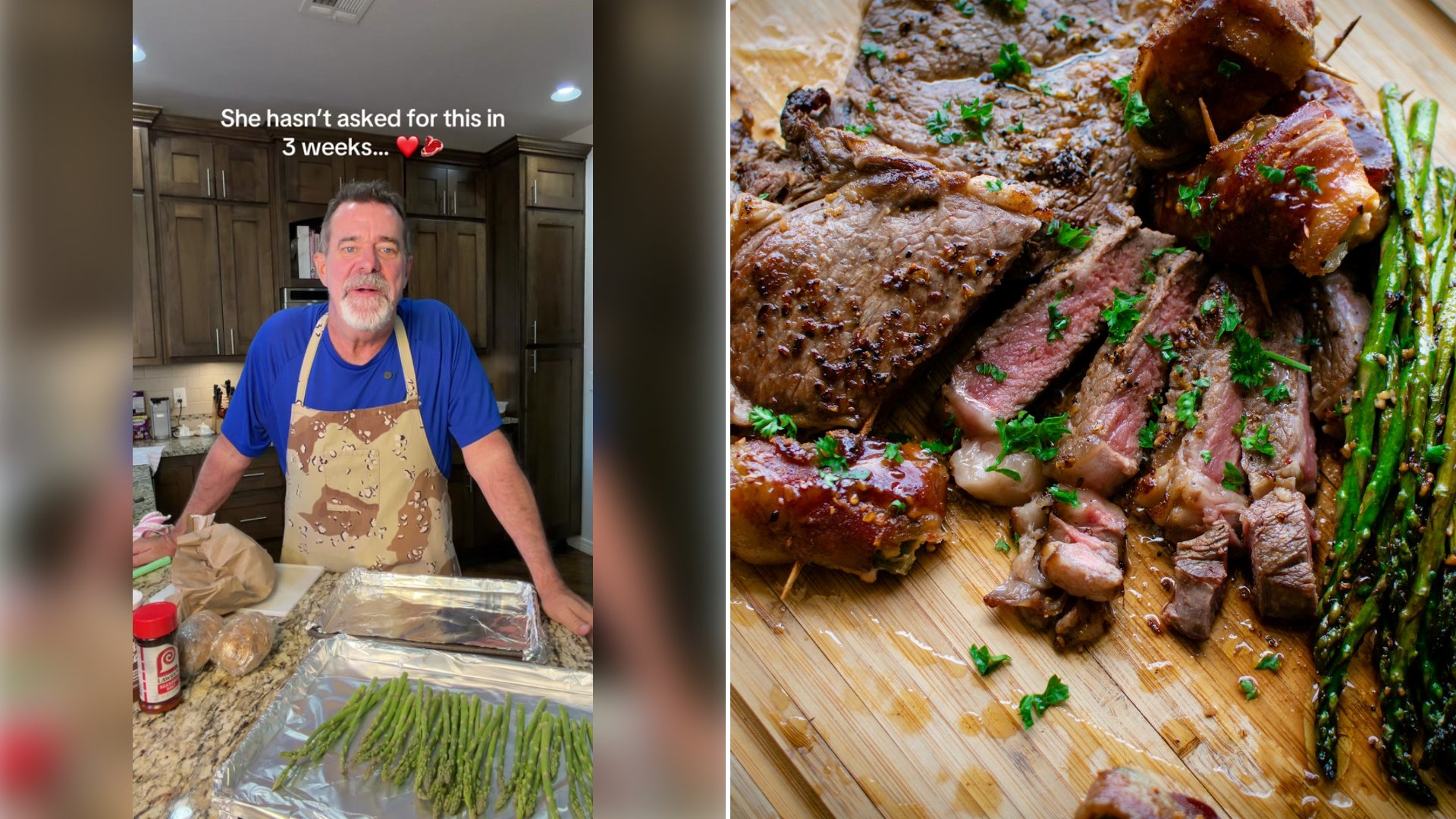
Damon Harrison unwraps a filet from brown butcher paper, sets it on a cutting board and slices it in half. Across the top of the screen, for the whole video, is one line of text: “She hasn’t asked for this in 3 weeks.”
“She” is his mother. Harrison, who posts on TikTok as @thedamonharrison, opens the video, posted on September 20, 2026, with the reason he is cooking in this kitchen at all: “My 85 year old mom has decided she wants to go home and be with Jesus.” He says he moved in, that he takes her dinner order every day, and that “we treat each dinner as though it may be her last.” The house rule follows: “Mama gets what Mama wants.”
This order is a repeat, a filet and a loaded baked potato. In the caption he writes that she usually asks for a filet about every two weeks and that this time it has been closer to three. She likes it medium rare, and he calls it “one of the few meals she will still eat almost every bite of.”
That appetite is why the steak gets cut in two before it goes near any heat. “Because she won’t eat that much, I’m just gonna slice this in half, that way it will cook quicker,” he says. He notes that filets “aren’t cheap,” that this one has more marbling than he is used to, and that half is a good size for her and plenty for him.
The seasoning is not his own idea. “I do this steak the way her dad, my papa, taught me to make it,” he says, holding up a bottle of the cooking sauce he says the family has used his whole life. He brushes a little over the meat, flips the pieces and shakes seasoned salt over both sides. Left to himself, he says, he would do less: “I don’t think a good steak needs a whole lot.” But this, he says, is the way “she always had it from her dad.”
His own father cooked T bone steaks the same way, he says, back in the 1970s and early 1980s. He says his dad died at 59, when Harrison was 29, and that this meal “brings back a lot of memories for her and for me of her dad and my dad.”
The potatoes go into the microwave in plastic wrap, and he stops to answer viewers who objected to that the last time he made this dinner. The wrap, he says, puffs up into a steam bubble and does not touch the potato.
The asparagus is washed, chopped, coated in olive oil, salted and peppered, and put in a 425 degree oven for 12 to 15 minutes. It is mostly for him. He says his mother told him she may not be able to eat it, because “she wants to be able to eat all her steak and all her baked potato.”
While he works he explains how he can be there every night. He says he had shut his business down shortly before his mother told him what she wanted. “I was burnt out,” he says, so “it came at the right time for me to move in and take care of her.” He says he now earns his living online, and that this is where the idea came from to film her meals and, in his words, “check in on the caregivers.”
The grilling happens outside, the two halves side by side on a grill set against a brick wall, and he comes back in with a complaint: “It is too hot in Oklahoma to be grilling right now.”
Then he answers the question he says many viewers have asked. “She’s doing okay,” he says. She “eats a lot less,” and “she said she wants to enjoy as much of the steak and potato as she can.”
So he builds her potato the way she likes it. “A ton of butter” goes in first and gets worked down into the potato, because “she likes a lot of butter.” Then a little sour cream (“Don’t wanna overdo it”), a few sliced green onions, freshly grated cheese and bacon he cooks and chops himself. Before the plate leaves the kitchen he cuts a piece of the steak and tastes it. “She likes it nice and medium rare,” he says. “And it’s perfect.”
His mother never appears on camera. The video ends with him alone at the counter: “Go spend time with your family and love them while you still can.”
Harrison’s routine is easy to copy for anyone cooking for a parent whose appetite is shrinking, and it starts before the stove is on. He asks. A nightly dinner order means she is the one choosing, and it is how he knows that a filet comes up about every two weeks and that this gap ran to three.
Second, cook their version, not yours. He says outright that he would season a filet more simply, and he still makes it the way her father did. If a parent’s favorite dish came from someone else’s hands, find out now whose it was and exactly what went on it, down to the bottle, while they can still tell you.
Third, size the plate to what will be eaten. Halving the steak made a portion she can finish and shortened the cooking time. The vegetable was cooked for the cook. She had told him where she wanted to spend her appetite, and he did not argue for the asparagus.
Fourth, dress it to their taste and check it before it leaves the kitchen. Heavy on the butter and light on the sour cream is her preference, not a recipe, and the bite he takes at the end is a doneness check, so the steak that reaches her is the medium rare she asked for.
More from Cultivated Comfort
- Son Honors His Mother’s Legacy With Her Braised Chuck Roast and Leek Recipe as Every Step, From Browning the Meat to the Final Plate, Honors the Woman Who Taught Him
- Creator and Her Mother Recreate Her Late Grandfather’s Korean Marinated Pickled Radish Recipe From Scratch as the Simple Family Delicacy Keeps His Memory Alive at the Table
- Caregiving Duties Reportedly Ambush the Average American at Just Age 34 Now, More Than a Full Decade Before Anyone Actually Feels Remotely Ready