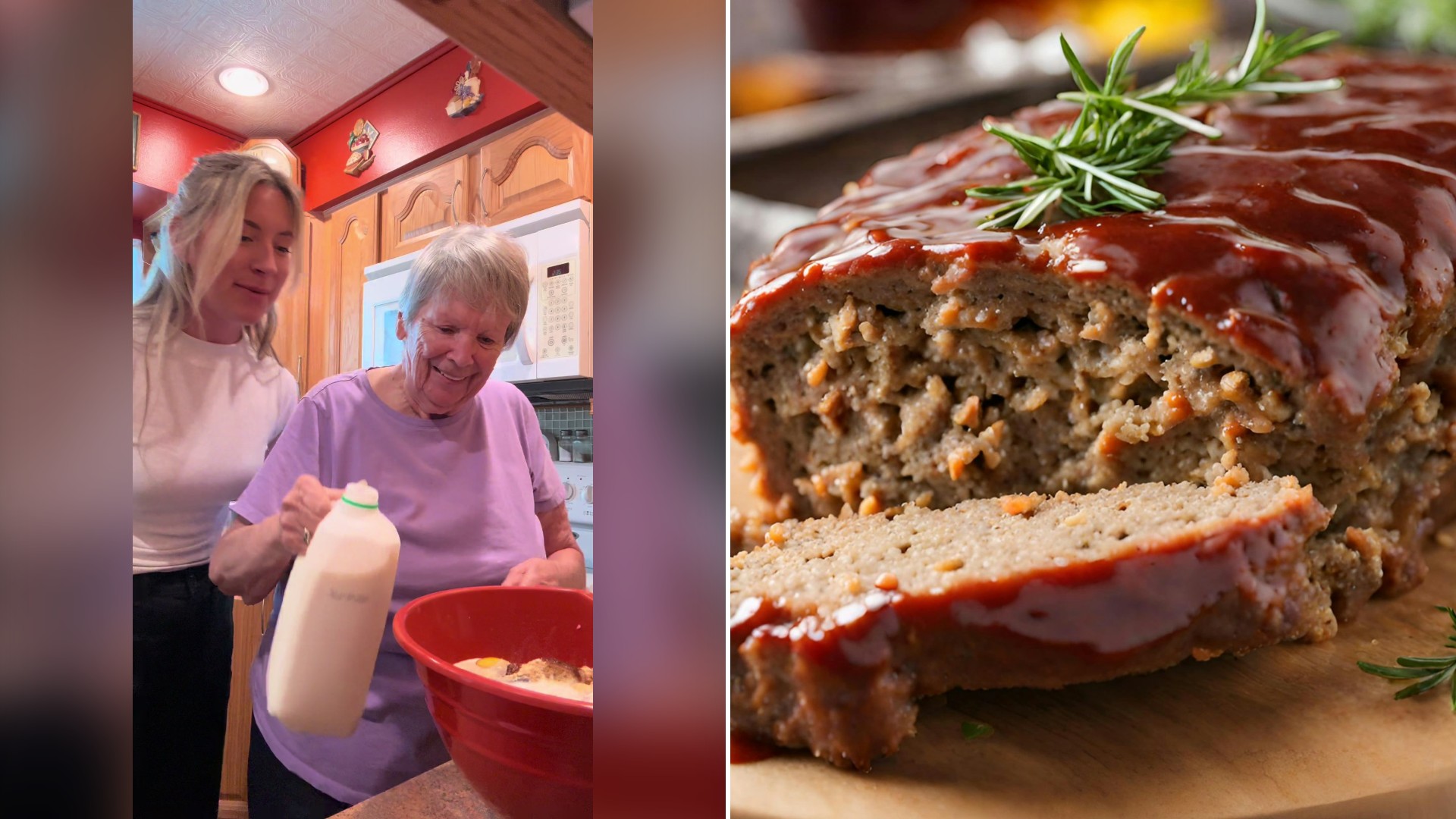
Some recipes live in cookbooks. Others live in a grandmother’s hands, and nobody has ever written down how much of anything goes into the bowl. Hannah Grunder, who posts as @hannahgrunder, set out to change that. She says she made her post for herself, because her grandma’s Sunday meatloaf is one of her favorite family dinners and she wanted to remember how it is made forever.
@hannahgrunder
The story starts with a pan and a can of cooking spray. Hannah begins by spraying her oven roaster, and she explains that she and her grandmother are making a double batch. Then comes the first lesson in how this recipe really works. The package of ground chuck in front of them holds four pounds, and when Hannah asks whether they are using the whole thing, the answer is no. They only need about half. When Hannah asks how much exactly, she wonders aloud whether it is three fourths or two thirds. In the caption, Hannah lists the amount as two and a half pounds of ground chuck, along with one pound of ground pork.
Next the onion goes in. Hannah checks that it is a yellow onion, and it is finely diced. Then come the breadcrumbs, and her grandmother is clear that they are plain, not panko. When Hannah asks how much went into the bowl, the answer is that she just does it until it feels right, though she allows that it was at least two cups. Salt follows, and Hannah’s caption guesses at two to three tablespoons, noting that the real measure is simply a bunch. At one point she laughs that they are measuring everything with their hearts, and that there is a lot of meat in that pan.
Three eggs are poured in. The same pattern repeats with the sauce, which her caption lists as half a cup of A1, and with the milk, which she guesses at roughly a cup and a half. Her grandmother’s advice is gentle but firm: you pour until it feels good. When Hannah pushes for a number, she is told that she does not have to measure, sweetheart. Hannah answers that she needs to know. Her grandmother’s reply, as the two of them trade it back and forth, is that she does not. Along the way her grandmother explains that she used to measure too, but that cooking this way is done with love and with whatever you want it to be.
Then comes the funniest moment of the afternoon. Hannah realizes that nobody has turned the oven on, and she says out loud that they have to get that on camera. After a laugh, the oven is set to 350 degrees Fahrenheit. The mixture is divided into two big loaves in the roaster, and her grandmother insists on one more rule: do not forget the lid. The roaster goes in the middle of the oven. According to Hannah’s caption, two loaves bake for about an hour and a half, and a single batch should be checked after an hour. When Hannah asks how her grandmother knows the meatloaf is done, the answer is that there are no rules around here, just vibes. After it comes out, it has to sit for ten minutes before anyone cuts into it.
The family history is what makes the dish feel so special. Hannah says she is the fifth generation to learn this recipe. Her grandmother learned it from her own grandmother, Grace Thornsley, who was born in the late 1800s. Grace passed it to her daughter Doris Parham, born in 1917. Doris passed it to Hannah’s grandmother, Marilyn Grunder, born in 1938. Now, Hannah says, it skips a generation and lands with her. She adds that the double batch fed eight adults and three kids, which is a good reminder of why a roaster pan this large exists.
Why This Style Of Cooking Works, And Where To Add A Little Structure
Cooking by feel is a real skill, built from years of making the same dish. A cook who has made a meatloaf hundreds of times knows what the mixture should look like in the bowl. It should hold together when pressed, look moist without being soupy, and feel tender instead of tight. If you did not grow up beside that cook, you can still borrow the idea. Start with the amounts Hannah shared, then adjust by texture. If the mixture feels dry and crumbly, add a splash more milk. If it slumps and will not hold a shape, stir in a few more breadcrumbs.
Some of the choices in this family recipe line up with what many home cooks and chefs recommend. Blending ground beef with ground pork is a classic move, because the pork adds richness and a softer bite. Breadcrumbs soaked in milk and eggs form what cooks call a panade, which holds moisture inside the meat as it bakes. Finely diced onion disappears into the loaf instead of leaving chunks. Covering the pan with a lid traps steam, which helps keep the loaf from drying out over a long bake. Resting the meatloaf afterward lets the juices settle, so slices hold together on the plate.
A few practical tips can help if you are making a loaf like this for the first time. Mix with a light hand, since squeezing and kneading the meat for too long can make the texture dense. Use a thermometer, because food safety guidance recommends cooking ground beef and pork mixtures to an internal temperature of 160 degrees Fahrenheit, and a probe in the center of the loaf is more dependable than a clock. Because ovens run differently, check a little early. Choose a sturdy pan with sides, since a loaf this size can release a good amount of juice. Leftover slices make excellent sandwiches the next day, and they freeze well when wrapped tightly.
Salt deserves a note of its own. Hannah’s caption guesses at a few tablespoons for a double batch, which she describes as a bunch. If you scale this down or are cooking for someone who limits sodium, begin with a smaller amount, cook a tiny test patty in a skillet, taste it, and adjust the rest of the mixture. That is a very old trick for getting seasoning right without baking the whole loaf first.
How To Keep A Family Recipe Alive
What Hannah did is something any family can copy. Invite the cook into the kitchen on an ordinary Sunday. Ask questions out loud, even the ones that seem obvious. Keep a notebook nearby and write down the guesses as well as the facts, such as at least two cups or about a cup and a half. Note the small habits, like the lid, the middle rack and the ten minute rest. Add the family names and dates, the way Hannah traced her recipe from Grace to Doris to Marilyn and then to herself. Years from now, those details may matter as much as the ingredient list.
There is also something lovely in the way the lesson is taught. Hannah wants numbers, and her grandmother wants her to trust her own hands. Both of them are right. The numbers give a beginner something to hold on to, and the feel gives the dish its soul. If you try the recipe yourself, make it on a day when there is no hurry, with someone you love standing beside you, and let the mixing be part of dinner. A Sunday meatloaf tastes best when it comes with a story.