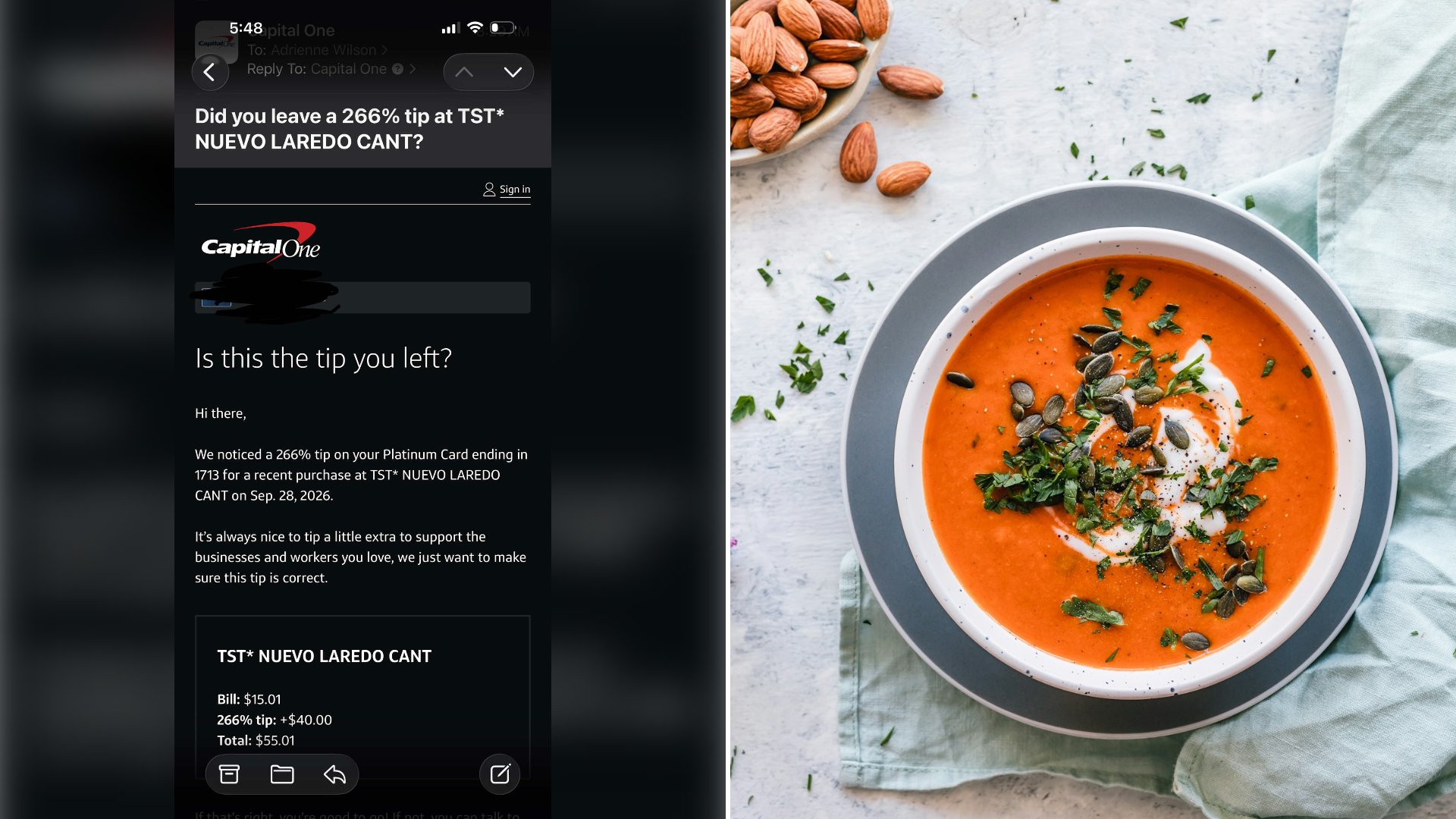
The email from her bank asked a simple question: did she mean to leave a 266 percent tip? According to Adrienne, an Atlanta area realtor, the order behind it was a $15.01 takeout soup. The tip on the charge was $40, bringing the total to $55.01, and she says she never wrote a tip at all.
She tells the story in a five minute video posted to her account @yoadriennesellshomes, sitting in her living room and talking straight to the camera. “So Capital One emailed me this morning and asked me if I meant to leave a 266% tip on my order,” she begins. Everything that follows is her account of what happened next.
She says she had ordered soup to go on a Sunday, which is why she did not leave a tip. Instead, she says, she put an X on the tip line of her receipt. “And somehow the X that I put on my receipt turned into $40,” she says.
So she got dressed and went back to the restaurant. She showed the employee at the counter the email. By her account, the employee agreed “that’s a lot,” went to the back, came back a few minutes later and went through the receipts until she found Adrienne’s copy. Adrienne says the employee looked at it and, without saying anything to her, repeated a coworker’s first name three times, then said she needed to talk to the owner.
The owner got on the phone. Adrienne says the first thing he told her was “we’re gonna make this right,” that he was “very apologetic,” and that he offered to put the money back on her card. Where he lost her, she says, was when he called it an accident. She says he told her a story about a restaurant visit of his own, where a $10 tip on a $99 bill was somehow turned into a $99 tip.
Adrienne did not accept that explanation. “I appreciate your willingness to help me and that you wanna take accountability for it, but I just wanna be clear, this wasn’t an accident,” she says she told him. Her reasoning: she put an X in the tip space because it was takeout, “so there’s no way that you can accidentally rerun my card for $40 when I didn’t intend to leave anything.” She says the conversation ended when he told her he would “stand by my staff.”
She did get her money back. According to her, the restaurant could not refund just the tip, so it refunded the entire order. Her caption describes the same outcome after “speaking with the restaurant manager.” She says she probably would not have made the video because of the refund, but posted it because she still believes the charge was intentional. That is her view; in her telling, the owner maintained it was an accident.
She is also candid about her own part. She says she does not usually look at her bills or receipts as they hit her card, “and I know I need to be better at that,” and credits her bank for catching it. Her caption puts the lesson in capital letters: “CHECK YOUR TRANSACTIONS.”
How to Catch and Dispute a Changed Tip
Adrienne’s story turned out well because her bank flagged the charge and she still had a way to prove what she wrote. If you are planning a dinner out, a date night or a quick takeout run, these steps cover the same ground.
Write a zero, not just a mark. An X or a dash on the tip line leaves room for argument. Write “0” or “$0.00” in the tip space and write the full total yourself on the total line, so the merchant copy shows exactly what you authorized.
Photograph your copy. Before you leave, take a picture of the signed receipt with the tip and total visible. Adrienne’s case hinged on the restaurant’s copy being found in the back; your own photo means you are not depending on that.
Turn on transaction alerts. Adrienne admits she rarely checked her charges and that her bank’s email is what caught this one. If your card app offers purchase alerts, switch them on and compare each alert to your receipt the same day.
Go back to the merchant first, with proof. She returned in person, showed the email and asked them to pull the receipt. That got her a refund of the whole order.
Know your formal dispute rights if the merchant will not fix it. The Federal Trade Commission says you must notify your card company within 60 calendar days of when the first statement showing the disputed charge was sent to you, and that if you call or dispute online, you should follow up with a letter, which serves as written notice to the card company. The FTC says to send it to the address your card company lists for billing disputes, errors or inquiries, which is not the same as the payment address.
Expect a timeline. The California Attorney General’s office explains that the card issuer has 30 days to confirm it got your letter and 90 days to investigate, and that during this time you may choose whether or not to pay the disputed amount. It also advises sending the letter by certified mail or a tracked service and keeping a copy.
More from Cultivated Comfort
- Man Skips the Tip Screen on an $18 Turkey Wrap After a Coffee Shop Would Not Add Sriracha, Then Says the Manager Told Him People in the Neighborhood Tip 18 Percent Minimum
- Woman Says a Relative Paid for Her Birthday Thai Lunch in Exact Cash With No Tip, Then the Server Told Them to Order Takeout Next Time and Refused the Tip She Offered on Her Card
- Server Says Four College Students Called Her the Best Server They Ever Had Four Times, Then Split a $68 Check Four Ways and Each Left 30 Cents