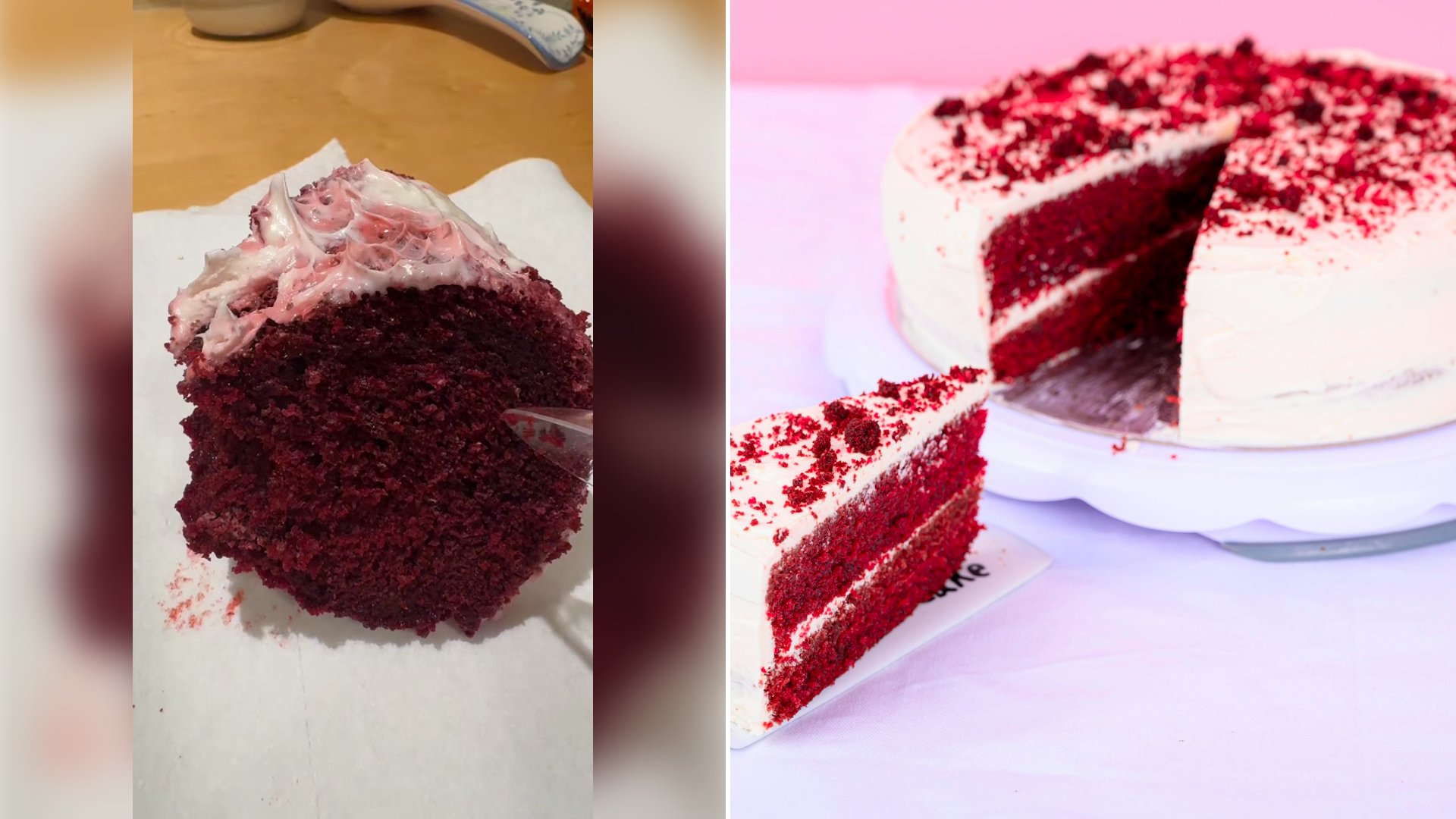
“Today I found rope in my cake.” The woman behind the account LittleHouseBigAlaska says it over a tight shot of a slice of red velvet cake being pulled apart with a clear plastic spoon, then corrects the picture her opening line creates: “No, I didn’t find a piece of rope in my cake. I found rope spoilage in my cake.”
The video, posted on September 20 by @littlehousebigak and tagged for Anchorage, Alaska, never leaves the cake. It is labeled “Rope Spoilage” on screen, and her caption opens, “A PSA if you will. Watch out for rope spoilage in baked goods.”
Her explanation starts with flour. “Rope spoilage comes from the bacillus bacteria that’s often present on wheat,” she says, “and it can live in your flour, and baking it in the oven doesn’t get rid of it.” The caption puts a number on that: the bacteria “can survive at 400F.”
By her account the trouble comes after the oven. Once a moist baked good has been baked and then stored at room temperature, she says, the bacteria “can actually grow and thrive and make you sick.” The conditions she tells people to watch for are specific: baked goods that are sitting out, “probably covered,” getting “moist and warm at room temperature” and left there “for up to 72 hours.”
She gives two signs, in order. The first is the smell. The food will “smell really sweet, like something’s rotting. Kind of a rotten fruit smell.” She calls that “your first clue.” The second shows up when the cake is cut: “You’re going to see these thin wispy spider web looking things through the cake. It’s not hair in your cake, that’s the rope spoilage.”
On what happens to someone who eats it, she is blunt. “It can give you food poisoning,” she says, and the caption repeats it: “Eating it can give you food poisoning.”
For the first minute and a quarter she works through the dark red crumb with the plastic spoon, which has white frosting smeared on it. Then she answers the objection herself. “In case you were thinking that the spoon I was using was dragging frosting bits through the cake,” she says, she went and got something clean: “Not a toothpick, a bamboo skewer.” The last part of the video shows the bare wooden skewer pushed into the middle of the slice and levered up through the crumb. “That way you can see that I am not grabbing frosting,” she says. “This is actual rope spoilage in a cake.”
She saves where the cake came from for the end. “This cake came from an established restaurant. It was not some cottage food industry baker. It wasn’t a food truck. It was in a restaurant selling cake by the slices. And it was under a cake dome.” She does not name the restaurant, and the identification of the strands as rope spoilage is her own reading of the slice in front of her.
How to Check a Slice From the Cake Dome Using Her Two Clues
The setup she describes, a moist cake kept covered at room temperature for up to 72 hours, is the cake dome on a restaurant counter. Before ordering a slice from one, ask which day the cake was baked. A server who can answer right away tells you someone is keeping track.
When the slice arrives, smell it before the first bite. Her first clue is a heavy sweetness with a rotten fruit note, which is different from the smell of frosting or cocoa.
Next, open the middle of the slice with a clean fork, away from the frosting, and pull two pieces apart slowly. What she says to look for is thin, wispy, web like threads running through the crumb.
If you think you see threads, repeat her skewer test. Take a utensil that has not touched the frosting, a second fork or a clean knife tip, and lift the crumb again. That rules out frosting being dragged through the cake, the same doubt she set out to answer.
If the threads are still there, stop eating. Film a close shot with the clean utensil in the frame, as she did, leave the slice on the plate and keep your receipt. Then show the server or a manager at the table, while the rest of that cake is still sitting under the dome for the next customer.
Her warning covers home kitchens too, since she says the bacteria can live in flour and survive baking. For a cake or loaf that has sat covered on the counter, write the bake day on a piece of tape on the lid, and run the same smell and pull apart check before serving it to guests.
More from Cultivated Comfort
- Woman Opens a Jar of Jam From Costco and Discovers It’s Moldy Underneath a Sealed Lid, Then Turns It Into a PSA Reminding Everyone to Check Their Safety Seals
- 9 Foods That Aren’t Worth Ordering at a Restaurant
- Woman Bakes a Pumpkin Crumb Cake From Scratch and Traces Her Whole Love of Cooking Back to Being a Food Network Kid Growing Up as Nostalgia Folds Right Into Every Bite